Consumption Paradigms: PART I

I just read that term in a press release advertising some schmo as president of some company I’ve never heard of. The release was so poorly written I don’t even know what the company does. Not important right now.

There are so many variables in this move to digital books that it’s hard to digest. TUMS, please. Compounded with people talking just for the sake of talking about it, it’s hard to identify issues that should really be tackled now rather than later, when everyone is all hepped up about an idea and it turns out it has no legs because no one thought of it.

[Editor’s note: strong language after the jump]

Two things that strike me as important are pricing model(s) and bridging the technology/content gap. This post is about book pricing. When I get my head together on the other thing, I’ll post that.

A Book Pricing Model: Just a Proposal

I know this is coming from leftfield, but it’s at least a proposal that’s different than discounting or finding the magic price. Big Pharma prices its new drugs according to a complex formula of R&D budget, marketing budget, patent portfolio, sales volume and profit margin. Fair enough. Direct your attention to the patent part. A patent can be enforced for a finite period of time. When drugs come off-patent, generic manufacturers can file a Amended New Drug Application (ANDA) to make and market the drug in its generic form. Generic companies are doing quite well, thank you, and have the benefit of a sympathetic congress and loosened regulations under which to operate. What the fuck does this have to do with book publishing?

While I don’t pretend to be any kind of an IP expert, there is a valuable lesson that content-givers (new name for writers and artists?) can learn from industry in patents and the protection they offer. We have run roughshod over copyrights, as writers. Publishers are not our friends. They are business partners. And yet, we give them our blood and guts and consent to fuck with it for near infinity. What’s up with that? As owners of our own "patents," our content, we need to look at publishers as lessors of our property for a much shorter period than is widespread business practices today. For those releasing their own books, it’s like the generic drug model without having to pay the costs of an ANDA application and ensuing litigation.

We should also be considering this model as a foundation on which to build a pricing model: When books are hot, newly released and getting a lot of marketing–whether through publishers OR by independently released books–they should be priced higher. Simple. Every industry does it, even publishing right now. The difference I propose is that as OWNERS of our works, we take the motherfuckers back after a 60-90 day period, give or take. I mean, like, listen, Mr. Publisher, you have 60 days to sell the shit out of my book, after which you give it back to me, pay me my royalties, and fuck off until next time. The SAME should apply for books we release ourselves. Price it high in hot-season, then when you’re done with your initial marketing push and your book tour (even if the book tour consists of yours and the 5 towns surrounding you that your local bus line goes to), lower the price. Make it a competitive generic price.

I’ll wait for a publishing person to argue with me about how much to price these things at, numbers wise, so until I see the accounting methodology, I’m unsure anything needs to be priced more than $10. It’s a fucking book, not a piece of gold. Can someone out there do a comparative pricing model with the inflation built in as to how the price of books has increased over the past, say 75 years? Ok, 50 years? That’d be great, thanks.

Stay tuned for the Consumption Paradigms: PART II when we’ll discuss bridging the gap between what the technies know and do, and what the content-givers want and can provide.

This is a reprint from Jenn Topper‘s Don’t Publish Me! blog. Also see her follow-up post, Consumption Paradigms: Part II.

Lulu: You Wanna Piece of Me?

DIY self-publishing service provider Lulu has set in motion a process which could see the company offering public shares on the Canadian stock market as early as next month.

Last Friday Lulu filed a preliminary prospectus with the regulatory authorities in Canada. The first moves that may see shares in Lulu sold on the stock exchange had been anticipated since early January, with the only surprise being the company’s choice of Canada.

The choice may have been influenced by the fact that Canada’s regulatory authority is not considered to be as heavily stringent and require the levels of open scrutiny demanded by its US counterpart. Company CEO Bob Young does have family connections in Canada and spent a period of time growing up there.

The prospectus filed on Friday does however reveal that Lulu had been making a loss throughout 2009 until the final quarter when it made its first profits of the year. Making a successful initial public offering (IPO) will depend greatly on Lulu attracting strong investors, and ultimately that investment may still come directly from the US, with Lulu still having the opportunity to try a move to the US stock exchange further down the financial road.

The prospectus also revealed that Bob Young will continue to remain a majority stockholder in Lulu following the IPO. Money raised from the IPO will be used to continue to expand Lulu’s marketing development and introduce new products and services to businesses, publishers and authors.

 
More in-depth detail here.

This is a cross-posting from Mick Rooney’s POD, Self-Publishing and Independent Publishing blog.

ISBN for Self-Publishers: Answers to 20 of Your Questions

One of the areas that I get the most questions about is the use of the ISBN, the unique numeric identifier that’s used around the world to identify books. New self-publishers are especially concerned with making sure their books are registered properly, that everything is done so that their book can be sold without any problems or confusion.

Because this area is specific to the book business, there’s a lot of confusion and misinformation about ISBN and how it works. I strongly recommend you use the resources provided by Bowker, the company resposible for ISBNs in the United States, on the ISBN website and at Bowker’s website.

But even faster, without any further delay, here are 20 answers to the most commonly-asked questions about ISBN.

Questions and Answers about ISBN

  1. What is an ISBN?
    ISBN stands for International Standard Book Number. It is a 13-digit number that’s used as a unique identifier for books. ISBN is used internationally.


  2. What do all the numbers mean?
    See my earlier article on decoding the ISBN.


  3. Why do we need ISBNs?
    We need them to identify each book that is published, and each edition of the same book. ISBN also identifies the publisher of the book. It is the standard ID number used to identify books by booksellers, libraries, book wholesalers and distributors.


  4. Should I get an ISBN?
    If you plan to sell your book in bookstores, to libraries, or through online retailers like Amazon.com, you will need an ISBN.


  5. Does a book have to be published to have an ISBN?
    ISBNs are issued to publishers, who then assign them to individual books. This can be done at any time, even before the book is written.


  6. Is the ISBN the bar code I see on the back of books?
    The bar code is a representation of the ISBN in a form that can be identified by scanners. The bar code might also have other information embedded in it, like the price of the book and the currency in which it is priced.


  7. Okay, do I need to have a bar code too?
    Only if you plan to sell your book in bookstores. If you only plan to sell online, or privately like at speaking engagements, you don’t need a bar code. Many publishers put them on their books anyway.


  8. If I get an ISBN, does that mean my book is copyrighted?
    No, ISBN is administered by a private company for the use of the international book trade. Copyright is administered by the Library of Congress and is an extension of intellectual property law.


  9. If I have an ISBN, does that mean my book will be in Books in Print?
    Once you have an ISBN you can go to BowkerLink to fill out the forms necessary for your book to be listed in Books in Print.


  10. Can self-publishers get an ISBN?
    A self-publisher is still a publisher, so yes, you just apply for an ISBN like anyone else.


  11. How do I get an ISBN?
    Go to myidentifiers.com, the ISBN website run by Bowker, which is the only company authorized to administer the ISBN program in the United States. Click on “ISBN Identifiers” and you’ll be taken to a page where you can buy 1, 10, 100 or 1000 ISBNs.


  12. How many ISBNs should I buy?
    The least economical choice is to buy 1 ISBN. If you ever publish another edition of your book, or another book entirely, you will need more than one ISBN. I suggest you buy the 10 pack.


  13. What do ISBNs cost?
    A single ISBN today costs $125, while 10 ISBNs cost $250, 100 cost $575 and 1000 cost $1000. Note that the price per ISBN drops from $125 to $25 to $5.75 to $1.


  14. Isn’t it just a number? Why does a number cost $125?
    Many people are pondering this question, so far without an answer. Obviously, it’s not because of the cost of the product. Could there be another reason?


  15. Well, can I re-use my ISBN?
    No, sorry, once assigned to a book, an ISBN can never be reused.


  16. Where do I put the ISBN?
    You’ll print it on the copyright page, and it’s included in the Cataloging-in-Publication data block, if you use one. Otherwise, just print it on the copyright page and, of course, on the back cover as part of the bar code.


  17. I’m doing a print book and an ebook. Do I need two ISBNs, or can I use the same one?
    This is a matter of some discussion at the moment, since there are more and more electronic formats. The policy of assigining a separate ISBN to each and every edition is under review. Check back for more info.


  18. How about a hardcover and a softcover of the same book?
    You need a separate ISBN for each edition, to identify them for everyone who might want to find them in directories, catalogs and databases.


  19. If I revise my book, do I need to give it a new ISBN?
    If you only correct typographical errors, and don’t make any substantial changes to the text, you don’t need a new ISBN because it’s considered a reprint. A new edition would contain substantially new material, a major revision, or the addition of completely new elements. Anything that makes it a new book is likely to create a new edition and, therefore, need a new ISBN.


  20. How about if I just change the cover?
    You can continue to use the same ISBN, since the text has not changed.

Well, there you have it. In 20 questions and about 5 minutes, you’ve overcome the confusion about ISBN. Have a question you didn’t see answered here? Ask in the comments and we’ll run down the answer.

Takeaway: Getting the ISBN for your new publishing company is a necessary step to becoming a publisher and getting your book into print correctly. It’s not difficult once you understand how to do it.

This is a cross-posting from Joel Friedlander‘s The Book Designer site.

Writing More Than One Book

You labor over your first book, maybe for years. You seek help from other writers and editors, finely tuning your book to hopeful perfection. The important day comes—it’s accepted for publication and it starts selling well. The buzz is out—you are a great new author with something important to say. Your publisher says, “Quick, we need a follow-on!”

You sit down to write your second book, but now you are under a time crunch and intense scrutiny. Will it surpass the first? Hey, no pressure here—riiight! This is why too many first time authors do somewhat poorly the second time around. They’ve rushed to get something out and their fan base or platform rushes to judgment.

It Can Happen to Self-Publishers As Well

A similar thing can happen to self-publishers. You work hard to produce your first book and then begin marketing it. You know you need to have a good follow-on to take advantage of the swell of the first one’s popularity. Unfortunately, you have also discovered the dirty little secret that producing the first book was not the hard part; it’s the marketing of it that takes so much of your time and resources. Having been down this road before on both sides of the coin with my nonfiction work back in the 80s/90s, I knew what to expect with my reentry into publishing with my fiction. This is why I carefully took several years to develop a series of four (soon to be five) mysteries before I launched the first. Once you hop on this merry-go-round of publishing/marketing, there won’t be as much time to write, unless you hire someone else to do all the marketing for you, which is expensive, since it is a full time endeavor.

Different Ball Game

To add to the challenge of creating additional works is the complexity of today’s publishing and bookselling business. There are so many more ways to produce a book in several different formats: POD, traditional offset print, ebooks in 6-9 different formats, audio books in CD and downloadable versions, DVDs, and all the attendant marketing that goes with them. It really requires much more attention.

So, What to Do?

Look for expert distributors and producers for some of your versions. Let them provide marketing paths they’ve established, which you don’t have the wherewithal to do—it’s worth their fees. My first mystery, Quad Delta, is published as an ebook with Smashwords at https://www.smashwords.com/books/view/8850  Think outside the box. I’ve made application to Lightning Source to print and distribute POD versions of my books. I’m still waiting for that application process to complete, so I’m ordering my first 50 copies from a good local source, insuring I have enough on hand for my official release. Once LS comes through, I’ll order 100 copies from them for the follow through. If the book sales are promising, I may go to traditional offset printing down the road. While all this is going on, my second mystery, Firebug, is already published at Smashwords as an ebook at https://www.smashwords.com/books/view/9114 , and I’m waiting a couple of months before I release it in print form. Now you can get a feeling for why I waited until I had four in the can before I launched into self-publishing again. It also shapes my marketing from selling just one title to selling a series of titles, which encourages whatever fan base I develop that other Bob Spear fixes are on the way. That helps the viral buzz.

Finally

Writers need to be aware of these dynamics and plan on coping with the complexities instead of blithely ignoring the realities of writing multiple books and then walking into a meat grinder of time pressures and public expectations. The bottom line is to always seek to be pro-active. Nobody likes SURPRISES!

This is a cross-posting from Bob Spear‘s Book Trends blog.

Lessons Learned From TOC: Don't Be A Jerk

Don’t believe what you hear about New Yorkers being rude. During the four days I was there for the O’Reilly Tools of Change conference [in 2009], only two people were rude to me. One was a woman who sat next to me during a showing of the musical Billy Elliot. The other was an author in attendance at the conference. I’ve blurred the details in relating my experience with the author here, but there’s still an important lesson to be learned from it.

I’d long been a fan of this author and a regular follower of her blog and online columns for various publications, and had long pondered a specific passage in one of her books. Seeing her at the conference, I figured this was my chance to ask her for further clarification directly. Her response was curt. She tersely said I’d completely misunderstood the passage and rather than indulge me with further explanation, directed me back to her site. Not surprisingly, my impression of this author has changed entirely, for the worse, and my new, negative impression will undoubtedly color my opinion of all her work in the future.

In fairness to this multi-published, big-name author, it must be said that she probably receives queries like mine all the time and is sick and tired of having to answer the same questions from the boneheaded public over and over again. However, in fairness to the boneheaded public, it must be said that we pay her bills and it is our desire to read and understand her work that allows this author to maintain her lifestyle and vaunted status. While I sell respectable numbers of books and get tens of thousands of hits on my various websites each month, I’m a relatively smalltime operator in the big scheme of publishing. Even so, I cared enough about this author’s work to buy it and try to absorb it, and I think that’s reason enough to deserve a modicum of respect from the author.

The author essentially made me regret having posed my question to her, and by extension, having spent the money and time I’d invested in her work to date. I was left to slink away in quiet embarrassment as other, better-known conference attendees swooped in and were granted a much warmer welcome by the author. What could I say? "Gee, sorry to show interest in your work, I’ll try not to do it again."

As an author, you should count yourself lucky to have each and every fan, and treat every one of them with the same level of respect and interest you would show to the most famous and influential person you can imagine. In the general sense it’s just plain good manners, but in the marketing sense it’s critical.

You may think a bumpkin housewife who accosts you to ask the most lamebrained question about your work you can imagine isn’t worth your time because she’s just a lamebrained, bumpkin housewife, but you’re wrong. That housewife buys books, belongs to book clubs, church groups and the PTA, and comes from a large circle of family and friends in her community. Whatever she tells her circle about you is something that circle will repeat to their circles, among whom are sure to be some bloggers and influential voices—six degrees of separation and all that.

Each contact with a reader is an opportunity to make a good impression, reinforce an already good impression, or spread bad press on your own behalf. No matter how tired, frustrated or annoyed you may be feeling on the inside, paste on a smile and show your audience some respect.

This is a reprint from April L. Hamilton‘s Indie Author Blog.

7 Reasons Not to Self-Publish—Is This You?

Yesterday the publisher services company Lulu.com announced that John Edgar Wideman, two-time winner of the Faulkner Award for fiction, would be publishing his new collection of short stories, Briefs, Stories for the Palm of the Mind, in conjunction with Lulu’s new VIP program. Wideman has been published for years by Houghton Mifflin, according to the report in Publisher’s Weekly.

This was notable, although Wideman may just be the first of many as self-publishing gradually loses its stigma and is seen as simply another path to publication, and for many people, a superior one to the traditional publishing route.

Here’s part of what he said in a press release issued by Lulu:

Wideman decided against a traditional publishing contract — and royalty advance — for Briefs because he wanted more control over the publishing process and to develop a more direct connection with his readers. He also wanted to experiment at a time when the publishing industry is undergoing more revolution than evolution. . . . I like the idea of being in charge. I have more control over what happens to my book. And I have more control over whom I reach.

I’ve often heard other self-publishers voice the exact same sentiment, although few had a royalty to turn down. But there are also echoes in Wideman’s statement of the move to what you might call author self-empowerment. When publishers rely on authors for marketing plans, platform building, and finding their own community of readers, they inadvertently also pass a great deal of power over to the author at the same time.

Self-publishers have traditionally grasped for this power directly. Before the internet, self-publishers lived by direct mail, and the direct selling that happens on the internet today owes a great deal to what direct marketers have learned over the last 50 years in other media.

But the growth of self-publishing as an accepted path to publication, aided by authors like John Edgar Wideman, is not what this article is about. No, this article is about you.

You Know Who You Are

Wideman found compelling reasons to self-publish his book, based on an informed and pretty astute reckoning of where publishing is at the moment.

But, like anyone connected to book publishing, I often hear the exact opposite from people who buttonhole me and start telling me about the book they have “in their desk drawer” or “packed up in the attic” or “in a big box under my bed.” These stories are amazingly common.

A woman dreamed of writing a book, spent months working on it, but never got any further. Or a man, getting up early for years, completes a manuscript but just prints a few copies to give to friends. Why?

Because they have found many reasons to not self-publish. Look, most authors are never going to get a contract offer from a big—or small—publishing house. The demand for publishing far outstrips the supply of big-publishing company openings for books. That’s what’s caused the meteoric rise of self-publishing, once digital printing and print on demand distribution removed the monetary risk of getting into print.

So what obstacles are left? Why haven’t these writers become authors, fulfilled their dream of publication, and found their readership?

Here are the top reasons I’ve identified why you might decide not to self-publish:

  1. You don’t want people to look to you as an authority—Authors acquire a definite authority within the area they write about. This is particularly true of non fiction authors. Even though you know quite enough to write a book on the subject, does something about being looked to as an authority make you nervous?
     
  2. You’re afraid of speaking in public—It’s common for authors to be asked to speak in public, and to pursue public speaking as a way to market their book. Common knowledge tells us that the number one fear in Americans is the fear of public speaking. Perhaps this is really the fear of appearing a fool in public. Is that what’s stopping you?
     
  3. You don’t need another income stream—Novelists would like to make money from their books, but would write them anyway. Nonfiction authors often write in order to make money, to capitalize on a business opportunity or leverage their experience to improve their clientele or their hourly rate. The independently-wealthy and people satisfied with their current income might see self-publishing as a waste of time.
     
  4. You have nothing unique to say in your field—Maybe you’ve spent a career as a primary school teacher, following curriculum. Perhaps you’ve been a cubicle slave for years, and the creative juices have been beaten out of you. I’d say it’s more likely you’ve simply forgotten how unique your own perspective on life, your business, or your hobby really is.
     
  5. You’d rather not contribute to publications in your niche—Once you start publishing you naturally start marketing, and writers use writing as a way to get the word out. But maybe you are embarrassed by the chance you might seem to some a “know it all” if you start getting articles published in relevant trade magazines and websites. That could slow you down.
     
  6. You prefer to wait a few years and see if you get offered a contract—There’s a certain kind of writer who is happy to write, and never get published if they can’t get that contract from Knopf, or Random House, or whoever. They accept the wisdom of the agents and editors they submit to (literally) over the years, and feel it’s better that their work stay unknown, since it’s unworthy of their gods. That’s a tough one.
     
  7. You hate the idea of autographing books for buyers—Having fans, people who will show up at bookstores to hear you talk, stand in line to get your autograph, may be disconcerting. People in our culture often feel unworthy of attention, as if others are deserving, but I am not. Maybe this shame was drilled into us when young, it certainly is long-lasting.

The World of Publishing is Changing: It’s Your Turn Now

I fully expect to see more authors like John Edgar Wideman turning to self-publishing out of pure self-interest. But many other writers can do the same thing. The tools of Lulu and other publishing services companies are there for us to use. Many involve little or no expense.

Writers who publish a book themselves, if they are realistic in their expectations are usually energized by the experience. Since print on demand means you’ll never get left with a garage full of unsold books, the risks have become almost completely psychological.

My message is this: Now is the time. It has never been easeir, faster, or less expensive to get into print. With the tools of the internet and social media, the marketing landscape has never been so level. Go drag that box out from under the bed. Climb up into the attic and pull that manuscript down. Fulfill what you started, or start what you’ve dremed of. You won’t regret it.

Takeaway: The obstacles to publishing are, increasingly, within us. Our opportunities to self-publish have never been better, and the stigma of self-publishing may fade rapidly. The time to act is now.

This is a cross-posting from Joel Friedlander’s The Book Designer site.

Calling For Tax Advice The Inexpensive Way

With this article, Publetariat premieres its new Business End department, and resident tax expert Julian Block. Indie authorship is a business, after all, and it’s important for indie authors and small imprints to keep on top of tax matters.

Internal Revenue Code changes have averaged one per day over the past eight years — with 500 revisions in 2008 alone and 235 in 2009. Who’s counting? Nina Olson, the National Taxpayer Advocate, announced the statistics in her annual report to Congress. An independent organization within the Internal Revenue Service, the Taxpayer Advocate Service helps taxpayers resolve complaints with the agency when problems cannot be resolved through normal channels.

 
Will Advocate Olson’s reports convince our lawmakers to draw back from their drawing board? Not during these troubled times. Expect them to enact even more alterations to an already confusing code in the immediate future.
 
How do individuals who need to focus on tax planning all year long keep on top of all those major and minor modifications? Most decide to become clients of tax professionals — advice-givers adept at calming the concerns of the affluent and nimbly sidestepping pitfalls while capitalizing on opportunities to diminish, delay or deep-six paying amounts that otherwise would swell IRS coffers. And that kind of advice does not come cheap.
 
In locales like my neck of the woods near New York City, such clients should expect to pay hourly fees of several hundred dollars and up for guidance. Help is available from lawyers, CPAs, financial planners, and enrolled agents — i.e., persons licensed to practice before the IRS who are neither attorneys nor CPAs, but who are former IRS employees or have passed rigorous tax examinations administered by the IRS.
 
Fortunately, pricey professionals are not the only source of help for Americans worried about their financial futures and retirement prospects. Cheaper alternatives are available. One option is to sign up at places like high schools and community colleges for inexpensive adult education courses on various aspects of personal finance — for instance, tactics that trim taxes or methods for investment selection.
 
But people who need financial advice should be wary of free lunch seminars that are actually showcases for hucksters. Seminar sponsors usually promote their programs as educational events, with free meals thrown in. But the seminars generally feature hard-sell pitches for substandard investments designed to enrich the sponsors — many may be Uncle Bernie wannabes — and impoverish investors, especially unwitting seniors.
 
It is also possible to obtain advice at no cost from knowledgeable, disinterested professionals. This resource is available to an ever-increasing number of individuals who belong to affinity groups or work for companies that offer such advice. Individuals eligible for assistance can call centers staffed primarily by financial planners who offer advice only — untainted by compensation linked to commissions on product sales.
 
But what is available for people in need of instant advice who are without access to such call-in centers? Thanks to technology, there are person-to-person Internet advice sites that let them talk to experts on topics like taxes and investing. It is important to note, however, that these sites do not vouch for the accuracy of their experts’ advice.
 
A major purveyor of telephone counseling is Keen.com, a company that describes itself as “Your Personal Advisor,” offering live, immediate advice (and hand-holding) for everyday life.  Keen provides computer tech help, career coaching, astrologic readings, relationship advice, credit counseling, and just about everything between. Unless you have need for such services, ignore them, and head straight for Keen’s tax-planning experts. (In the interests of full disclosure, I was among the first dispensers of tax advice recruited by Keen when it debuted in 2000.)
 
Keen’s specialists cover a broad range of financial topics  —  anything from tax-efficient maneuvers that callers can implement themselves, to new theories to test out on real-world advisers, to portfolio diversification strategies.
 
Keen allows callers to check out advisors’ backgrounds and client ratings. Another confidence booster is that Keen makes the call to both parties — ensuring that its online specialists remain clueless about callers’ names, phone numbers, and other personal information, unless callers choose to divulge such details.
 
What does a service like this cost, and how does one pay? As with most Internet sites, Keen accepts credit cards and bills per minute, but frequently discounts fees for first-timers. There is no minimum fee commitment, and callers decide when to conclude the conversations, so they are in control at all times. The result is helpful advice at far less than the cost of in-person sessions.
 
That noted, Keen is not ideal in all situations. At least some of its mavens will lack your mom’s smarts and accessibility, and none can compete with her, whose 24/7/365 counsel comes at no cost at all! Still, Keen is particularly well suited for several common situations. Its advisors can provide inexpensive reassurance when taxpayers want to verify that information received from their advisors or the IRS is correct or when their returns are being audited.
 
Keen is particularly useful during tax filing season, when other advice lines may be overloaded. According to the Government Accountability Office (GAO), taxpayers trying to dial into the IRS telephone assistance system for comparable help may be stymied by busy signals or put on hold, only to endure lengthy waits. But Keen’s advisors offer prompt answers.
 
Throw in another plus for last-minute filers choosing Keen over the IRS: They improve their chances for obtaining advice on circumventing stiff, nondeductible penalties for late filing (as much as 25 percent of the balance due on a return submitted after the due date) and late payment. The IRS charges interest on penalties and back taxes. Whereas taxpayers can count on Keen’s availability on April 15, that is the day when “abandoned calls” — the GAO’s term for calls to IRS telephones that go unanswered — surge. And, in case you forgot, that is also the day the Titanic sank.
 
For Keen’s directory of tax advisors, go to  http://www.keen.com/categorylist/Taxes/41/. You can select one by clicking on a “Call Now” icon, or you can dial 1-800-ASK-KEEN (275-5336) and follow the voice prompts. That may be all it takes to speak with someone who can staunch the potential hemorrhaging to the IRS.
 
Julian Block, an attorney in Larchmont, NY, has been cited as a "leading tax professional" (New York Times), "an accomplished writer on taxes" (Wall Street Journal) and “an authority on tax planning” (Financial Planning Magazine). His books include “Tax Tips For Small Businesses: Savvy Ways For Writer, Photographers, Artists and Other Freelancers To Trim Taxes To The Legal Minimum,” praised by law professor James E. Maule of Villanova University as "An easy-to-read and well-organized explanation of the tax rules. Business owners would be well advised to buy this book." To order his books, visit www.julianblocktaxexpert.com. Copyright 2010 Julian Block. All rights reserved.

Business End

This is the Business End department, featuring Publetariat’s resident tax expert Julian Block, where you’ll find articles pertaining to the business side of indie authorship and running a small imprint: taxes, bookkeeping, setting up your own small business and keeping it running smoothly.


So Much Traffic, No More Parking Spots

You’ve seen the stats: upwards of 280,000 "self-published" books in 2009, according to Bowker or some big brother agency; with 2010 expected to dwarf those numbers and crush the number of mainstream published books.

We’re all like, "woo hoo." Kind of.

[Publetariat Editor’s Note: strong language after the jump]

Because you’ve also seen a lot of shit out there, too: Your twitter buddy who asked you to beta-read her manuscript which is a piece of shit; or that authonomy friend who implored you to read his wanna-be-commercial-genre-fiction-lookalike-but-awully-written piece of shit. The barrier to entry to successful readership is not gatekeeper agents any longer, but writers ourselves. Lack of credible editors (or our investment in them) is problematic. First drafts will kill us all if we’re not careful. The culture of swapsies and kindness is dangerous–really dangerous.

There is and is going to continue to be an enormous population of work by authors who have attempted to be published commercially and have not had success in getting the attention of agents and publishing companies. There are a couple of reasons why we haven’t seen their work published by the mainstream companies: (a) it’s good, but it’s *not good enough,* (b) it’s really fucking good, but outside the formula for the pubbies (e.g., experimental, mixed-media, gritty); (c) it’s just awful.

And then there are those of us who never intended on being published by another entity and blazed our own trail. We should stop applauding ourselves so much and focus more on making our work the best that it can be: ruthless cutting, investment in a credible editor and copy/proofreader. [I proofread 29 Jobs and a Million Lies and there isn’t one fucking typo in the entire thing, so it CAN be done. I printed it out in another font and combed through every line.]

So we’re dealing with a few issues here which I just don’t have a proposed solution for and it bothers me tremendously:
 

  • Intensively increasing competition for attention (we’ve talked about this before and it’s all over other pub blogs)
  • An increasingly compartmentalized and siloed readership
  • Literary fiction — that which doesn’t fit into a genre — is ever-increasingly homeless. We can’t develop a marketing niche, or a community of readers who will want to identify with this non-genre. After all, we can’t define something by that which it is not, right? Where will we belong? How will we stand out? Answer-in-theory: We just have to be awesomer.

I’m not heading in the direction of publishing industry apologist, don’t worry about that. But maybe the cropping up of writer’s affiliations and communities is a solution to leveraging the strength of other writers’ marketing visibility. Strength in numbers, right? That’s what we’re doing at Year Zero Writers and it’s new and exciting and cool. But there is a dicey line between editorial control, right? With these affiliations, or independent mini-publishing companies, seems like someone or some body needs to help vet, right? Well, then it becomes a publishing company. Think about it–objectives to earn solid profits, yadda yadda, and before you know it, your totally cool independent community now is run by committee, decisions take eons to make, you have to make political compromises, and it’s worse than divvying up the fridge in your college apartment with a half dozen broke-ass roommates.

Not all are like that (Year Zero won’t head in that direction). But look how authonomy turned out — like Marion Stein described it recently to me:, Lord of the Flies. And that’s an independent writers community? That’s how we propose toppling the publishing industry? Ain’t gonna happen. It’s like they pitted writers against each other in a global cage-fight and sat back and watched us destroy ourselves.

So, it won’t be writers or an independent movement that will topple the publishing industry, so let’s stop taking credit for that. Readers–the marketplace–have control and let’s not forget that.

There are still hordes of readers who browse the stacks, literally. There are still hordes of readers who only read one genre and will never even consider picking a book up outside that purview. There are still hordes of readers who rely solely on book club recommendations. No independent movement of outside-the-box fiction will change that force, and neither will any technology gadget.

So to writers embarking on their next project: If you have to ask yourself why you are writing, remember it is for readers–THOSE readers who you know appreciate your work (even if it’s just your mom and cubicle-buddy)–who hold all the control. No matter how defiantly independent, DIY, and whatever other title we love to label ourselves with, if we’re pissing off readers because they just don’t "get" what we’re doing, it serves no purpose other than our own exercise in writing.

We’re in a tremendously exciting time right now and the entire landscape is changing every day–this is fucking history and it’s great. Let’s revel in it. Let’s not fool ourselves that a pivotal shift in the marketplace will occur, though. There are ever more platforms, writers, genres, and TV shows competing for the SAME number of eyes. So while accessibility to the marketplace is eased, consider it like a crowded highway onto which we are merging, headed to a city with a finite number of parking spots. 

Fuck, did I just liken our writing to a game of musical chairs?

This is a cross-posting from Jenn Topper’s Don’t Publish Me! blog.

The Real Source of Self-Publishing Stigma

So here is the thing…

There is a lot of talk about the “stigma” of self-publishing. But for the most part this stigma is rather contained. For example:

Mainstream Publishers/Agents: They don’t really care whether you self-publish or not. I mean think about this for a moment. If you’re self-publishing, you’re one less manuscript in their slush pile. If you fail, they don’t have to deal with you. If you succeed, then you are a proven quantity to them… a sure thing, which is something publishers like. So exactly why would they care? Publishers and agents reject bad writing all the time. They don’t remember the bad writing because they see so much of it, it all bleeds together (from one of the horses’ mouths.)

Agents DO discourage self-publishing very often on their blogs and such, but the stigma doesn’t really flow from them. More about that in a minute…

And while there is much talk about how if you self-publish you’ll ruin your future chances at a career because bookstores won’t order your books from a publisher because your self-pubbed books sold so poorly, that’s not a very strong argument and I’d like someone to bring in an actual bookstore book purchaser to confirm this. BOOKS are all returnable inside the brick and mortar bookstore system. They don’t HAVE to assess risk with a major publisher.

Chances are really good they NEVER stocked your book. So… if you’ve got bad sales, and since everyone claims brick and mortar distribution is Distribution Mecca, then… oh gee, maybe they’ll “get” that it may be a distribution issue and not that the book isn’t good. The double standards out there are astounding. Either way though, with a major publisher backing a book and taking their sales people around, do you really think bookstores are doing intensive background checks? Who cares if you self-pubbed a book?

Bookstores:
With bookstores the stigma isn’t so much stigma as shelf-space. While it’s a common belief that self-published books can’t get shelved on brick and mortar bookstore shelves, this is BS. There is a vetting process whereby small press and self-published authors can get their books vetted and into the store, even the MAJOR chains. I know of many self-pubbed authors whose books are sitting on major bookstore shelves.

But if you WANT that, you have to do the legwork necessary. You have to produce a quality book and you have to get into Ingram and Baker and Taylor (the primary distributors of the book trade), but it can be done. At the end of the day it isn’t “stigma” that keeps a self-pubbed book off a bookstore shelf… it is the self-publishing author’s lack of education about the process to do it or willingness to do it, or the quality of their book. Plain as that.

Also, even if you can’t get on bookstore shelves, you should ask yourself whether or not this is something that’s necessary for you. The bookstore returns system can cannibalize your sales and for a small operator, that might not be the place you want to be at. Especially not in the beginning as an indie. Though your mileage may vary.

So far we’ve established that agents, publishers, and bookstores don’t really “care” whether or not you self-publish. If you’ll note bookstores don’t start big blogs ranting and whining about self-publishing. Neither do publishers. In fact, many are open to the idea of finding authors to sign among those who are successfully self-publishing. They understand due to distribution issues that it’s still hard for an indie to sell a lot of books and they adjust their expectations accordingly. While agents may discourage writers from self-publishing… it would kind of be contradictory to their business model to do anything else. It’s called self-interest, folks, not empirical reality.

If an author self-publishes and THEN gets picked up by a publisher, the agent wasn’t needed to scout out and find the talent. The author is then the one in the power chair. And that author is unlikely to call up that agent for representation. They may call AN agent, or they may call an intellectual property lawyer to handle their contract. But the important part in this scenario is that the author has the power, not the agent… more about that in a minute.

Now granted, the odds of succeeding as an indie are slim (but the odds of succeeding ANYWAY are slim.) If you’ve got the goods, you’ve got them, no matter how you publish. Agents have to wade through a lot of crap to find gems but right now their job is still necessary. If all hopefuls were to start self-publishing, or even if ENOUGH of them did, that publishers got all the work they needed from successfully self-published books, then the agents’ job description all but disappears.

Most of the “self-publishing stigma” hinges on the idea that all self-published books are bad and written by deluded morons who can’t really write. The moment enough truly GOOD writers buck the system and self-publish, this stops being true. In order for the stigma to continue, it must remain a self-fulfilling prophecy. And in order for THAT to happen, everyone WITHIN the system must heavily discourage anyone working outside it by appealing to their vanity and their fear of being ostracized from the community.

And if the agent’s job doesn’t completely disappear (i.e. they could go back to just doing what they were supposed to be doing: contract negotiation), their perceived power among writers does, because then their position in the system as the writer’s employee, is reinforced. I believe many of the agents out there on the Internet who verbally abuse the writer community every change they get, enjoy this false power they’ve been temporarily granted. But, if there is an easier and more drama-free way for publishers to find talent, besides the slush pile and agents, then agents go back to being employees and not a second round of gatekeeper.

I find it insane that while many in traditional publishing will pontificate about how indie authors aren’t “vetted,” GUESS WHAT? Agents aren’t vetted. Anyone can call themselves an agent and a bad agent is worse than no agent at all. Most top agents aren’t taking on new clients because they don’t have to. They’ve got enough good authors making them plenty of money.


Reviewers:
What about all the review sources who won’t review your book? Another myth. There ARE self-pubbed books that are reviewed in major sources. If you do things the right way the issue of whether or not your book is self-published shouldn’t even come up. i.e. You have an imprint that isn’t YOUR name (like not Sally’s Books), you have a professional-quality book, and you’re presenting yourself as a professional.

You may still not get reviewed, but… it’s not because of the stigma of self-publishing. It’s because of ALL the books out there and how competitive it is. Most trad published books don’t get reviewed in major sources either. Also, most major sources for reviews are drying up and being replaced by the voice of readers on book reviewer blogs that gain a following. It is a WHOLE different landscape out there, and yet many are still functioning as if it’s 1999.

Readers: I don’t care what anyone says, readers are why writers write. There is no other reason. If you want to make money you can find something that will pay you far better than writing. Writing is what you do because you have something to express and share with the world. So reader opinions? The buck stops with them I’m afraid.

You just can’t delete readers from the equation no matter how much the industry seems to want to. They are the end consumer of the book. And the more the traditional publishing system abuses and disregards the wants and needs of the readers, the more readers will shrug and go find other entertainment options, whether it be small press and indie books, or reality TV. Either way, they’ll get tired of the shit eventually.

So what do readers think? Well, for the most part, since most of them aren’t exposed to bad self pubbed work, since crap doesn’t rise to the top, they don’t care. They don’t know who your publisher is and they don’t care who your publisher is. While there are SOME readers who have either somehow been exposed to a lot of bad self-pubbed work and got a bad taste in their mouth over it, or who are plugged in enough to the pulse of the publishing industry that they have become influenced by the “stigma”, most readers don’t know about all this bullshit politics. Nor do they really care one way or the other.

You don’t have to overcome reader objections to your method of publication if you produce a quality book. The reason you don’t is that publishers never branded THEMSELVES. No one knows who Dan Brown or Stephen King’s publisher is… or not average readers anyway. They don’t know the different imprint names or publisher names for most mainstream-produced book. They can’t tell a small press imprint, from a division of a larger well-known publisher. SOME of them, can’t even tell AuthorHouse from Random House (This one is Henry Baum’s brilliance, not my own.)

So you don’t have to overcome reader issues. In fact, if I didn’t interact at all with the writing community on the Internet, and just went about my business self-publishing, I’d never run into any drama whatsoever about my method of publication. I choose, for better or worse, to get into the debates that I do, because while I know I won’t change the pig-headed views of the person I’m talking with most likely, I *may* influence the view of someone reading who hasn’t made up their mind yet. And that, to me, is worth it.

Okay… so if the source of the stigma isn’t “really” agents, publishers, bookstores, reviewers, or readers, what is it?

OTHER WRITERS.

Traditionally published authors who get bent out of shape about self-publishing, may, in fact, have a partly altruistic motive of protecting authors from making bad business decisions, though I think the better alternative is to teach a writer how to assess business risk, rather than making up asinine rules like “money always flows to the author.”

However, don’t ever be led to believe it is merely altruism that causes a traditionally published author to rail against self-publishing. Self-publishing is a threat. It doesn’t matter that a lot of self-published work is bad… many trad pubbed authors suffered through years of rejection to get “accepted.” They have been validated by a certain system.

If it becomes socially acceptable to work outside that system, then where does their validation go? It becomes less valuable because readers already don’t care. Bookstores already don’t care. The only people who REALLY care are other writers. And so it’s important to set up this “cult of truth” for writers and make everyone goose step and ostracize those who don’t.

If someone won’t march in line like the rest, you attack the quality of their writing, their character, and their mental state or capacity. They aren’t good enough, they haven’t been validated, they are lazy or taking a shortcut. They are delusional. They are naive. And if none of that works, you define them as “the exception” and say they shouldn’t encourage anyone else to do what you’re doing. Writers are so desperate for validation that often they will ignore their own will in favor of being accepted by their peers.

But guess what? Indies have their OWN peers.

Unpublished writers generally want to be accepted by those they look up to. And so because the self-published author is the only one “beneath them” on the food chain, they join in the mob to attack as well.

So let’s sum up… in a really competitive industry the stigma against going outside the system is your competition.

Have a different view about that stigma now? The moment you stop associating with these people and focus on the readers, they just fall off your radar. I’ve chosen under this name, to be loud and out there about being indie and to confront stupid arguments head on because I know for many it’s too hard to stand up to the people who have either been elevated or elevated themselves to grand high potentates of publishing.

Though now I need to probably take a bit of a break from arguing, so I can get something worthwhile accomplished… like I don’t know… publishing.


This is a cross-posting from Zoe Winters’ blog.
Comparing Ebook Covers for Second Mystery

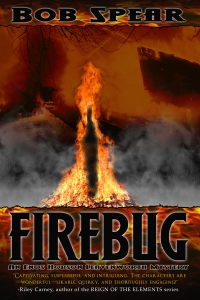
This is what Cliff Fryman, know as @Selorian to his Twitter followers, came up with for an initial design:

Firebug Cover #1

I had some suggestions, so he came up with three more versions. We then conducted a marketing survey with our bookstore customers and certain professional artists and designers. Here are covers #2, #3, and #4:

Cover #2 (above)
 

Cover #3 (above)
 

Cover #4 (above)

The results of the poll were many liked the first, but were confused by the background in the upper area, which looked like a burning ship to many. Most of the pros said there was too much detail for an on-screen thumbnail image, especially if a square audio book cover was based on the same image. Number four got very few votes as its letters were too dark. Number three got a lot of votes; however, number two won because it was simple, easy to read on screen, and manageable to cut down to a square format.

The flames in the letters in both #2 and #3 were really cool (great work Cliff) and the only difference was some smoke in #3 at the base of the burning stake. The second image cut down to the audio format very handily, as shown below:


Audio Book Cover (above)
 

The story is based on a true event in Leavenworth’s 1901 history when a young black man accosted a white lady and was arrested as a suspect in similar incidents, including a murder of a girl during the previous year. A lynch mob (white & black) of 5,000+ tore the iron doors off the jail that night, took him to the edge of town and burned him alive at the stake. In modern times, a young man researches his roots and discovers he is a descendant of the burned man. He decides to take vengeance against the descendants of the mob’s ringleaders. The protagonist has to figure all this out and put a stop to it.

Survey’s Hidden Agenda

In addition to helping us make a decision about the ebook cover (ebook is available at http://bit.ly/bUymON), the survey became a wonderful marketing tool to prepare the public for something exciting is coming to our town. We got strong positive reactions to the fact that we would be publishing a mystery series based in our own town which appears very professionally done. Wow, what a powerful side benefit that was!!!

Cliff ’s work as a web designer and illustrator can be seen at http://cliffordfryman.com/  As you can see, I’m very pleased with his work!


This is a cross-posting from Bob Spear‘s Book Trends blog.

Promote Your Book in Your Own Backyard – 10 Strategies for Success

Online book marketing is a terrific way to promote your book to a worldwide audience, but sometimes authors overlook book marketing opportunities in their own backyard.

In your local area and region, you have the opportunity to stand out as a bigger fish in a smaller pond. Here are ten tips to promote your book in your own area:

1.   Always carry books and literature with you. Keep a case of books and some flyers in the trunk of your car, and business cards in your wallet. You never know when you will run across a potential customer or marketing contact.

2.   Look for opportunities across your region. Headed for a weekend getaway or off to visit grandma? Do a little research ahead of time to identify bookstores, retailers and libraries in the area that you can call on. Or plan your own book tour, staying with friends and relatives along the way.

3.   Promote yourself as a local author to bookstores and libraries. Many bookstores and libraries have a special section where they showcase the books of local or regional authors.

4.   Look for other retailers that are a good fit. Think about what type of retailers relate to the topic of your book, and promote your book as written by a local author.

5.   Put "local author" stickers on the books that you sell in your area.

6.   Speak at libraries. Contact libraries about doing a presentation on your book’s topic. This can be especially effective for children’s books and for nonfiction titles that have a broad appeal (such as travel, business, or fitness).  Many libraries will let you sell your books at your presentation, and some have a budget for paying speakers.

7.   Find other speaking opportunities. Speaking is a great way to promote your book, and you may even get paid to speak once you get some experience. There are lots of organizations looking for interesting speakers for their meetings, including business and civic organizations, church groups, schools and universities, trade associations, and more.

8.   Seek publicity through local and regional media. Send a book announcement press release to media in the town where you grew up and where you live now.  The "local girl makes good" angle works especially well in smaller towns. Create press releases based on local tie-ins, such as a novel set in the region, and on current news events. Don’t forget your college alumni newsletter and any civic or professional associations you belong to. Nonfiction authors should consider radio and television talk shows.

9.   Exhibit at book fairs and festivals. These usually work best if your book is related to the theme of the event, or if the book has appeal to a broad audience.

10.   Market children’s book through schools and youth organizations. School visits are a great way to reach kids. For tips, see Melissa Williams’ article at http://snipr.com/s4qga.

Dana Lynn Smith is a book marketing coach and author of The Savvy Book Marketer Guides. For more book promotion tips, follow @BookMarketer on Twitter, visit Dana’s book marketing blog, and get a copy of the Top Book Marketing Tips ebook when you sign up for her free book marketing newsletter.

10 Greatest Writers Who Became Famous After Death

This post, from Anna Miller, originally appeared on the Online Degree site and is reprinted here in its entirety with her permission.

The old cliché states that artists and writers never achieve true fame or appreciation for their creative output until after their death. While the advent of bestselling authors who peddle their wares on television, radio, and other media outlets, the seductive cult of celebrity has begun trickling its way into the literary world at a much faster pace than yesteryear. But the following writers never had a chance to see the greater influence and love that their painstaking, passionate work earned due to dying before receiving recognition. Some, of course, never actively sought critical or academic renown for their novels, short stories, essays, or poems – though their intentions do not exclude them from proving the old adage true.

1. John Kennedy Toole

Following his disheartening 1969 suicide, John Kennedy Toole would go on to leave a permanent mark on the American literary landscape with his hilarious and heartbreaking A Confederacy of Dunces. His route towards history is indelibly marked by tragedy and well-known to anyone familiar with the brilliant novel and its lesser-known companion The Neon Bible. Toole’s mother Thelma brought the found manuscripts to Loyola University New Orleans professor Walker Percy in 1976. Initially skeptical of her claims that her son was a phenomenal writer, Percy found himself surprisingly bowled over by the grotesquely entertaining Ignatius Reilly and Toole’s pitch-perfect depiction of life in New Orleans and rallied to find a publisher for A Confederacy of Dunces. Louisiana State University agreed, and in 1980 Toole went on to win a posthumous Pulitzer Prize for the novel. Today, it remains a much-beloved work of American literature with a healthy and continuous following – studied frequently in high school and college-level English classes across the United States and subjected to many painstaking dissections by scholars and academics.

2. Franz Kafka

Today considered one of the quintessential existential (and, to a lesser extent, modernist) writers, many unfamiliar with Austrian writer Franz Kafka’s life will be shocked to discover that his intensive influence never coagulated until after his 1924 death from tuberculosis. Kafka actually spent much of his short life working in insurance and factories with the occasional dabbling in theatre. Most of his dark, deeply psychological short stories, novels, novellas, letters, and essays never saw publication in his lifetime – in fact, he ordered his contemporary Max Brod, the executor of his estate, to burn every manuscript without reading them. Obviously, Brod disobeyed these last requests. As a result, Kafka’s descriptive exploration of the more twisted, unknown corners of the human psyche entered into the literary canon. Loved and appreciated throughout the world, critics laud works such as The Metamorphosis, The Trial, The Metamorphosis, and many, many others as some of the greatest literary contributions from the 20th century. They have gone on to heavily inspire not only other writers, but artists, musicians, and other creative types as well.

3. Henry Darger

A curious figure, Henry Darger enjoyed acclaim as an outsider artist and writer after Nathan and Kiyoko Lerner, his landlords, discovered the massive cache of pen and pencil drawings, watercolors, collages, and manuscripts he left behind. After moving into a Lincoln Park, Chicago apartment in 1930, he remained there until his death in 1973. Darger worked menial labor jobs in a hospital before retiring in 1963, and lived an exceptionally solitary existence revolving around attending mass and collecting discarded magazines, newspapers, and books that served as references for his art and inspirations for his stories. Growing up in a traumatic Catholic mission house after his mother’s death forced his being given up for adoption, Darger channeled many of the anxieties and frustrations he experienced into 3 gigantic literary works and a couple of smaller ones. The preservation of innocence and protection of abused children stood as the main themes of his entire creative output, with the seminal 15,145-page The Story of the Vivian Girls, in What is known as the Realms of the Unreal, of the Glandeco-Angelinnian War Storm, Caused by the Child Slave Rebellion as the most visible and popular example. He kept several diaries, some of them about the daily weather, and also penned The History of My Life (a 5,084-page autobiography) and the 10,000-page Crazy House.

4. Emily Dickinson

Like many beloved writers before her and many after, Emily Dickinson spent much of her adult life living like a hermit and was dismissed as a mere eccentric until shortly after her nephritis-related death in 1886. She attended Amherst Academy and studied literature, math, Latin, the sciences, and other disciplines and counted William Wordsworth and Ralph Waldo Emerson amongst her many influences. Keeping to herself, most of her family and peers knew her as a passionate gardener while in private she penned some most unorthodox poetry at the time. Only a small handful of her almost 1800 poems were published during her lifetime, and her sister Lavinia burned a few of her posthumous leavings upon request – mostly letters. However, Dickinson failed to leave behind instructions for some of her notebooks, and as a result her first volume of poetry hit the shelves in 1890 with the help of supporters Thomas Wentworth Higginson and Mabel Loomis Todd. Critics received it with a largely mixed response, though later scholars would come to heap praise upon her experimentations in slant rhyming and unconventional punctuation and capitalization.

5. Sylvia Plath

Sylvia Plath did, in fact, find a modicum of literary recognition in her lifetime before committing grisly suicide in 1963. In 1955, she even won the Glascock Prize for “Two Lovers and a Beachcomber by the Sea.” Following her graduation from Smith College, she guest edited at Mademoiselle magazine to much disappointment – an experience that inspired her celebrated semi-autobiographical novel The Bell Jar – and published the occasional poem in the Cambridge University newspaper Varsity. Plath struggled with mental illness all her life, finding solace in her confessional works that discussed her overwhelming emotions with raw, open honesty. However, this intimate peek into her tumultuous inner life gained far more momentum after her death, with 4 children’s books, 6 works of fictitious and nonfictitious prose (including diaries), and at least 7 volumes of poetry attributed to her name after 1963. Prior to that, she had released The Colossus and Other Poems to a small but largely positive critical base that would later come to prefer her posthumous works. She even won the first posthumous Pulitzer Prize for poetry for 1981’s The Collected Poems. It was the publication of The Bell Jar that fully solidified her place in the American literary pantheon, though. Written under the pen name “Victoria Lucas,” it had been accepted for publication and hit the shelves one month before Plath’s suicide – meaning she never had a chance to actually enjoy the subsequent adulation.

6. Jane Austen

Considering contemporary media’s nigh-obsession with all things Jane Austen – a disconcerting many of them jettisoning the truly biting Regency satire in favor of focusing on the more profitable romances – it comes a shock to many that she never garnered hefty amounts of popularity in her lifetime. Austen did, in fact, publish several of her most beloved novels (Sense and Sensibility in 1811, Pride and Prejudice in 1813, Mansfield Park in 1814, and Emma in 1815) prior to her 1817 death from a disputed disease. Many literary critics and intellectuals spoke well of her spunky parodies of English society, though others criticized the novels for their failure to adhere to Romantic and Victorian philosophies and literary protocol. While never huge, they enjoyed a steady stream of moderate success, and her comprehensive Juvenilia series sent her family rollicking with its cheeky, anarchic humor. In spite of all this, however, Austen remained almost an entire unknown entity until after her death…when her brother Henry revealed in the biographical notes of the posthumously published Northanger Abbey and Persuasion (both in 1817) that she spent her entire literary career writing anonymously.

7. James Agee

Known during his lifetime as a moderately successful literary critic and co-screenwriter for the classic films The African Queen in 1951 and The Night of the Hunter in 1955, James Agee’s alcoholism frequently prevented him from ever achieving fame equal to his talents. A lifelong writer, he wrote for Fortune, Life, The Nation, and Time (he also served as a movie critic for the latter 2), published a volume of poetry (Permit Me Voyage), and released a largely ignored novel (Let Us Now Praise Famous Men) prior to his death by heart attack in 1995. Agee’s most celebrated and studied work, the autobiographical novel A Death in the Family, saw publication 2 years later and earned him a posthumous Pulitzer Prize in fiction in 1958. Afterwards, interest in his oeuvre skyrocketed and eventually earned him a place as one of the most respected American writers of the 20th century.

8. Nathanael West

As with many who worked as screenwriters in the 1930’s, Nathanael West never enjoyed great success for his literary prowess. Prior to his fatal car accident in 1940, West released 12 screenplays (and 1 remaining unproduced), 2 short stories, and 4 novels all while participating in a few writers’ seminars with the likes of Dashiell Hammett and William Carlos Williams. Most of his works – including the celebrated Miss Lonelyhearts (1933) and The Day of the Locust (1939) – drew from his experiences in the tarnished, writhing underbelly of the supposedly glamorous and idealistic Hollywood. It took his sudden and unexpected death to launch any real interest in West’s output, and the 1957 re-release of his collected novels only solidified his popularity. To this day, many regard The Day of the Locust as the quintessential Hollywood satire, offering a portrait into the shady wheelings and dealings of producers, actors, and other movie professionals vying for stardom and glory.

9. Anne Frank

The tragic story of Annelies Frank needs very little introduction. Fans of history and literature alike need to read the young girl’s diary, which she kept from June 12, 1942 until three days her capture by the Nazis on August 4, 1944. Frank died in Bergen-Belsen Concentration Camp in 1945 at the age of 15 as one of the 6 million completely unnecessary Jewish murders during the Holocaust. Miep Gies, one of the women responsible for hiding Frank’s family from the Third Reich, handed her father Otto the famous account. He sought a publisher for it as a means of educating the populace on Hitler’s atrocities, and came to find a valuable ally in historian Annie Romein-Verschoor and her husband Jan Romein. The Diary of a Young Girl was first published in 1947 in The Netherlands, with much of Europe and the United States following shortly thereafter. Critics enjoyed the book as both a harrowing glimpse into life as a hated minority in Hitler’s Germany and as a well-written piece of literature in its own right. Though a teenager, Frank’s experiences granted her work a maturity beyond her years that paradoxically never tarnishes her childlike perceptions of the chaotic world. The result is an entirely necessary entry into the literary canon – a work that absolutely needs reading if humanity ever hopes to quell the possibility of another fascist genocide.

10. Theodore Winthrop

Better known as a Civil War soldier and one of the first Union fatalities, Theodore Winthrop made a name for himself as a Yale-educated lawyer and seasoned world traveler before enlisting in 1861. He published a few articles, short stories, sketches, and essays but garnered little attention beyond the popular, patriotic “Our March to Washington.” Only after his death at the Battle of Big Bethel shortly after entering the army did anyone pay much attention to Winthrop’s writings. His sister, Laura Winthrop Johnson, was responsible for compiling all of his poetry and prose for submission and an eventual collection. At least 5 of his novels hit the shelves posthumously, many of them drawing from his generous academic and travel experiences. However, it was his Cecil Dreeme that garnered the most attention. Challenging and progressive, he turned traditional perceptions of social, gender, and racial roles upside-down using New York University as his backdrop.

No matter their ideology, style, or motivations for writing in the first place, these talented men and women left their undisputed legacy on the literary scene only after passing on. They obtained the level of fame that inadequate, trend-chasing copycats or celebrity-worshipping predecessors and successors only dream about, molding and shaping the written word with oeuvres that far outlived the limitations of human flesh.


Top 10 Book Promotion Tactics

This post, from Graham Storrs, originally appeared on his site on 2/6/2010. 

A survey of book promotion tactics was conducted by The Savvy Book Marketer in December, 2009, and is reported today. It asked a number of authors what their book promotion strategy would involve in 2010. You can check the method and the outcome there. I just want to look at the list of tactics they came up with and try to get a feel for how appropriate they might be for marketing an ebook. The list, most popular at the top, is this:

  1. Social networking and social media
  2. Blogging
  3. Seeking book reviews
  4. Seeking testimonials and endorsements
  5. Press releases
  6. E-zines or email marketing
  7. Radio and television talk shows
  8. Speaking or teleseminars
  9. Article marketing
  10. Book signings

There are some obvious things to say about this, so let’s say them first. The people surveyed clearly included a lot of non-fiction authors. So I can eliminate items 8 and 9 as not really relevant for a novel. I can also eliminate 10. With an ebook, there is nothing to sign, and, for that matter, no reason why a bookshop (the traditional venue for such things) would let you in the door. So that leaves:

  1. Social networking and social media
  2. Blogging
  3. Seeking book reviews
  4. Seeking testimonials and endorsements
  5. Press releases
  6. E-zines or email marketing
  7. Radio and television talk shows

1 and 2 are no-brainers. Anybody with a book to promote in any format and little or no money to spend, will be all over the social networks and blogsphere.

Seeking book reviews (3) might also seem obvious but it isn’t an avenue that is open to ebook writers in most genres. Where ebooks have been popular for years – in erotica and romance – there are dozens of popular and authoritative review sites on the Web. In all other genres, book reviewers will almost never review an ebook. Only rare exceptions exist among the popular review websites and online magazines. I am unaware of any exceptions among the major offline reviewers. So we can scratch that one. Over the next decade, as it becomes normal to release ebook-only novels (and as more reviewers buy ebook readers!) this will change. But in 2010, ebooks just don’t get reviewed.

Read the rest of the post, which includes commentary on the rest of the list of promotional tactics and how they apply (or don’t) to ebooks, on Graham Storrs’ site.

Anniversary Contest Finalist #6 – How To Be Your Own Best Editor, Pt. 1

This post, from M. Louisa Locke, originally appeared on her The Front Parlor blog on 2/16/10 and is reprinted here in its entirety with her permission. This is Locke’s entry in our anniversary contest, in which the winners are selected based on total unique page views. So if you like it, and would like to see Locke become a regular Publetariat Contributor, spread the word and the link!

I made the decision that I was going to self-publish my historical mystery, Maids of Misfortune, in the spring of 2009. Having discovered and become a faithful reader of the website, Publetariat, I was well aware that I had several tasks in front of me if I wanted to be a successful indie author. I had to decide where to publish, design a cover, set up a website, learn how to format the manuscript for  different publishing mediums, and set up a marketing plan. But most importantly, I needed to make sure that my manuscript was completely ready for publication.

 
Over the years, through at least 3 rewritings of my manuscript, I had gotten excellent advice from  my writers group. However, with each rewrite, I had always assumed that any lingering problems with the manuscript would somehow be taken care of when it was finally accepted for publication and went through the traditional editing process. I had no such safety net as an indie author.
 
Read any blog post on self-publishing, and the question of editing comes up. In fact, this seems to be at the crux of most arguments against the validity of self-publishing–that self-published work just can’t be good because it hasn’t been through the vetting of an agent and editor. See Tom Barlow’s “Six reasons that self-publishing is the scourge of the book world”  for a typical example of this point of view.
 
Even strong defenders of self-publishing often suggest that indie authors should hire a professional editor before publishing their books. For example, see  “Why do you need an editor?” by Heidi Thomas.
 
Yet, even if I had decided to hire a professional editor (which I didn’t) this wouldn’t preclude my responsibility for the finished product. Editors can point out errors, they can suggest changes, but ultimately, as an indie author, I needed to be my own best editor.
 
These are the steps I took:
 
I read.
American Idol has demonstrated the amazing capacity of humans for self-delusion, but I knew that no matter how tickled I was with the story I had written, it was not up to the quality of the best of the published fiction I enjoy reading. That knowledge came from a life-time of reading, cringing at badly written material and being transported by the good stuff. I knew that it would be from reading that I would hone the skills to edit my own work.
 
First I concentrated on reading (or rereading) books by all of my favorite mystery authors.
I have never understood the would-be novelists-and I have met a number-who tell me they are writing in a particular genre because they think it will sell, even though they don’t really like that genre. As “research” they read one or two books-usually recent best sellers (which are probably not even the best written book by those authors-since the best sellers often aren’t as good as the first lovingly crafted books that got those authors their first contracts.) They then try to model their work on those best sellers-and what they come up with is often derivative and lacking the joy that comes from a writer writing what they love to read.
 
I love mysteries. That’s why, when I wanted to tell a story about working women in the far west, I wrote my story as a mystery. Because of the number of mysteries I have read, I have a much finer tuned sense of what it takes to make a good mystery. So, as I reread my favorite authors, I looked specifically at what I liked about their writing. I noticed what voice they used and if they provided multiple perspectives. I noted how long the chapters were and examined the transitions from chapter to chapter. I paid attention to their secondary characters and how much physical detail was used to describe each one. I looked for the story arc, searching for the red herrings, the sub-climax, the climax, and at how the book ended. When there was something I didn’t like, the ending disappointed, or I couldn’t keep all the characters straight, or I got bored and found myself skipping ahead, I tried to figure out what had gone wrong.
 
I didn’t confine myself to my sub-genre (historical mysteries set in Victorian era). In fact I rather steered away from these books, because I didn’t want to find myself copying from them. Instead, by learning how to maintain a fast pace from a Dick Francis, or how to create a sense place or time from a Navada Barr or Laurie King, or how to provide sexual tension without sex from a Dorothy Sayers, I was able to apply their methods to my own original work without becoming derivative.
 
Next, I read or reread all the advice books I had accumulated over the years, including practical guides on grammar.
For example, Publetariat’s section on writing featured a long list of tips that I found very useful. I knew how to write, but I needed to be reminded what to look for when I was reading my own work. I also discovered some new rules. For example, sometime since I wrote the first draft of my manuscript, the standard had shifted from two to one spaces between sentences! Who knew!
 
Then, I read all the comments from agents, rejection letters from editors, and critiques from my writers group.
I looked for common threads (several mentioned that I had too many arguments between the protagonists). I looked for differences of opinion (one said it didn’t have enough romance, another too much). I read these comments in the light of what I had learned from all the reading I had been doing in the genre and about writing.
 
Finally I was ready. And, in my next post I will detail what I did to prepare my manuscript for publication as my own best editor.
 
(If you want to see how successful I was, check out the free excerpt of Maids of Misfortune, or better yet-buy the book!)