This post, by Publetariat founder and Editor in Chief April L. Hamilton, originally appeared as a guest post on the BookBuzzr Blog on 10/21/11.
Amazon has been instrumental in the rise of the indie author. Amazon provides do it yourself publishing platforms both for ebooks (Kindle Digital Publishing platform) and print (Createspace), as well as its own imprint for a print and ebook publishing model. But that’s just the beginning. Amazon takes things a step further by treating indie authors the same as mainstream-published authors when it comes to marketing and promotional opportunities on the site. One example of this is Amazon Author Central, through which anyone who has authored content offered for sale on Amazon can have his or her own, dedicated Amazon Author page.
An Amazon Author page can be a surprisingly robust plank in your author platform, especially considering that they’re offered totally free of charge. Your Amazon Author page can include all of the following:
• Author Photo
• Author Brief Biography
• Author Bibliography (of books/content for sale on Amazon)
• Author Blog Posts
• Dedicated Discussion Board
• Integration With Facebook, Twitter, and Email
Here’s my Amazon Author page:
Setting up your Amazon Author page is very, very easy, and it’s an opportunity that’s open to all authors, mainstream-published and indie alike.
First, you need to have an Amazon account. It doesn’t matter whether you have one set up as a consumer or self-publisher, either type of account is fine to use for Author Central sign-up. Just go to the Amazon Author Central page, login, and fill in the provided form to have an Amazon Author Page created for you. On the U.S. site its URL is http://authorcentral.amazon.com, and on the U.K. site the URL is http://authorcentral.amazon.co.uk . This page shows the options and tabs available to you once you’re logged in:
“Apple’s Lower Prices Are All Part of the Plan,” ran the headline for an interesting piece yesterday by Nick Wingfield of the New York Times.
Really?
Wingfield believes that Apple, “once known as the tech industry’s high-price leader,” is carrying out a major strategy change to the point where it is now competing with, and often beating, its rivals on hardware prices.
I’ll have to admit that despite some interesting anecdotal pricing comparisons made by Wingfield, I’m not feeling him. Yes, Apple has certainly shown some signs that it is pulling back some on its hardware prices, and those prices could soon collapse by 30% or more due to forces entirely outside Apple’s control. We’ll get to that, but it is unlikely that such a collapse would reflect Apple’s strategy.
To conclude that Apple has a real commitment to competitive pricing in its corporate DNA, we’d have to see a lot more evidence of significantly lower prices on mainstream hardware items like the iPad, the iPod Touch, and the various workhorse Macs (as opposed to boutique products like the MacBook Air or carrier-subsidized products like the iPhone.)
It could happen. But to suggest that Apple management will be in the driver’s seat applying the gas on such a strategic transformation is to ignore a number of powerful forces that leave Apple few options.
For starters, let’s look at the tablet market, which it is entirely fair
to say was created through the innovative brilliance of Apple and its
late leader Steve Jobs. The brilliant success of the iPad — both in its elegance and in its acquisition rate by the public — made fierce competition inevitable. So while iPad sales continue to grow dramatically quarter over quarter, iPad’s overall tablet market share fell from 95.5% a year ago to 66.6% in the third quarter of 2011, FierceWireless reported Friday. Nothing truly stunning there; it’s a pattern one could expect to see in any new market as it begins to mature.
A little more of a jaw-dropper is that the market share for the various Android tablets on the market — including devices from HTC, LG, Motorola, Samsung, Acer and Dell — grew from 2.3% to 26.9% in the same period.
Now, in the fourth quarter of 2011, the Android market share is likely to grow even more dramatically with the launch of the Kindle Fire tablet, priced at $199 and capable, Amazon clearly believes, of doing everything an iPad can do except for the things that only a few people really care about.
If the Kindle Fire hits the hardware sweet spot once people have it in their hands, it could quickly become the single most coveted holiday gift for smart grownups this year at that $199 price, and that price and popularity would constitute a very powerful if traditional pressure on the $499-to-$829 iPad price structure.
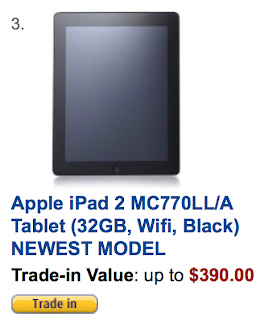
But there is another set of pressures forming just now that could totally pull the rug out from under iPad prices. As we reported last week in our post Interested in Trading Up for a New Kindle Touch or Kindle Fire Tablet? Pull Your Clunker In to Amazon’s Super Lot, Amazon is now investing website real estate and an aggressive marketing campaign to create its own secondary marketplace for virtually all tablets and ebook readers. If Amazon can succeed at enticing thousands of the customers whom it shares with Apple to trade in their iPads and iPod Touches for the 30% to 40% offers now on the Amazon website, those trade-in units could stake Amazon or its “Warehouse Deals” subsidiary to an off-price inventory that might, in time, create an entirely new form of downward pricing pressure on Apple.
But there could be another mission for Amazon, one that could well influence the economics, the retail pricing, and perhaps even the share price for a competitor such as Apple over the next few years. It’s easy at this point to think that Amazon’s new two-way hardware market will be dwarfed in scale by Apple’s front-door production and retail power.
But Amazon knows better than anybody the effects that its Amazon
Marketplace secondary market for new and used books had on competing
booksellers and publishers over the past decade. Some in the publishing
industry believe that Amazon’s customer-friendly innovations actually
destroyed billions of dollars in corporate wealth, even if it also
fueled tens of thousands of small and often home-based businesses.
“Some companies,” Amazon CEO Jeff Bezos is fond of saying, “do everything they can to raise prices for their customers. Other companies do everything they can to lower prices for their customers.”
It is clear that Amazon has always been the latter kind of company, and equally clear that Bezos feels that Apple has been the former kind of company both generally and in its activities with the Big Six publishers to create the “agency model” to fix ebook prices at higher levels than Amazon wanted to charge.
If Apple now seems to be in a state of transition from the former kind of company to the latter kind of company, it remains to be seen whether the transition is “all part of Apple’s plan” or, at least in some significant part, the result of an impressive array of economic pressures that Amazon’s innovations are bringing to bear on Apple.
Note: it happens every 90 days or so, and this afternoon Amazon will report its quarterly earnings after the close of the markets, with the usual conference call scheduled at 5 pm Eastern. Apple reported its earnings last week and apparently disappointed investors. Amazon may well do the same in the short term, but the company’s commitment to low margins could well be leading it to a promised land in which it could gain as much as 50% of the U.S. trade book market by 2013.
This is a reprint from Stephen Windwalker’s Kindle Nation Daily, where you can find real-time listings of free and quality 99-cent Kindle books in Amazon’s Kindle store, as well as book reviews, news and commentary about the Kindle and ebooks in general.
Everyone says you must social network as part of your author platform.
Publishers, agents, self-publishing marketing people, other authors. It now seems part of the non-negotiable author platform for indie authors and those wanting a traditional deal.
But there’s more to social networking than just marketing.
I started blogging, tweeting and Facebooking over two and a half years ago and consider it a life-changing experience. I have made some fantastic online friends, connected with peers in the industry, gained an online platform that now reaches thousands of people and my novel, Pentecost, is still in the Amazon bestseller rankings after six months, based on a launch fueled by social media. Twitter in particular is an important part of my social life as well as my work and I am a passionate evangelist for the platform.
It doesn’t matter what social network you want to jump into, there are principles that apply to all and some basic mistakes that you can avoid which will make it a much more effective place for you to be.
Here are the top 7 mistakes authors and writers make in social networking.
(1) Not being useful/interesting/entertaining.
If you want to stand out in a crowded market online you have to offer something to people. Remember the phrase ‘what’s in it for me?’ Everyone wants to know things that will help them, or interest them or make them laugh. If you’re not offering that, then you won’t get attention. If you don’t have attention, it won’t lead to interest in you or action in terms of buying your book. So focus on being one of these things as the main pillar of your social networking. For example, I tweet useful links to blog posts on writing, publishing and marketing @thecreativepenn .
(2) Not understanding generosity and social karma.
There is an understanding online that we are not competitors, that this isn’t a zero sum game, that the pie just gets bigger. In fact, those of us in the same niche post on each others blogs, share posts that aren’t our own and promote other people’s products, even if they overlap with ours. The blogging and social media world is all about being generous with links, with information, with help. It makes the community a very positive place to be and we all benefit. It’s important to do this for it’s own sake but it also generates social karma, as in you will receive back in the measure you give. I don’t mean this in any spiritual manner, just that ‘what goes around, comes around’ as in any community.
(3) Not being personal enough.
Yes, you have to be useful but you also have to be a real person. Don’t just tweet information all the time. Intersperse some updates about your life, your writing, maybe your pets or interests, some photos. People connect with people, not info-streams. Use pictures and also link to multi-media that you create or participate in. Remember that people buy from those they know, like and trust so you have to earn that. I also recommend using a picture of your face throughout your networking. It’s much more personal to connect with someone specific rather than an avatar or random picture. Using the same picture all over the web is a good idea and will help people recognize you across the networks.
(4) Being too personal or too marketing focused.
Of course, personal does need balance. You can’t just have personal updates as no one is interested in that. Also, do not just tweet about your new book. The fastest way to get blocked by people is if you are just interested in selling your stuff. There’s a time for that but it’s AFTER you’ve built up some social karma and goodwill with the online audience. Also, if you want to get retweeted, or Liked so your post is shared across other people’s networks, it needs to resonate. That generally means it should have a good headline. I frequently rewrite headlines from blogs in order to get more Retweets. Basic copywriting skills will serve you well here. I recommend Copyblogger as the best place to learn about this and much more on internet marketing.
(5) Expecting short term gain.
Social networking is basically hand-selling to people around the world. You have to connect with people over a longer period of time, before you try to sell them your book. Many authors dive into social networking just before their book launch and then try to sell immediately, or try desperately to grow their following at the last minute. But it doesn’t work like that. You need to work on it consistently, putting in the effort to create relationships over time. This is a long game. Luckily, authors are used to long term projects!
(6) Not being consistent with niche and timing.
People tend to clump together around their interests online, so people will follow your twitter stream for several reasons. They like what’s in your profile (writer/author/loves books!) or they like your tweets/updates, or both. It follows that you need to be consistent with the topics you share because those people will be turned off if you start in a completely new direction. So I tweet about writing, publishing and book marketing @thecreativepenn. I can be tangential e.g. creativity, books I’m reading, things that relate but I won’t be sharing on things really outside the niche e.g. weight loss/ TV programs etc. If you stick to your niche, you will develop a nice, tight community who share your interests. Consistency is also important in terms of timing. If you don’t tweet/update/post for months, people won’t follow you. Simple as that.
(7) Not being global enough with tweet timing and book availability.
Online social networking opens up the world to your books. That is truly exciting…but only if you take advantage of the opportunity. I’m based in London but 70% of my traffic comes from the US and 15% of my podcast audience is in China, and there are many others represented in my twitter stream and blog traffic stats. The only way to reach people everywhere on social media is to use a scheduler for your tweets. I use Su.pr but you can also use SocialOomph or Hootsuite. Scheduling in multiple time zones means you can appear in streams at different times of day. It’s what I used to specifically try to network with Americans (and it works! Hello American friends!) However, you should also remember that there is only a point in connecting internationally if your book is also available everywhere i.e. on Amazon.com and also in ebook format.
So, those are the top mistakes I see people making on the social networks. If you have any more lessons to share, please add them in the comments below.
Do you need some more in-depth help with social networking?
Many people want to be successful at social networking but they are afraid of wasting time and not being effective, as well as the concerns of privacy and just not knowing where to start. So I have launched a multi-media mini-course that will help with this.
It has a 59 page ebook, plus audios and 4 behind the scenes videos on all the major social networks. I share all my top tips and strategies for building your social network and using your time most effectively. I help you through the process saving you time and effort in jump-starting your social networking platform.
This guest post, by Foz Meadows, originally appeared on Alan Baxter’s The Word on 10/11/11.
Today I’ve got a guest post from author Foz Meadows. A discussion elsewhere led to this very lucid and, to my mind, accurate post on the nature of piracy in the digital age and the pros and cons of authors offering free content. It applies equally to all forms of digital media. I agree wholeheartedly with Foz on this and hope it makes some interesting reading for you guys.
Piracy and Free Content
by Foz Meadows
Neil Gaiman tried the free giveaway experiment a little while back – the readers of his blog voted which novel of his they most wanted to recommend to friends (it ended up being American Gods), and then he made it freely downloadable for a month, after and during which time his publishers monitored his sales to see what happened. Similar to Cory Doctorow’s experience, sales of ALL his books (and not just American Gods) went way, way up, which I think Gaiman compared to something of a library/lending effect, i.e.: most people discover new authors because someone, be it a friend or a library, loans them a copy of the book, thereby encouraging them to buy that author’s works in the future but without the initial risk of paying money for a product they might not like.
What I took away from the whole endeavour (apart from the fact that, when it comes to any experimental sort of book sale process, it is very helpful to already be a megastar) is that it seems to work best for writers who already have a published back-catalog. Putting up one book for free, for a limited time, draws attention to all your works together; and if people like the free product, then they’re more inclined to pay for your other stuff, because you are now one of Their Authors. Which could work as a promotion for a second book if done right, I think – but the call is yours.
Regarding people who download, I do think there’s something to the argument that the majority (or at least, a significant proportion) of DLs don’t actually constitute a lost sale, per se, so much as a parallel form of consumption. Allowing for the 10% of assholes who will always rather steal than pay even when they can afford it, I know there have been myriad reported instances where people who already own physical copies of books have sought out illegal digital versions because of region control issues in the legal versions, such as someone from Australia not being able to buy an ebook version of a novel they already own because it’s only published in America.
Publetariat welcomes author Cheri Lasota. In this guest post, Cheri introduces the idea of using physical gift cards as a means of ebook distribution through brick-and-mortar and other offline outlets.
Have you heard of e-book cards? If you haven’t already, I think you will soon. They are a new book marketing technique making headway and headlines around the country now.
I heard about them from author Dean Wesley Smith. The idea stems from this simple question: how do authors and publishers sell a digital product in a physical store?
So many of us are releasing e-book only versions of our fiction. In such cases, how do we sign our books at events? How can we hand-sell our books at conferences, speaking tours, or to the neighbor next door? How do we start to educate the paperback public that e-books are both the wave of the future and the here and now? E-book cards can accomplish all this.
These plastic cards are the same size as your credit card or the gift cards you might buy at the store. Why that size and shape?
· You can fit them into your wallet or purse.
· You can slip them into larger sleeves or envelopes that can display even more content about the book.
· You can put them in a display holder that has a slot for business cards.
· You can sign them at events because the plastic makes them durable.
· You can mail them in a standard envelope for promotional packages because they are so small and compact.
And just think about how little space they would take up on the bookstore shelf, as opposed to a 600- to 800-page paperback?
SpireHouse Books released my novel on Sept. 13, 2011 and we have wholeheartedly embraced e-book cards in our marketing campaigns since then.
Thus far, we sold many of the cards at my book launch, I’ve sold some by hand, several stores are displaying and selling them, many have bought them as gifts for their friends, and I have used them as giveaways at events and elsewhere.
In the future, we plan to mail them out to book reviewers,continue to use them for giveaways and to sell at events, give them as gifts for holidays and birthdays…the possibilities are endless.
You can tailor your e-book cards for your own needs. For my cards, my publisher put the book cover on side 1 and included two important notes on it: “E-book Card Edition” and “Read On Any Device.” On the accompanying display, we mention that the e-book card edition is cheaper than anywhere else the book is sold, which gives bookstore owners a clear incentive to stock them and gives readers a great reason to buy in-store as opposed to buying online. Our e-book card edition also contains exclusive content.
On side 2, we included a “tagline” as well as a short synopsis of the storyline; clear, concise instructions on how and where to download the book; an ISBN/barcode; and a unique scratch off promotional code,which the buyer plugs into my publisher’s website.
We see this as an incredible opportunity for bookstores as well as authors and small publishers. Spread the word to other authors. Talk about this with your local bookstore managers. Think outside the box and you may find that these cards give you access to readers you never thought you could reach.
Have questions? Just comment on this post.
[Publetariat Editor’s note: more of the how-to nuts and bolts, and costs, of getting ebook cards produced are covered in this linked post from Dean Wesley Smith, which was referenced by Cheri near the beginning of this post.]
_______________
SpireHouse Books just launched Cheri Lasota’s first novel, Artemis Rising, this fall. The book is a YA historical fantasy based on mythology and set in the exotic Azores Islands. Currently, Cheri is writing and researching her second novel, a YA set on the Oregon Coast. Over the course of her sixteen-year career, she has edited fiction, nonfiction,screenplays, and short stories for publication. Cheri also has twenty-four years of experience writing poetry and fiction. Learn more about Artemis Rising at http://www.cherilasota.com or buy it at http://bit.ly/ArtemisRisingNovel.
Editor’s Note: while most Publetarians are indie authors and small imprint owners, this article is still worth a very close look from all of us. It touches on the indie authors’ and small imprints’ new competitors, companies which are a hybrid of literary agency and publisher. Plenty of indies have a mainstream-published backlist, and those indies need to be particularly wary of the kinds of business practices revealed in this article.
This article, by David Gaughran, originally appeared on his Let’s Get Digital site on 10/19/11.
120 titles will be released between November and the end of the year, with 400 more coming in 2012, and the books will be available in both digital and POD formats.
Regular readers might remember that, in May, Curtis Brown were considering a move into publishing after fellow-agent Ed Victor launched his own imprint Bedford Square Books.
At the time, Jonathan Lloyd, the managing director of Curtis Brown, was quoted by The Bookseller as saying, “Where Ed Victor leads, others follow – and we are right behind him, but with a rather larger list.”
However, Mr. Lloyd may not have expected what happened next. Ed Victor’s move created a firestorm, with angry reaction from publishers, authors, and even other agents – including calls for his expulsion from the UK’s representative body, the Author’s Association of Agents (scroll down to comments for quote)
In addition, later that month, one of the first UK agents to move into publishing – Sonia Land – was dramatically cut out of a publishing deal by one of her own authors – Tom Sharpe – who made a backlist deal directly with his publisher.
It seems that Curtis Brown decided to rethink their move into publishing.
Instead, they have announced a deal to sell 520 books en masse to a new imprint owned by Pan Macmillan created especially to house these books. Naturally, with a deal of this size and nature, questions are being asked. Here is what Passive Guy (a lawyer) had to say:
In managing your author website and your publishing business, it’s important to understand visitor trends for your site. Here are just a few of the things you can learn by studying website statistics:
• Number of visitors each day/week/month • Number of page views each day/week/month • How much your traffic is increasing over time • How are people getting to your site • What specific search terms people are using to find your site through search engines • What Web page people were on before they landed on your page • How long people stay on the site • How many pages they visit • Which pages are the most popular • What countries or regions your visitors come from
You may want to use more than one statistics counter to get a full picture of your website traffic patterns. Here are a few options:
1. Statistics from your blog or website host
Check to see what kind of statistics you’re already getting from your blog or website host, and consider what other data you may be able to get from external sources.
2. Google Analytics
Google offers a free statistics counter at www.google.com/analytics. You’ll need to log in with your Google user name and password to set up your analytics account.
One nice feature of Google Analytics is a chart of where your website traffic comes from. Here’s what mine looks like:
Search engine traffic comes from web searches (primarily on Google), Direct Traffic refers to people who came directly to the site, Referring Sites means that someone clicked a link from another website to get to my site, and Other includes things like traffic generated by RSS feeds.
3. Other statistics counters
There are a number of other statistics counting services available, both free and paid. I use Google Analytics along with the free service at www.StatCounter.com. The StatCounter interface isn’t as pretty as Google Analytics, but I find it easier to use for quick traffic checks, and I’m able to exclude my IP address from the counter so that my visits to my own websites don’t get counted.
If you’re using an external statistics counter, they will provide you with a snippet of code to place on your own website. On a blog you can place the code in a widget or sidebar item. In most cases, you will want to select an "invisible" counter so that the code is not visible to visitors.
Don’t be surprised to find that you’re getting different numbers from different statistics counters. They don’t all use exactly the same data capture methods, but the overall trends should be similar.
I spent this weekend in Brisbane at the Emerging Writers’ Festival Digital Writing Conference and it was a top weekend of excellent information and quality company.
The event started on the Friday evening, with a meet and greet of attending writers, editors, artists and organisers at Greystones Bar. It was great to put 3D fleshforms to Twitter personas, some of whom I’ve known online for a long time, as well as making new friends right off the bat.
The Conference itself started the following day at the Queensland State Library. Lisa Dempster (@lisadempster) opened proceedings and we were then supposed to cut to a video presentation from Christy Dena (@christydena). However, library technofail meant there were problems with the wifi. For me, a certain degree of technofail at a digital writing conference seemed somehow fitting. So we had a presentation from Morgan Jaffit (@morganjaffit) on writing for videogames.
This presentation was excellent, especially as I’m involved with some game writing now. One of the simple yet very important things Morgan said in reference to game writing was that, whereas with prose writing we’re told to “Show, not tell”, with games it’s “Do, don’t show”. In other words, let players actively participate in the story rather than showing them all the story in elegant cutscenes. Gamers remember the stuff they do in a game more than the stuff they watch. This is a Very True Thing.
Then we kicked into the first panel.
Sophie Black (@sophblack), Andrew McMillen (@niteshok), Jason Nelson and Sarah Werkmeister (@fourThousand) discussed the nature of writing online, hosted by the wonderful Alex Adsett (@alexadsett). It was interesting and varied stuff. Andrew McMillen told a tale of caution when it comes to the organic nature of online journalism and how important it is to fact-check and maintain your integrity and ethics as a writer. Jason Nelson blew us away with a variety of interactive online poetry and games that has to be seen to be believed. He’s also on the board offering grants to digital writers, and it’s worth your time investigating that as it seems very few people are applying and there’s money to be had. Real spending cash. A rare treat for any kind of writer. Sophie Black, editor of Crikey, talked about how online journalism is different to the print journalism of old, and how they source material from all over the world. Sarah Werkmeister drew interesting comparisons as well. And this is, of course, only a fraction of the stuff covered.
Following that panel was another moment of technofail (which, I should point out, was again the fault of the venue, not the conference or organisers!) and so we had an early break. Then we came back to the next panel, which included myself, Simon Groth (@simongroth), Charlotte Harper (@ebookish), and Festival director, Lisa Dempster. It was hosted by the inimitable Karen Pickering (@jevoislafemme). We were talking about using the online environment to promote your work, to get work and to work for you. I used my own website as an example of how to manage a central online hub, where people can find you and your work and contact you if they want to. Of course, it was also a moment of shameless self-promotion, with my site projected behemoth-like behind me. Here’s a photo from Amanda Greenslade (@greensladecreat):
From L to R – Karen Pickering, Lisa Dempster, Simon Groth, Charlotte Haper, and me at the lectern
The other panelists presented very interesting stuff, important to all writers – concepts like “Know your niche”, “be an expert”, “define your audience”, “don’t be a dick”, “don’t spam people”, “engage with people online, don’t preach to them” and so on. The panel and subsequent Q&A wandered all over the place and covered a lot of ground, which I won’t try to replicate here.
Suffice to say that these two 75 minute panels were jam-packed with juicy tidbits of writerly wisdom and, judging by the feedback when I was chatting with people afterwards, most attendees got a lot out of it. I certainly learned some new stuff and had some old stuff reaffirmed. The truth is, no matter how emerging or emerged you may be as a writer, these things are invaluable.
After that panel we recovered somewhat from earlier technofail and had Christy Dena’s video speech – “7 things I wish I had known at the beginning of my digital writing career”. I’ve embedded that video here as it’s fucking brilliant. Absolutely solid advice, well worth your 15 mintes:
See, how good was that?
Then we mingled and drank, often the best part of any writers’ event as people are the engine of this industry and socialising with them is invariably fascinating and entertaining.
The following day there was a talk at Avid Reader bookshop (@avidreader4101), where Karen Pickering and Chris Currie (@furioushorses) talked to writers about writing about writing. Yes, all very meta. Here they are, in the sunny courtyard out the back of the bookshop/cafe. There were periodic pigeon attacks to keep them on their toes:
It was a fascinating chat, but sadly I had to leave early to catch my flight. However, due to the frenzied tweeting throughout the entire conference, I was still able to keep a bit of an ear to what was happening. And I got to follow the excitement of the spelling bee that evening, which rounded out the Festival.
A truly spectacular event that I was proud to be a part of. Given that most of my conference activity is quite genre-focused, I always enjoy these wide open writers’ events, with everyone from journalists to fiction writers and beyond all mixing together, all styles, all media, all slightly crazy. It’s inspiring and motivating in so many ways, I can’t recommend it highly enough. If you want to be a writer or you already are one, get out there and mix with these overlapping tribes. We’ve all got our love of writing and reading in common, after all.
You’ve hopefully noticed that throughout this post I’ve been linking Twitter handles. Go and follow them all – they’re very interesting people.
If I got one over-riding thing from this conference it was that right now is an exciting and invigorating time to be a writer. I couldn’t agree more with that perception. Vive le Worditude!
Kindle for iOS has just been updated to version 2.8 (iTunes link), which complies with Apple’s new in-app purchase rules.
Kindle Store button was removed from the home page – it was obvious. I’ve also checked endings of free samples to see what Amazon did with their Buy Now link, which in older versions was switching to book’s Kindle Store page in Safari. Buy Now button is still there (as well as See details for this book in the Kindle Store). However, both links show an alert: “We’re sorry. This operation is not currently supported.”
Apple and Amazon are playing games, which are more and more annoying. Status for today: Apple won’t earn money, Amazon won’t lose money. The only losing part is the reader.
Below you’ll find tips on how to make the most of Kindle on your device – especially after making our lives harder by removing any option to buy a book from within the app. A good thing to do is to change attitude: Kindle on iPad or iPhone is not only about using a Kindle application.
1. Browse Kindle Store in Safari
After 2.8 update it will be reasonable more than ever to browse and buy books right away from Safari browser (without bothering to open Kindle app). Never tried it? Don’t worry. Amazon mobile site looks really well on iPhone/iPod Touch. On the iPad a regular site is displayed, works well, I haven’t noticed any flaws.
2. Add Kindle Store to your Home Screen
Add Kindle Store to your Home Screen
It’s good to add Kindle Store either to a list of bookmarks in Safari or to a Home Screen. On the iPad just go to Amazon site and select Kindle Store from a drop list.
If you’re on the iPhone/iPod Touch, go in Safari directly to this address http://amzn.to/fW2ffk. It’s Kindle Store’s site optimized for small screens – not the same as regular one. You can add it as a bookmark to Home Screen (see picture on the right) and a nice icon will show up.
In fact, you can use the browser to add books from other sources than Kindle Store. What’s very important, you can add them directly to Kindle for iOS. This is possible since 2.5 update.
What you have to look for is books in mobi format, without DRM. To add a book to Kindle app, tap on a link to a book file, ending with .mobi.
4. Add books to your Kindle for iOS – not only via iTunes
iTunes is a default way to add content to applications, but happily it’s not the only one. As I’ve written above, you can add books from Safari.
There are two more options available: via e-mail (just send a file to yourself and open it with a native Mail app) and via cloud storage apps like Dropbox.
5. Discover books on Twitter and add them instantly to Kindle app
It’s my favorite topic. If you spend a lot of time on Twitter, using Twitter iOS applications, why don’t you try to find Kindle books there? It’s actually pretty easy. Just look for a keyword Kindle or a tag #kindle and you’ll find out a lot of tweets with amzn.to links.
Or if one of Twitter friends is recommending a Kindle book, just tap on a link and you’ll be redirected to mobile Safari (either within Twitter app or outside it) and you’ll decide whether to download a free sample or buy a book.
Finally, Kindle for iOS can also work as a great dictionary application, so there is no need to buy another one. This is possible thanks to the The New Oxford American Dictionary installed.
I hope you enjoyed the tips. Please share in the comments what’s missing. If you want to keep up with what’s going on with Kindle on iOS devices, get free updates of Ebook Friendly Tips (via RSS or e-mail) where I focus on sharing simple Kindle tips.
Getting a notable VIP, industry guru, or media celebrity to write the foreword for your book is a great way to jump-start bigger sales and get positive publicity for your book. If you are an unknown author, getting a notable leader in your field to write your foreword is essential if you want to get readers to take a chance on you and buy your book. Having your name associated with an industry leader will greatly enhance your credibility within your industry and with your readers.
Forewords give the endorser another place to discuss and show-off their skills and knowledge. It also gives them and an opportunity to connect with your reading audience in a deeper, more meaningful way. This is a great selling point to consider when requesting this service from someone. You get a foreword for your book that will help improve your sales, and the foreword author gets additional exposure and credibility for their own name and business. It’s a win-win situation for the book’s author and the foreword’s author.
The process of getting a foreword written is the same as with endorsements. But instead of simply writing a few sentences endorsing your book, the endorser writes what amounts to being a glorified recommendation letter to the reader. It can be as short as several paragraphs or as long as a few pages, and gives, in greater detail, the reasons why the industry guru recommends your book.
One thing you should remember – that when you ask a VIP to write your book’s foreword, that you should not be selling your prospect on your book’s good points. You need to sell them on their own value as a potential endorser of your book. In other words, don’t start off by telling them how great your book is. Start by saying why you admire their opinion and why it’s important for you to have their opinion included in your book. Also, make sure that you share your reasons for writing the book. Discuss the subject of your book in detail. Finally, discuss who the market is that your book is addressing so that the endorser can readily see that you are marketing your book to the same audience that they serve. Doing this allows them to see the advantage in having their name visible to your network of readers. They are looking to connect with their own audience as much as you are.
This article was written by Joseph C. Kunz, Jr. and originally posted on KunzOnPublishing.com
Ebook sales have been steadily growing over the last 2 years and those of us readers who converted early are almost entirely ebook consumers now.
For authors, the global ebook sales market has meant we can sell direct to customers and every month receive a cheque from Amazon. We can log on and see our sales by the hour. It has been life changing for me and so many others.
But ebooks have been far from mainstream. Until now.
These new Kindle devices change everything.
Amazon has unveiled a new family of Kindles including one at the magic price of $79. This is what happened with the iPod when the price came down low enough that it was a no-brainer purchase. Those people who had been on the fence about new-fangled digital music went out and got one, just to see what the fuss was about. I was one of those people (with the ipod) and it hasn’t left my side since.When did you switch to digital music?
Kindle sales growth almost vertical (Image source: Business Insider)
I was one of the first people in Australia to buy the Kindle when it (finally) become available. I converted to 90% ebook reading within weeks and the number of books I bought at least trebled. I am unashamedly an Amazon fan but this is a massively exciting development for any author who can see what’s round the corner.
These new Kindles will ship in October and November. There will be many of them in Christmas stockings and ebook sales go up over Christmas because people have time to read, and of course, play with their new gadgets.
So what does this mean for you?
If you don’t have a Kindle yet and you are a writer or want to be. Get off the fence and buy one of these(affiliate). Experience for yourself what the digital revolution means. Even if you still love the smell of a new book, there are millions of people converting to ebooks and you want to sell to them. You are not your market. You have to see this to believe it.
If you are a traditionally published author and your publisher has not put your book on the Kindle with global rights, then go see an IP lawyer and see what you can do to get the rights back or ask the publisher to get your books up there. It’s not rocket science.
Trust the market
People want to read. They want to find books that will inspire them, entertain them, educate them, take them out of their world for just a few minutes. These book lovers are people like me. I devour Kindle books. I download samples several times a day. My biggest entertainment expense is ebooks. I love reading. Chances are, so do you, and so do millions of readers. Maybe they will like your book. But they won’t find it unless it’s on the Kindle platform.
I’m sure there will be the usual lamentation that this attitude will flood the market with more self-published books of bad quality, but I trust the market. I am a heavy Kindle user. I am the market. I always download a sample unless I trust the author. I always delete the sample and don’t buy if the formatting is bad or if the book is not enjoyable or useful. I only buy books that pass this sample test. I go by reader recommendations and how many stars there are. I buy based on recommendations from my friends on twitter. Crap books with crap covers do not sell. They don’t rank on the bestseller list. They do not get recommendations.
Stop with the excuses about why you think ebooks will fail, or how they are destroying publishing. Enough already.
This is no longer the future. This is right now.You need to act.
Niche Publishing Is For a Tightly Defined Market Niche publishing means publishing to a very specific, tightly defined, focused audience. If, for example, you have been living in New York City’s Manhattan for many years, and have become an expert in ‘roof-top gardening in the city’, this would be your niche. Your niche would not be ‘gardening in North America’. It also would not be ‘gardening in the North East’.
With Niche Publishing You Need to Become an Expert To promote your books, and give yourself credibility with your readers, you would need to write articles, and a blog, and a website, etc., devoted to ‘roof-top gardening in New York City’. You might expand on this to cover all gardening within New York City. You would become well known as an expert in this subject. Therefore, your readers, which are your potential customers for your books, would believe that you have a very extensive knowledge about this subject, and happily buy your books that you write.
Niche Publishing Is Publishing With a Mission After you successfully publish your book on your niche, you might decide to grow your self-publishing business into a niche publishing company. To do this you might go out and find other authors that you would like to publish. These authors would most likely be experts in city gardening in each of the other big cities in the U.S. Your niche publishing company would become known as the publishing company that specializes in helping city-dwellers have a successful garden. This would be your company’s mission.
Niche Publishing Is the Best Way to Grow Your Company This expertise, or focus, is what will drive readers to purchase books from your company. Your expertise and reputation will help you command a premium price for your publications. Your company’s niche and brand, and your reputation and authority on this subject, will give your company the ability to grow.
With Niche Publishing You Must Know Your Intended Audience This is an essential part of your success. Since you have been ‘roof-top gardening in New York City’ for many years, and friends and neighbors already look to you for advice on this topic, and you read every book and article on this subject, you already have an intimate knowledge of your audience’s needs. You know what questions they have, and what problems they have. You have already developed your own tips and tricks, and do’s and don’ts, to having a successful roof-top garden. Now your mission is to share this knowledge with your readers.
This article was written by Joseph C. Kunz, Jr. and originally posted on KunzOnPublishing.com
With Borders closing its doors after 40 years in business in addition to other major bookstore chains either downsizing locations and/or closing altogether, many can’t help but wonder if the era of brick-and-mortar bookstores are joining the Walkman, Windows 95 and vinyl records in becoming things of the past.
It was bound to happen once books – from classic to present-day titles – became available on devices such as Kindle, iPhones, and others made for downloading electronic reader versions of various books. Colleges are now offering online textbooks for their students; hence, there won’t be many physical textbooks being ‘bought back’ by college bookstores once the terms end as it was in my day.
Ereaders can’t take all the blame, though. Sites such as Amazon make book browsing and purchasing a lot more convenient, and many times, favorite books can be bought for a cheaper price than the neighborhood bookstore.
While Kindles and Nooks are wonderful gadgets, they don’t have the feel and smell that a good hardcover (or even paperback) offers. Ereaders are lightweight, but there’s something about turning pages of a chilling mystery novel while cuddled under a large down comforter by the fire on a stormy night. I also wouldn’t recommend using a Nook to read in the bathtub, and Kindles are hard to dog-ear pages.
There is some good news, however. Half Price Books continues to do well, as are some smaller, independent bookstores. For those who really enjoy nostalgia with their reading, nothing beats a weekend afternoon in the local vintage bookstore – the best place to find out-of-print favorites.
A fellow book aficionado told me about an independent book store in Houston that’s perfect for crime buffs: Murder by the Book.
Bookstores also offer a social aspect that all the web sites and ereaders in the world will never compensate. When was the last time you discussed a great new book with a total stranger standing side by side a Nook? Does an aroma of exotic house blend of coffee come from an iPad? There’s also nothing like chatting up the sales staff while they ring your purchases, especially if it’s something they too have read. Kind of difficult to do the latter making an Amazon purchase, isn’t it?
What would happen if every bookstore in the world closed and actual books stopped being printed? Not only would there be a lot of devastated printed book buffs, but also publishers taking a large hit (and some already have). Many say there’s nothing more delightful than sitting and getting lost in a book, and I have to agree. Ereaders just don’t offer the same effect, no matter what anyone says.
Kind of like video killed the radio star, ereaders and other technology may kill the traditional bookstore…
Blame Kris Rusch and her excellent blog for this post. Kris writes one of the best business of writing blogs out there, and if you desire a career in this business and aren’t reading her stuff, you’re probably missing opportunities. But anyway, that’s irrelevant here, except that she mentioned Yog’s Law in a recent post, and it inspired this rant. So…sorry about that
Yog’s Law, simply put, states that “money flows to the writer.” Traditional publishing companies and writers use this anthem to decry shady business practices by vanity presses and unethical agents, and in those cases it is very valid. If an agent charges a “reading fee” to look at your manuscript, they’re not a real agent, they’re a scam artist getting paid to read books. Agents get paid to sell books. When you make money, your agent makes money. Same as a sports agent or an actor’s agent. None of these people get a thin dime if their client isn’t working. That’s one reason agents have more than one client — so they don’t starve!
And the statement used to be just as valid in the publishing world. Unscrupulous vanity presses trying to pass themselves off as legitimate publishers would come up with fees for all sorts of things that publishers typically do for their authors for free, like editing, layout, formatting, cover art, etc. These are red flags when dealing with a publisher – if they want you to pay for these things, and you’re an author, then you’re not dealing with a publisher, you’re dealing with a crook.
But the world is different now. I say that a lot, because we’re living in the flippin’ future, people! Seriously, my cell phone has more computing power than the machines that put men on the moon! So the world is different, and the usual laws don’t always apply in the same ways.
Or do they?
Does Yog’s Law still apply just as firmly as it used to?
Yes. But in the case of a self-published author it’s important to understand that sometimes the PUBLISHER has to spend money so that the WRITER can make money.
And those people often inhabit the same body. That’s where the wicket gets all sticky. As a self-published author, or even someone just reading about and paying attention to self-publishing, you need to understand that there are times when you wear the writer hat, and times when you wear the publisher hat. When I’m ripping apart Return to Eden: Genesis next month, I’ll be wearing my writer hat. When I just paid a guy to redo all the covers for my Black Knight Chronicles books, I was wearing my publisher hat.
Yes, money should flow towards the writer. But sometimes the publisher has to pay for things. And those two roles may be fulfilled by the same person. So whenever you hear someone toss around “money flows towards the writer” just understand that they haven’t thought through the fact that sometimes you’re the writer, collecting the coins, and sometimes you’re the publisher, spending them.
Many Publetarians may be familiar with Sean Platt as the Writer Dad, Ghostwriter Dad, or through the Collective Inkwell site. In addition to those endeavors, Sean is also an author. In this interview, I talk to Sean about his many irons in the fire and his latest experiment: a serialized novel entitled Yesterday’s Gone.
First off, April thanks for having me. It’s great to be here!
And that’s a great first question. In three years online, I don’t think anyone’s ever asked it before!
Writer dad was my original home on the web, the site I started before I had any clue what I was doing. It was an outlet, a conduit, a way for me to nurture my online voice and connect with an audience.
I’d only recently started writing when I bought the domain. But even three years ago it was clear to see what was happening with the publishing industry. I didn’t want a traditional contract, but that meant I had a lot of work to do as far as building a base. So Writer Dad was born from a desire to establish my own audience.
Attention was easy enough to get, but it was impossible to make any money with a site where I mostly talked about life and family. I had no advertising, and wasn’t willing to, despite my traffic. It seemed too incongruent with what I was trying to do. But I had to something since I was bleeding badly, having closed a successful business to follow my dream of becoming a writer.
Ghostwriter Dad was the solution to the problem, the site I started to capitalize on the name brand I had established for myself with Writer Dad, but with a built-in mechanism to make it easy to trade my time for money. I figured it would be simple enough to slip ghost in front of writer and trade a reasonable fee to keep my name off the byline, product, sales page, or whatever I was producing.
David Wright and I started Collective Inkwell around the same time as Ghostwriter Dad. Originally the site was designed to draw design and copy business, but we ended up mostly writing about creativity and the creative writing process. This was a BIG mistake, though we didn’t realize it at the time. Turns out you can’t really market your services as a writer when writers are your target audience. Seems super obvious when staring in the rearview, but it’s a common mistake a ton of writers make, ourselves included.
Collective Inkwell is now our publishing imprint, and home for all the work Dave and I do together. We’ll be re-launching the site soon as a a hub for self-publishing news and interviews, along with behind the scenes peeks at everything we’re going through ourselves during our own publishing process.
Should be a ton of fun. So far this year our teeny-tiny imprint has published six titles, including the full our horror novel, Available Darkness, and the full season of Yesterday’s Gone.
Your career in writing started out with copywriting and ghostwriting, but this year you’ve ventured into publishing your own full-length fiction and nonfiction as well. What prompted you to start publishing your own full-length works?
My intent was always to be an author and publisher, long before I ever registered my first domain. Copywriting and ghostwriting were a means to an end, a way to pay the bills until the sea change that would eliminate the gatekeepers and help authors like me and you get easily heard was complete.
I didn’t really see that happening until 2013 of the earliest, 2014 more likely, and was totally blown away last January when I saw numbers pouring in from writers like Konrath, Hocking, and Locke, doing exactly what I wanted to do (and was doing for others already!).
From that moment forward, it was game over. David and I completely shifted our business, and I started to break free from the work-for-hire hamster wheel.
I love my experience ghostwriting and copywriting. I’ve written everything. Sales letters, auto responders, blog posts, wedding vows, speeches, fiction. You name it, I’ve written it. I love knowing my fluency is strong enough to write pretty much anything that lands on my desk, but the articulate strength born from copywriting and persuasion techniques have helped Dave and I to design Yesterday’s Gone more like scripted serialized television, filled with open loops and awesome cliffhangers that make the viewer, or in this case the reader, salivate over what may happen next, more than a traditional novel.
I enjoy writing copy, and ghostwriting for others, but it reached a saturation point where I was fatigued by seeing other people reap success for words that came from inside me. You only want to be Cyrano for so long.
Your most recent writing project is a serialized novel entitled Yesterday’s Gone. Why have you and your writing partner elected to release this work in installments?
Dave and I love serialized TV. LOST, Dexter, Walking Dead, etc. But beyond that, we were tired of the slog of writing a single title at a time, then surrendering to the “hope and pray model.”
When we looked to others in self-publishing who were moving the units we’re looking to move, they’ve all published multiple titles. Konrath has his entire back catalog, Hocking is cranking hers out, and Locke had 5 Donavan Creed books before he even started his marketing!
We wanted to establish a heavy presence on Kindle by Christmas, but knew there was no way we could publish multiple titles with the quality we expect from ourselves, and that our readers have come to expect from us. Serializing a large story by writing it all out at once, then breaking it apart, exactly like they do with television, was what made most sense to us.
Have you found any particular creative challenges in working with the serialized approach?
In many ways, this is much, much easier than writing a regular book. A regular book, begins and ends, and if done well has a “hero’s journey” and solid story structure sprinkled through the pages in between. Our fiction, like the television it’s modeled after, takes a “season” approach. That means every episode leads into the next, and the finale leads into the first episode of our followup season.
People love watching television this way, but we believe the market will love buying and enjoying their e-content this way, too.
How about in more practical terms: what kinds of business considerations have gone into this book?
The business of the book follows a simple, classic model. Dave and I want to give the first episode away for free, or as close to it as we can get. We’ll publish the “pilot” for $.99 on Amazon, then make it available for free on Smashwords and hope Amazon price matches. People will buy the first episode, or download it for free, then if they love it they’ll want the next in the series.
This should also help us get a more qualified buyer for the entire season, meaning our reviews will be better and our links are more likely to get spread around. Of course, this is all contingent on creating something of quality that people really, really love. You can’t expect to throw anything on Kindle and have it do well. That doesn’t work now and it never ever will.
Our model is simple: the pilot is free or $.99, episodes 2-6 are $1.99, and the full season is $4.99.
We’re happy with our work getting read regardless, but were happiest when people download the full season, not only because they’ll get to enjoy the complete work as it was written and intended to be read, but because it’s where all the profit is ($3.50 versus $.30) for us as writers and publishers.
You are co-authoring the book with another author, David Wright. How does your collaborative process work, in terms of the actual writing?
I can’t imagine doing creative writing with anyone else and having it turn out nearly as fluid as it is when writing with David. We’ve been writing partners for three years, and have exchanged countless pages between us. Just as I’ve been a ghostwriter for many people, Dave’s been a ghostwriter for me, making my copy cleaner, and always helping to me to sound smarter than I actually am!
Specifically, with Yesterday’s Gone, it’s been a tremendously fun process. We started with the premise, agreeing that there would be six different POV’s and that we would each start by writing three. I wrote mine for the first episode and he wrote his, then we blended them together in a single narrative. This worked extremely well, both creatively and for overall efficiency, so it was how we divided the writing duties for the remainder of the project as well.
Admittedly, I’ve had a much easier time. My job was to write my chapters, and go over his. But Dave had to go over mine, assemble everything so it had the best possible flow, edit everything together, insert dates and times, then make sure we don’t have any snafus, like the one we had in the pilot where a guy in handcuffs tries to take off his shirt!
Yesterday’s Gone is being published exclusively as an ebook at this point. Do you think the rising popularity of ebooks could lead more authors to explore the serialization option?
Absolutely. It just seems smart. Honestly, I’m surprised it’s not being done more already, but I’m also thankful we’re early, before the market is flooded. Having said that, I believe there is and always will be plenty of room. As long as you publish a quality product that puts your reader first, and you take the time required to do it right, rather than seeing Kindle as a gold rush, and you work furiously to develop an engaged audience, even if that means falling down 341 times and standing up 342, you will eventually succeed.
Do you have any plans to publish the book as a single volume after the last installment has been released?
The entire season will be available as a print book, but that’s more of a marketing decision than one motivated by profit. If readers want to enjoy a print version, we want them to have it, yet so few of our sales are coming from print, across all our titles, it’s not enough to justify a print run on single episodes.
How are you approaching marketing for the book?
I spent the last couple of years as a ghostwriter, helping others market their finished products, but it’s always been within established networks. This round I have no list to lean on, so we’re going grassroots, trying to hit around 100 or so blogs in the next three months, and hoping influencers notice us.
After a while, I’ll start my round of emails. But I’m trying to avoid any cold emailing. I’d like people to find Yesterday’s Gone on their own, because I feel as though the growth will be more organic. Beyond that, I wrestle around 300 emails a day myself, and understand the deluge. I don’t want to be a yappy puppy adding to anyone else’s inbox triage.
Most authors and writers are familiar with the challenge of finding the time, energy and quiet focus they need to write. With all you have going on, the sites, the books, and being a family man to boot, how do find enough hours in the day to get everything done?
I can’t take credit for that. I have an amazing support team, an absolutely wonderful and impossibly patient wife, who handles all the household heavy lifting so I can make all this happen, and a remarkable team. Not just my partner Dave, but my other partners Tracy O’Connor, Danny Cooper, and my wife, Cindy, who have helped me with everything I’ve needed to get this project off the ground. Of course, it helps that I write fast, but it’s definitely not enough!
But fair warning: if you don’t like serials like LOST and writers like Stephen King, you probably won’t like reading Yesterday’s Gone. But if you like stuff that starts awesome, and then is awesome on every page until the WTF? cliffhanger ending, you’ll totally dig Yesterday’s Gone!
We also have a special insider’s club where we’ll be sending readers exclusive content and behind the scenes stuff. It’s a great place to be if you’re a writer interested in the publishing process and would like to tag along and get free sneak peaks at how it’s all going.
Click here if you want to be a “goner” and get the exclusive episode with the shocking ending.
Thanks so much for having me, April. It’s been fun!




 Neil Gaiman tried the free giveaway experiment a little while back – the readers of his blog voted which novel of his they most wanted to recommend to friends (it ended up being American Gods), and then he made it freely downloadable for a month, after and during which time his publishers monitored his sales to see what happened. Similar to Cory Doctorow’s experience, sales of ALL his books (and not just American Gods) went way, way up, which I think Gaiman compared to something of a library/lending effect, i.e.: most people discover new authors because someone, be it a friend or a library, loans them a copy of the book, thereby encouraging them to buy that author’s works in the future but without the initial risk of paying money for a product they might not like.
 You can tailor your e-book cards for your own needs. For my cards, my publisher put the book cover on side 1 and included two important notes on it: “E-book Card Edition” and “Read On Any Device.” On the accompanying display, we mention that the e-book card edition is cheaper than anywhere else the book is sold, which gives bookstore owners a clear incentive to stock them and gives readers a great reason to buy in-store as opposed to buying online. Our e-book card edition also contains exclusive content.


