Vellum: New Ebook Production Tool Launches

This article by Suw Charman-Anderson originally appeared on Forbes on 12/19/13.

If you’ve ever tried to produce a nice-looking ebook that works as well on your device as it appears to on your computer, you’ll know that it’s often a nightmare. Although there are several programs that will take your text and create an ebook from it, rarely are they easy to use. This is the problem that Vellum is trying to solve, for Mac users at least.

Vellum is a very good looking piece of software, with your chapter list on the left, text window in the centre and a preview pane on the right so that you can see what your book will look like when it’s an ebook. Whilst the preview pane only provides facsimiles of the iPad, iPhone, Kindle Paperwhite and Nook Simpletouch, it is nice to be able to see what your book will look like whilst you’re working on it.

This becomes particularly useful when you open the styles list and start experimenting with the built-in options. There are eight overall book styles, and then you can also choose from a small selection of options for your headings, first paragraphs, block quotes, ornamental breaks and the paragraph after a break. It is easy to quickly select a series of options that result in a very good looking ebook, which is rather the point of the software.

In terms of ebook output, I sent the sample files over to Baldur Bjarnason, the most knowledgable ebook wrangler I know, for his opinion.


Click here to read the full article on Forbes.
 

Ten Things You May Not Know About Ebook Prices

This post by Rachel Willmer originally appeared on TechCrunch on 1/15/14.

How much should you pay for an ebook? $9.99? $0.99? $0? And how much should you price your ebooks? I’m going to tell you what people have actually paid for their ebooks, based on some hard data from Luzme. You can set the price of your book to be anything you want; what really matters is what someone will pay for it!

Last year, Luzme captured a large amount of ebook price data and reader pricing preferences. I am analysing this data and will share any interesting results.

I do not claim that this is representative of the whole ebook industry, but I hope that some real data might contribute something useful to the debate.

So here is my analysis of the actual prices that people have paid at Amazon in 2013, when they bought via Luzme.

USA
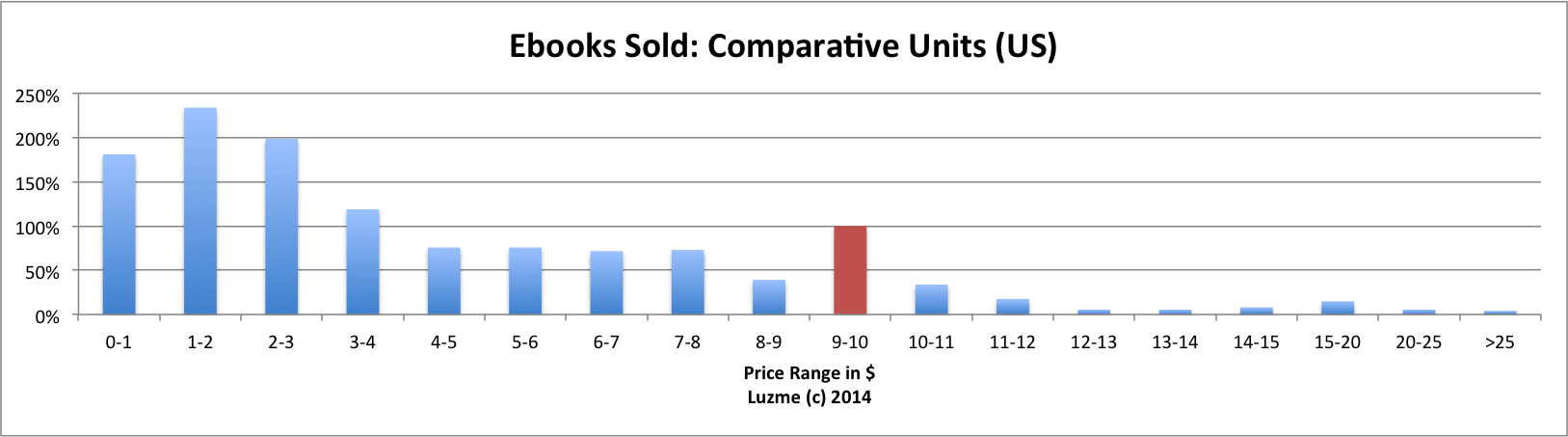
For the US data, I have normalised it against the “standard price” of $10.

Here is the way the various prices worked in terms of units sold. [Click on image to view an enlarged version in a new browser tab/window]

The most popular price points are at the low-end, with a local peak around the $10 mark, and then tailing off as the price increases.

This does not surprise me. But what I did not expect, is how much people will actually pay for an ebook (well over the $10 price! How much do you think the most expensive one went for? I will tell you later…)

Now look at the revenue over the same price points.

[Publetariat Editor’s note: this is where it really starts to get interesting – please click through on the link below to see more charts and an analysis of the comparative net earnings across various ebook price points]


Click here to read the full post on TechCrunch.


The Tipping Point (E-Commerce Version)

This post by Jeff Jordan originally appeared on his site on 1/15/14.

The news around shopping during the holiday season was dominated by two separate stories. One talked about how traffic to brick-and-mortar stores was well below expectations, and that these retailers were forced to discount tremendously to drive sales. The other talked about how an enormous late surge in packages coming from e-commerce companies overwhelmed the capacity of UPS and, to a lesser extent, FedEx, and caused many of these packages to arrive after Christmas.

But, to me, these two stories are not at all separate, they simply reflect different sides of the same narrative: We’re in the midst of a profound structural shift from physical to digital retail.

The drivers of this shift are simple:

• Online retail has strong cost advantages over its offline counterparts and is rapidly taking share in many retail categories through better pricing, selection and, increasingly, service.

• These offline players have high operational leverage and many cannot withstand declining top-line revenue growth for long.

• The resulting bankruptcies of physical retailers remove competition for online players, further boosting their share gains.

So, how has this shift been playing out? Recent data suggests that it’s happening faster than I could have imagined.

The U.S. Census Bureau publishes what I consider to be the most accurate figure on e-commerce penetration in the U.S. It reports that e-commerce penetration of total retail sales in the U.S. was around eight percent in 2012. But, as I’ve blogged previously, this aggregate figure seriously underestimates the impact of e-commerce in large sectors of the retail landscape. Let’s unpeel the onion and look at the next level of reporting from the Census Bureau, where it segments the retail landscape into six large categories of goods. It’s at this level that things start getting more interesting:


Click here to read the full post (which includes charts) on Jeff Jordan’s site.


Does Digital Publishing Mean The Death Of The Author?

This article by Richard Lea originally appeared on The Guardian UK’s Books Blog on 1/23/14.

We used to know what it took to be a writer – you had to publish a book. But electronic publishing is piling pressure on myths of the author’s life.

What’s the difference between making money out of books and writing books that people want to buy? Turns out it’s about 40% – if, that is, you believe this year’s Digital Book World (DBW) survey.

Only 20% of the 1,600 self-published authors surveyed, and just a quarter of the almost 800 writers with a traditional book deal, judged it “extremely important” to “make money writing books”. Shift the issue to publishing “a book that people will buy” and the figures leap to 56% and 60% respectively.

But of course, you say – this is literature we’re talking about. These authors have loftier concerns than the grubby business of making money. Art is their province. If they must consort with the commercial world to find an audience, then so be it. But heaven forfend they should be interested in something so base as raking in the cash.

Except, in the digital age this kind of logic just doesn’t wash. If all you’re interested in is finding an audience for your work, then electronic distribution allows you to find it without any connection to the marketplace at all. Write your masterpiece, stick it on your website, and sound the trumpets for the victory of Pallas Athene. Or, if what you’re really looking for is the grateful adulation of your adoring fans, stick it on Scribophile or WritersCafe and get ready to feel the love. These days the only reason for worrying about publishing “a book that people will buy” is to “make money writing books”.


Click here to read the full article on The Guardian UK’s Books Blog.


The Illusions of Traditional/Self Publishing & The Reality of Hybrid Publishing

This post by Bob Mayer originally appeared on Write It Forward on 1/23/14.

There’s a lot of heated rhetoric regarding publishing being bandied about on-line lately. Some of it was generated by the CEO of Kensington putting himself out there with some posts that had a large backlash, but overall, people seem to be digging in and drawing lines.

These lines are more blurred than most acknowledge if we examine them carefully.

It would seem to break down with traditional publishing “vs” self-publishing. I’d like to point out where this isn’t the reality and also how Cool Gus deals with these issues as a ‘hybrid’ publisher with a focus on being agile and working as a unified team.

“We treat our authors so well. You need us!” This is the message that Kensington’s CEO recently stated on-line. I also just read an interview from the CEO of Random House/Penguin saying essentially the same thing. This should be amended to: “We treat our top 5% of authors so well.” I don’t know if these CEOs are simply out of touch, being BSed or what, but the vast majority of authors are treated as interchangeable parts at trad houses and even most agencies. Because the top authors are pretty much the only authors these CEOs interact with, they make the illogical leap that all their authors are treated exactly the same way. I’ve seen many current and former Kensington authors come out on various on-line mediums describing a less than great publishing experience, yet not a single author defend the CEO’s statements. I was published by Random House and sold over one million books under the Dell imprint. During my years there I received almost no marketing support and was essentially dumped as the market coalesced. It wasn’t personal. It was business. Reminds me of Denzel Washington’s character in Man on Fire: “It’s just business.”

“We own Author Solutions.” It would appear that RHP’s CEO does not understand the pure hatred for this company among authors. You want to make money off authors? You think that equals KDP? This goes to a deep misunderstanding about authors, especially those with experience.

The Death of the Midlist.


Click here to read the full post on Write It Forward.


Print as the Future of Barnes & Noble

This post by Jane Litte originally appeared on her Dear Author site on 1/19/14.

Barnes & Noble is a venerable brand in US consumer circles. It touts itself as the world’s largest bookseller and is composed of three segments: the main retail segment, B&N College. and Nook Media.

In 2009, B&N launched the Nook, a product aimed at the upper middle class mother with two children. Overpriced and underfeatured, the Nook tablets have faltered despite the hundreds of millions of dollars poured into the Nook segment of the business.

After poor holiday sales in 2012, it was acknowledged that BN would need to move away [from] developing hardware devices and look toward licensing its product on existing platforms. After the disappointing 2013 holiday sales, BN’s CEO was fired and the Nook Media head moved into the position leaving Nook Media without an internal leader.

Everyone in the business of publishing is holding its collective breath about the health of BN. On the plus side, the largest portion publishing revenues come from the sale of educational books (textbooks and other educational products) but that market is headed for a disruption soon. On the negative side, overall consumer dollars spent on books is contracting. One think tank believes that it will continue to contract over the next five years as consumers shift dollars from higher paid books to self published and free books.


Click here to read the full post on Dear Author.


Astroturfing: The Source of Zombie Memes in Publishing?

This post by David Gaughran originally appeared on his Let’s Get Visible site on 1/8/14.

Why are there so many zombie memes in publishing? Why is there so much groupthink? It might be because the industry isn’t particularly diverse. Or it could be that book-lovers are nostalgic types who are automatically wary of change.

But I suspect it’s astroturfing by the publishing establishment, a practice admitted to last month by YS Chi, chairman of Elsevier and president of the International Publishers Association, in paragraph six of this article.

For the click-lazy, here’s the money quote (emphasis mine):

We gathered all the communications people together to discuss the issues and create an action plan. We have a multi-faceted audience to address, and in the next 12 months you will see key messages delivered, compelling stories of our impact on society for culture and education. We’ll ask you to personalize that message. I’m very excited that there is a meeting of minds on this.”

Yey, talking points! I don’t know if I’m more excited about the centrally approved messaging that’s going to flood the blogosphere, or the mental image of YS Chi doing a mind-meld with everyone in publishing.

But I digress. This post attempts to dispel multiple industry myths in one fell swoop. Perhaps then we can start having meaningful conversations, instead of batting around boardroom memos.


Self-publishing is a bubble

Remember Ewan Morrison’s prediction in The Guardian? “Epublishing is another tech bubble, and it will burst in the next 18 months.”


Click here to read the full post on Let’s Get Visible.


How to Curate Your Facebook News Feed

This post by Kurt Wagner originally appeared on Mashable on 1/19/14. The post explains recent changes to the Facebook news feed design, and what users can do to control the content shown there.

Baby photos. News articles. Selfies. Advertisements. Job announcements.

It’s likely your Facebook News Feed contains some combination of these, if not all of them (and likely other categories, too). That’s both the beauty and the curse of News Feed: It provides updates from all aspects of your life in one place, including those you may not care to see.

In March, Facebook announced a News feed redesign. Mark Zuckerberg told press, “What we are trying to give everyone is a copy of the best personalized newspaper in the world.” The redesign has since stumbled, but the goal of turning Facebook into a “personalized newspaper” remains strong. And Facebook could use your help.

Mashable sat down with Greg Marra, Facebook’s product manager for News Feed, to discuss how users can best curate the content that they see in News Feed. The easiest way to change what you see? Engage with content, says Marra.

“The basic interactions of News Feed are some of the most important signals that we get,” he explains. “Unfortunately, those interactions aren’t able to capture everything that we want to know, so we also give people additional controls to tell us things we can’t figure out just from normal usage of News Feed.”

Here’s what we learned.


If You Want to Stop Seeing Posts From a Facebook Friend…

If you’re cold-blooded, eliminating News Feed posts from an annoying friend or ex-flame is simple: Unfriend them. But many people don’t have the heart to completely eliminate someone from their Facebook life.


Click here to read the full article on Mashable.


How Social Media Influences Purchasing Decisions

There’s a terrific infographic over at Alltop / Holy Kaw! that breaks down some very interesting statistics about how social media can influence purchasing decisions. This kind of information can be very useful for authors and publishers who use social media for promotion. Here are just a few of the facts included in the infographic:

71% of consumers are more likely to make a purchase based on social media referrals.

38% of Facebook users purchase an item after sharing or Liking it on Facebook.

50% of purchases inspired by social media exposure take place within one week, 80% take place within three weeks.


Click here to view the infographic on Alltop / Holy Kaw!


Amazon Cracks Down on Bogus Keywords

This post by Mercy Pilkington originally appeared on Good E Reader on 11/27/13.

A growing number of self-published authors are receiving ominous emails from ebook distributor Amazon, warning them that their books are about to be removed from the website if action isn’t taken immediately. The warning–which some authors claim they did not actually receive before their titles were removed from sale–pertains to authors who’ve used titles of other books in the keyword searches for their titles.

Authors who have attempted to garner more searchability for their books have resorted to including titles like “Fifty Shades of Grey” or “Gone Girl” in the keywords for their books, hoping that potential readers stumble across their book listings. This practice is also in place by the traditional publishing industry, and apparently the ruling applies to those titles as well. Warnings to traditionally published authors have even been posted on message boards, encouraging them to contact their publishers as these authors do not upload their own titles or establish their keywords.


Click here to read the full article on Good E Reader.


Barnes & Noble's Nook Nightmare Stars Amazon and the DOJ

This article by Brad Stone originally appeared on Bloomberg Businessweek on 1/9/14. It’s a worthy read for authors or publishers releasing books for the Nook platform.

Let’s boil down Barnes & Noble’s (BKS) Nook nightmare into a handy juxtaposition concerning the price of the digital version of Donna Tartt’s gripping new novel, The Goldfinch.

Amazon’s (AMZN) Kindle price: $7.50.

Barnes & Noble’s Nook price: $14.99.

There are plenty of reasons for the stunning decline of the once-promising Nook. Barnes & Noble has found itself unable to compete with the likes of Apple (AAPL) and Amazon in the broader arena of multipurposed tablets. The New York-based retailer has also been undermined by the continuing migration of its customers from physical stores to online book-buying and by the desire of its risk-averse institutional shareholders to support deep, profit-draining, long-term investments in new frontiers.

Even that doesn’t completely account for the dramatic upending of its Nook business. Barnes & Noble today reported gruesome numbers—a 60 percent drop in its digital division, to $125 million, from its sales in last year’s holiday period. (Sales in its physical stores fell 6.6 percent from the previous year.)


Click here to read the full article on Bloomberg Businessweek.


Is Your Amazon 'Look Inside' Preview All In Italics?

This post by Kimberly Hitchens originally appeared on Booknook.biz on 1/18/14.

On a recent Saturday afternoon, I received a panicked email from a long-time editing acquaintance of mine. Her award-winning book needed some updates, so, being über-competent in making her own ebooks, she made the changes and uploaded the book. She checked back a few hours later, and it was one of those, “good news, bad news” moments. The good news? The LITB (Look Inside The Book) had updated, almost immediately. The bad news?

Holy Typography, Batman! Her entire Look Inside The Book was in italics.

What happened? She asked me if I could very quickly fix the book, because she had recently received a prestigious award, and sales were brisk. She had had such a shock about the “all italics” that she’d taken the book off sale.

Now, I would love to say that I’m a genius, but the truth was the same thing had recently happened to another client of mine, who had not updated her book, a mobi file that she got from us. So: what the heck had happened?

Both author-publishers had created their own nightmares, through sheer inadvertence. Both had read recent blog posts or “how-to” information on how to use HTML in their book descriptions in order to draw more attention to their books. They used header tags, bold, italic; all the things that any diligent publisher would do. But they had made one mistake.


Click here to read the full post on Booknook.biz.


How Writers Can Stay Productive Even During Sick Days

This post by Jennifer Mattern originally appeared on the All Indie Writers site on 1/13/14.

So far this year, I’ve had one normal work day. One. Just a day after returning to work from my holiday break, I needed a sick day. That turned into a “sick week.” And it’s now going on week two.

Surprisingly though, those sick days have still been productive days. I launched several new features here on this site. I published several blog posts on various sites I own. I installed and customized a new theme on my business site. And I completed plenty of other smaller projects in a fairly long to-do list.

The key? I stayed away from business emails, and I was officially off in terms of working with clients.

Why was this key? It meant my schedule in no way revolved around anyone else. If I wanted to work for ten minutes, I could. If I wanted to work on something for hours and I felt up to it, I did. And if I wanted to say “to Hell with it” and climb back in bed for the day, I could do that too. It also meant I wasn’t putting out client work when I was far from 100%. That wouldn’t have been good for anyone involved.

By all means, if you feel too sick to do anything, take off completely. Your health should be your top priority. But if you have even a little bit of energy, there are many things you can do to make sure you stay productive, or at least don’t fall too far behind, when you take sick time as a writer.

Here are some specific ideas for work you can do, even when you’re not feeling well.


Catch up on some reading.

Read blogs. Read books. Read magazines you plan to query. As a writer, you can never read too much. And this is something you can do even if you’re confined to bed while you recover.


Click here to read the full post on All Indie Writers.


The Self-Publishing Debate: A Social Scientist Separates Fact from Fiction

This post, by Dana Beth Weinberg, originally appeared on Digital Book World on 12/4/13.

Is self-publishing an amateurish endeavor, a means of sharing stories, a strategic move in a writing career, or an entrepreneurial activity? To gain insight into this question, I have been analyzing the responses from the nearly 5,000 authors who responded to the 2013 Digital Book World and Writer’s Digest Author Survey in relation to whether an author is aspiring (not yet published), self-published only, traditionally published only, or hybrid (both self-published and traditionally published). In Part 1, I compared the top priorities of these 4 types of authors, and in Part 2, I examined the differences in their stock of published [and] unpublished manuscripts. Now I turn my attention to the differences in their income from their writing.

Not surprisingly, most aspiring authors in the sample reported no annual income from their writing. About 19% of self-published authors in the sample also reported no annual income from their writing, compared to 6% of traditionally published authors and only 3% of hybrid authors. While most of the survey respondents clustered at the lower end of the income distribution, some authors did report earning $200,000 or more from their writing, the highest income choice on the survey: less than one percent (0.6%) of self-published authors, 4.5% of traditionally published authors, and 6.7% of hybrid authors who reported on their income. (In the chart, I have collapsed the top categories to $100,000 or more for better visibility. These aggregated category represents 1.8% of self-published authors, 8.8% of traditionally published authors, and 13.2% of hybrid authors.)


Click here to read the full post on Digital Book World.