100 Tips to Be a Smarter, Better Twitterer

This post originally appeared on the Computer Colleges site on 5/12/09.

1. Set up your profile: Give people a glimpse beyond what your tweets reveal.

2. Include a picture: Make sure you add a photo of yourself so that your tweets will be more personal.

3. Create a simple and short Twitter name: The longer your Twitter ID, the more space it takes up, and having a complicated name can make it hard for people to respond to or mention you.

4. Just do it: Don’t just lurk-jump into the conversation.

5. Make your profile link something that tells more about you: Share your blog, an about me page, or any other page that offers more information about the person behind the tweets.

6. Share photos: Post your photos on Twitter to shake things up a bit and add some interest to your stream.

7. Use proper grammar: Occasional abbreviations are passable, but make sure that your tweets are readable.

8. Use your real name: Build your personal brand by choosing your real name as your Twitter ID.

9. List your location: Many people use Twitter for local networking, so they’ll be more likely to follow you if they know where you are.

10. Learn the lingo: If you don’t know what DM, @, RT, and other Twitter symbols and words are, look them up or ask.


Click here to read the full post, which includes 90 more Twitter tips, on the Computer Colleges site.


10 Creative Ways to Challenge and Improve Your Writing

This post by David Eagle originally appeared as a guest post on Laurie Pawlik-Kienlen’s Quips and Tips For Successful Writers site on 7/6/13.

My writing skills improved dramatically when I freelanced for Reader’s Digest, because the editor would go over every sentence with me. She’d call me up and we’d analyze my articles – and I’d learn what Reader’s Digest readers were looking for, what editors want from writers, and even how to pitch future articles.

Most editors don’t have the time to do this – I was one lucky writer! Though it was painful at times, I have to admit.

Anyway — in this article, you’ll learn several ways to improve your writing skills. It’s written by David Eagle, on behalf of the GKBC Writing Academy.

Here’s the one very important thing I’d add to his tips: EDIT your writing. Don’t just write stuff and file it away. Find someone who writes better than you – better yet, find an editor – and get him or her to tear apart your writing.

10 Ways to Improve Your Writing

Guest Post ~ David Eagle

I work as a freelance writer, creating content for various clients. I also have a blog on my website that I’ve been writing since 2009, which allows me to experiment and develop as a writer in a more unstructured environment.

Like any skill, the more you practise at writing the better you become. I’m going to share with you ten tips that you can use to improve and challenge your writing. These are free, simple and fun things that you can start doing right away…

1. Pick a Word
Open a dictionary at random, take the first word you see and write about it. What feelings and emotions does it evoke in you? This is a great way of inspiring new and original ideas, and adding new words to your vocabulary.

2. Play a Wikipedia Game
Wikipedia has a “random article” feature in the left column of its homepage. Hit the link and let it decide your fate! Try writing about whatever subject it randomly selects. This is another a great way of stepping out of your comfort zone, writing about things you probably know very little about which also helps develop your research skills.

3. Look Around You
Observe and write about what’s going on around you. I get so many ideas just from conversations I’ve overheard in restaurants, on buses or on trains. If you are looking to write fiction then observing situations and characters around you is an excellent exercise. Just don’t get caught staring intensely at people as you write derogatory things about them in your notepad! I am not taking responsibility if you end up in hospital.


Click here to read the full post on Quips and Tips For Successful Writers.


Vellum: New Ebook Production Tool Launches

This article by Suw Charman-Anderson originally appeared on Forbes on 12/19/13.

If you’ve ever tried to produce a nice-looking ebook that works as well on your device as it appears to on your computer, you’ll know that it’s often a nightmare. Although there are several programs that will take your text and create an ebook from it, rarely are they easy to use. This is the problem that Vellum is trying to solve, for Mac users at least.

Vellum is a very good looking piece of software, with your chapter list on the left, text window in the centre and a preview pane on the right so that you can see what your book will look like when it’s an ebook. Whilst the preview pane only provides facsimiles of the iPad, iPhone, Kindle Paperwhite and Nook Simpletouch, it is nice to be able to see what your book will look like whilst you’re working on it.

This becomes particularly useful when you open the styles list and start experimenting with the built-in options. There are eight overall book styles, and then you can also choose from a small selection of options for your headings, first paragraphs, block quotes, ornamental breaks and the paragraph after a break. It is easy to quickly select a series of options that result in a very good looking ebook, which is rather the point of the software.

In terms of ebook output, I sent the sample files over to Baldur Bjarnason, the most knowledgable ebook wrangler I know, for his opinion.


Click here to read the full article on Forbes.


On Plot

This post by S. Andrew Swann originally appeared on Genrewonk.

What is a “Story?”
(SF or otherwise.)

A character with a problem.

Every story is about a character trying to deal with some sort of difficulty. Characters who have happy lives, who are content with their lot, and who have achieved their goals are not good fodder for fiction. The people we read about are people in trouble.

The central problem.

Most genre stories can be thought of as revolving around some central problem, or problems. The central problem(s) can be considered to be, in some sense, what the story is “about.” Will the mystery be solved? Will the protagonist survive? Will the rebellion succeed?

Begin with a crisis…

Whatever the length you’re dealing with, short story or novel, you want to begin with a character in crisis. The reader should find characters in difficulty within the first chapter, the first page, and ideally, the first paragraph. Structurally, it may not be possible to have the story’s main problem begin on the first page, but every story should begin with some problem, often with the first line.

…end with a resolution.

If the story is organized around a single central problem, it ends naturally when you’ve resolved that problem. If the story deals with a series or complex of problems, it ends when the last problem is dealt with, or when all the problems identified as most important are solved. A story can persist as long as there are problems to deal with.


What makes a Story SF?


Click here to view the full post, which includes a thorough analysis of not only plotting but also characterization and pacing, on Genrewonk.


Authors' Sleep Patterns and Productivity

This post originally appeared on ShortList.com on 1/28/14.

Early to bed and early to rise makes a man healthy, wealthy and a better author. Wait, that’s not right.

The influence of daily routines on creative output has always been a mild obsession of Maria Popova, a New York-based Bulgarian writer and blogger.

Such was her interest in successful writers’ sleep habits that she commissioned illustrator Wendy MacNaughton and information design team Accurat to create this rather superb infographic, charting authors’ sleeping patterns and their literary productivity.

Having researched each author’s wake-up time from journals, biographies and interviews, the chart illustrates their preferred hour of rising with a clock-like marker. The author’s productivity is indicated with a small count for each of their books, poems or works, adjacent to the time. Literary awards are indicated with a coloured smudge around the author’s portrait. The writers are ordered according to their hour of rising.

It makes for an interesting read, demolishing any notion that there’s a ‘perfect hour’ to rise. We’re all for adopting Charles Bukowski’s approach to mornings…
 

Click here to view the infographic, along with instructions for how to read it.


50 Tools That Can Improve Your Writing Skills

This post originally appeared on dumblittleman in May of 2007. a

Last year we posted a large list of tips aimed at improving your writing skills. Since then, the site that we referenced changed all of the links and our post was rendered useless.

That is until today. Rory Sullivan a reader of DLM, displayed some remarkable generosity (that he calls nerdishness). He took the time to update all 50 of the links and he asked that Dumb Little Man republish this great list. The decision was pretty simple for me because I actually use these sites as reference for my own writing.

So with that, here is the original list with the updated URLs. Before you start firing off emails to your customers or you embark on that eBook writing project, do yourself a favor and review.


Click here to view the full, linked list of 50 writing tip articles on dumblittleman.


How to Write 2000 Words a Day

This post originally appeared on the WriteAnon blog on 3/14/11.

The last few weeks, I’ve been trying to write 2000 words or more each day. I’ve found there are a few things that have helped me be successful.


1. Don’t sit down to write 2000 words at once.

I’ve found a lot more success when I focus on writing a scene or much smaller goal, like 100 words. I can write 100 words in 3-5 minutes. At that pace, it will take 1-2 hours to write 2000 words. However, blocking aside 1-2 hours seems hard, while blocking a few 30-minute chunks makes it a lot easier. With 30 minutes at lunch, 30 minutes before dinner, and 30 minutes before bed, there are one-and-a-half hours right there. I can usually find the extra time somewhere else (generally a little longer at night).


2. Focus on scenes, not word counts

Each of my scenes tends to run from 1000-3000 words. By focusing on completing a scene, I take the pressure off just filling out my word counts, and can focus on completing scenes. The word counts tend to flow after that.

That being said, if I’m stuck, I’ll fall back to just trying to write 100 words. Small goals are easy to achieve.


Click here to read the full post, which includes four more specific strategies, on WriteAnon.


Written Off: Jennifer Weiner's Quest For Literary Respect

This profile by Rebecca Mead originally appeared on The New Yorker on 1/13/14.

Early one morning in November, five hundred clinicians gathered at the Philadelphia Airport Marriott for the twenty-third annual Renfrew Center Foundation conference, devoted to the understanding and treatment of eating disorders. The keynote speaker, Jennifer Weiner, the best-selling novelist, was there to offer a personal perspective on weight issues, with a talk entitled “The F Word: On Growing Up Big, Speaking Out Loud and Raising Betty Friedan Girls in a Britney Spears World.”

The Renfrew foundation’s Web site described Weiner’s 2001 début, “Good in Bed,” now in its fifty-seventh printing, as “the first ‘chick-lit’ novel featuring a large protagonist.” The character, Cannie Shapiro, established the template for a number of Weiner’s subsequent heroines: clever, quippy young women whose dress size tends to be well into the double digits. Her characters navigate the perils presented by lacklustre boyfriends or disappointing husbands, slender mean girls, dysfunctional families, and self-esteem issues. “Nobody’s going to date me looking like this,” Cannie tells the tall, handsome, kindly doctor who interviews her for a weight-loss study. “I’m going to die alone, and my dog’s going to eat my face, and no one will find us until the smell seeps out under the door.” Despite their travails, Weiner’s heroines arrive at happy endings that defy cultural prejudices while upholding the implausible conventions of a Hollywood romantic comedy. (Cannie’s tall, handsome, kindly doctor falls madly in love with her.) Weiner’s second novel, “In Her Shoes,” was actually made into a romantic comedy, in 2005; it starred Toni Collette, as the brainy, full-figured heroine, and Cameron Diaz—featured prominently on movie posters—as her skinny, feckless sister.

Weiner, who is forty-three, was outfitted as if for a cocktail party, in a scarlet sleeveless dress and nude stilettos. Her makeup had been applied, before dawn, by a professional; her long, dark-brown hair was loose and shiny. She looked pretty and polished but approachable, like a co-host on “The View.” Weiner, who has a degree in English literature from Princeton, is cognizant of the expectations that attend a writer of commercial women’s fiction. “Handbags are important signifiers,” she told me. (Lately, she has leaned heavily on an orange Givenchy tote.) Her outfit projected confidence, but it also gave her an opportunity to reveal a winning vulnerability. After ascending the podium, she began, “Good morning, Renfrew Center clinicians and therapists. Or, as I have been affectionately referring to you in my head, the people I don’t need to wear Spanx for.”


Click here to read the full profile on The New Yorker.
 

Start Writing Your Novel Now

This post by Lovelyn Bettison originally appeared on her blog on 12/6/13.

It’s come to my attention that a lot of people want to write a novel. It seems like most people think they’ve got a book in them, but for some reason they just haven’t gotten around to writing it.

There are a lot of excuses for not sitting down and actually getting to that novel you’ve always dreamed of writing, but this post isn’t about excuses. I don’t want to hear any of those. Many writers have gotten up a few hours earlier than usual to write in the morning before heading out for work. Many have burned the midnight oil after work to write the book they always dreamed of writing.

Walter Mosely wrote his novel, Devil in a Blue Dress, whilst working full time. I heard an interview with Toni Morrison in which she described handwriting The Bluest Eyes on a legal pad with her baby in her arms. If you really want to write a book you will find a way to make it happen. If it is important to you you’ll make time for it.

Here are some tips to get you started.

Make a commitment to write everyday. Writers write. You can’t call yourself a writer if you don’t. Give yourself an allotted amount of time, whatever you feel like you can set aside: an hour, thirty minutes. Whatever you feel like you can do is fine. Sit in front of your computer, with the internet off preferably, and write something. Write anything at first. This is just to get you used to writing.

Even if you only come up with a couple of sentences that’s fine.


Click here to read the full post on Lovelyn Bettison’s blog.


Ten Things You May Not Know About Ebook Prices

This post by Rachel Willmer originally appeared on TechCrunch on 1/15/14.

How much should you pay for an ebook? $9.99? $0.99? $0? And how much should you price your ebooks? I’m going to tell you what people have actually paid for their ebooks, based on some hard data from Luzme. You can set the price of your book to be anything you want; what really matters is what someone will pay for it!

Last year, Luzme captured a large amount of ebook price data and reader pricing preferences. I am analysing this data and will share any interesting results.

I do not claim that this is representative of the whole ebook industry, but I hope that some real data might contribute something useful to the debate.

So here is my analysis of the actual prices that people have paid at Amazon in 2013, when they bought via Luzme.

USA
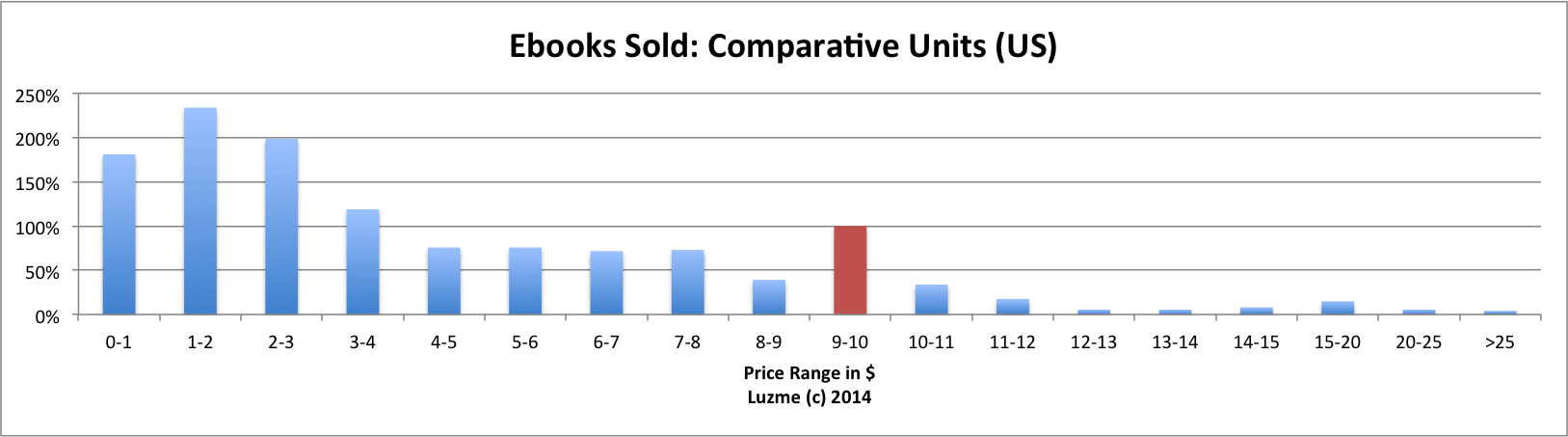
For the US data, I have normalised it against the “standard price” of $10.

Here is the way the various prices worked in terms of units sold. [Click on image to view an enlarged version in a new browser tab/window]

The most popular price points are at the low-end, with a local peak around the $10 mark, and then tailing off as the price increases.

This does not surprise me. But what I did not expect, is how much people will actually pay for an ebook (well over the $10 price! How much do you think the most expensive one went for? I will tell you later…)

Now look at the revenue over the same price points.

[Publetariat Editor’s note: this is where it really starts to get interesting – please click through on the link below to see more charts and an analysis of the comparative net earnings across various ebook price points]


Click here to read the full post on TechCrunch.


The Tipping Point (E-Commerce Version)

This post by Jeff Jordan originally appeared on his site on 1/15/14.

The news around shopping during the holiday season was dominated by two separate stories. One talked about how traffic to brick-and-mortar stores was well below expectations, and that these retailers were forced to discount tremendously to drive sales. The other talked about how an enormous late surge in packages coming from e-commerce companies overwhelmed the capacity of UPS and, to a lesser extent, FedEx, and caused many of these packages to arrive after Christmas.

But, to me, these two stories are not at all separate, they simply reflect different sides of the same narrative: We’re in the midst of a profound structural shift from physical to digital retail.

The drivers of this shift are simple:

• Online retail has strong cost advantages over its offline counterparts and is rapidly taking share in many retail categories through better pricing, selection and, increasingly, service.

• These offline players have high operational leverage and many cannot withstand declining top-line revenue growth for long.

• The resulting bankruptcies of physical retailers remove competition for online players, further boosting their share gains.

So, how has this shift been playing out? Recent data suggests that it’s happening faster than I could have imagined.

The U.S. Census Bureau publishes what I consider to be the most accurate figure on e-commerce penetration in the U.S. It reports that e-commerce penetration of total retail sales in the U.S. was around eight percent in 2012. But, as I’ve blogged previously, this aggregate figure seriously underestimates the impact of e-commerce in large sectors of the retail landscape. Let’s unpeel the onion and look at the next level of reporting from the Census Bureau, where it segments the retail landscape into six large categories of goods. It’s at this level that things start getting more interesting:


Click here to read the full post (which includes charts) on Jeff Jordan’s site.


Does Digital Publishing Mean The Death Of The Author?

This article by Richard Lea originally appeared on The Guardian UK’s Books Blog on 1/23/14.

We used to know what it took to be a writer – you had to publish a book. But electronic publishing is piling pressure on myths of the author’s life.

What’s the difference between making money out of books and writing books that people want to buy? Turns out it’s about 40% – if, that is, you believe this year’s Digital Book World (DBW) survey.

Only 20% of the 1,600 self-published authors surveyed, and just a quarter of the almost 800 writers with a traditional book deal, judged it “extremely important” to “make money writing books”. Shift the issue to publishing “a book that people will buy” and the figures leap to 56% and 60% respectively.

But of course, you say – this is literature we’re talking about. These authors have loftier concerns than the grubby business of making money. Art is their province. If they must consort with the commercial world to find an audience, then so be it. But heaven forfend they should be interested in something so base as raking in the cash.

Except, in the digital age this kind of logic just doesn’t wash. If all you’re interested in is finding an audience for your work, then electronic distribution allows you to find it without any connection to the marketplace at all. Write your masterpiece, stick it on your website, and sound the trumpets for the victory of Pallas Athene. Or, if what you’re really looking for is the grateful adulation of your adoring fans, stick it on Scribophile or WritersCafe and get ready to feel the love. These days the only reason for worrying about publishing “a book that people will buy” is to “make money writing books”.


Click here to read the full article on The Guardian UK’s Books Blog.


The Illusions of Traditional/Self Publishing & The Reality of Hybrid Publishing

This post by Bob Mayer originally appeared on Write It Forward on 1/23/14.

There’s a lot of heated rhetoric regarding publishing being bandied about on-line lately. Some of it was generated by the CEO of Kensington putting himself out there with some posts that had a large backlash, but overall, people seem to be digging in and drawing lines.

These lines are more blurred than most acknowledge if we examine them carefully.

It would seem to break down with traditional publishing “vs” self-publishing. I’d like to point out where this isn’t the reality and also how Cool Gus deals with these issues as a ‘hybrid’ publisher with a focus on being agile and working as a unified team.

“We treat our authors so well. You need us!” This is the message that Kensington’s CEO recently stated on-line. I also just read an interview from the CEO of Random House/Penguin saying essentially the same thing. This should be amended to: “We treat our top 5% of authors so well.” I don’t know if these CEOs are simply out of touch, being BSed or what, but the vast majority of authors are treated as interchangeable parts at trad houses and even most agencies. Because the top authors are pretty much the only authors these CEOs interact with, they make the illogical leap that all their authors are treated exactly the same way. I’ve seen many current and former Kensington authors come out on various on-line mediums describing a less than great publishing experience, yet not a single author defend the CEO’s statements. I was published by Random House and sold over one million books under the Dell imprint. During my years there I received almost no marketing support and was essentially dumped as the market coalesced. It wasn’t personal. It was business. Reminds me of Denzel Washington’s character in Man on Fire: “It’s just business.”

“We own Author Solutions.” It would appear that RHP’s CEO does not understand the pure hatred for this company among authors. You want to make money off authors? You think that equals KDP? This goes to a deep misunderstanding about authors, especially those with experience.

The Death of the Midlist.


Click here to read the full post on Write It Forward.


Be Afraid

This post by Andrew E. Kaufman originally appeared on The Crime Fiction Collective blog on 1/22/14.

Being a writer is like climbing the tallest peak in the world. We barely get to enjoy the victory, when someone straps us down, tears our shirts open, and tells the vultures to bring it on. Let’s face it: to be an artist is to be vulnerable. And perhaps a little unstable. We pour our souls onto the pages. We sweat. We cry. We scream a lot. We drink ridiculous quantities of coffee, but never enough to combat our emotional and physical exhaustion.

Not to mention, the brutal criticism, and really, there is no way to combat that. We read it, we cringe, and we may (possibly) throw some things (at least, I hear). After that, we pick ourselves up and dust ourselves off, taking what we can use, and throwing away the rest…that is, between the hysterical sobs, and guttural groans (also, of course, not a first hand experience). Other sides of our artistry are a bit less brutal and far more enjoyable. If we do it right, we get to create worlds and characters from nothing other than our hungry imaginations, then watch them flourish into amazing stories. Also if we do it right, we relish in the knowledge that our readers are enjoying them, and more importantly, feeling them. Of course, getting to that point is easier said than done.

In reaching that goal, my approach can be at times… a bit unconventional. Possibly insane. For me, writing a novel means feeling my way through the darkness and through my pages, essentially with no idea what the outcome will be. I don’t plan before I launch into my work. I write on instinct. As I do this, one persistent and nagging question pokes at me: Will this work?


Click here to read the full post on The Crime Fiction Collective blog.