My 4 Golden Rules of Writing

This post by Nicholas C. Rossis originally appeared on his site on 8/26/14.

I’ve been wanting to write this post for a while now. The main reason is that I keep coming across several writing rules that make little sense to me. Then, I came across a gem of a post by Constance Hale, “When Shakespeare Committed Word Crimes” on TED.

Constance confirmed what I long suspected: when there is tension in a language between what comes naturally and the rules, it’s because someone has tried to shoehorn the language into their idea of conformity.

Does this mean there are no rules? Not at all. It just means that the ones we are taught in workshops and classrooms are not necessarily the ones that matter to actual readers – as opposed to teachers, agents and editors. So, here are my golden rules; the ones no fiction writer should ever break, in my view:


Rule #1: Don’t let your writing get in the way of your story.
I know I say this all the time, but it bears repeating. Fragment your sentences. Break the rules. Hemingway is considered the “master of the short sentence,” but when his stories reach a climax, he will suddenly write long sentences—as long as three or four hundred words even. So, throw caution to your wind. Have fun with the language.


Read the full post on Nicholas C. Rossis’ site.


The Path to Success

This post by J.A. Konrath originally appeared on his A Newbie’s Guide to Publishing on 4/12/15.

On the surface, the path to becoming a successful writer has three key components.

1. Write a great book.

2. Do whatever you can to make that book a success.

3. Repeat steps 1 and 2.

Like all paths, just because the path exists doesn’t mean you’ll be able to follow it. There are known routes up Mount Everest, but there are no guarantees you’d make the summit no matter how good you are or how hard you try. Even the best mountain climbers must deal with the unpredictability of weather, among many other bad things that can happen.

Luck is always a factor.

Even if you’re an Olympic gold medalist with natural talent and years of training, you were lucky no one was better than you at that time. Because all records get broken. Someone always winds up being better.

Hell, you were lucky a bunch of Greeks thought it was a fun idea to compete in sports thousands of years ago. Without them, you’d be doing something else.

Keeping the luck factor in mind, let’s review those three points.


Read the full post on A Newbie’s Guide to Publishing.


May 2015 Author Earnings Report

This post originally appeared on Author Earnings in 5/15.

Welcome to the May 2015 Author Earnings Report. This is our sixth quarterly look at Amazon’s ebook sales, with data taken on over 200,000 bestselling ebooks. With each report over the past year and a half, we have come to see great consistency in our results, but there is always something new that surprises us. Often, it’s something we weren’t expecting, like the massive shadow industry of ISBN-less ebooks being sold, or the effect Kindle Unlimited has on title visibility. This time, we went into our report curious about one thing in particular. But we were still not prepared for what we found.

If you’ve been shopping for ebooks on Amazon lately, you may have seen this new addition to many ebook product pages:

Nelson Book

This announcement can be found on ebooks from several of the largest publishers, and it appears to serve as both an apology from Amazon and also a shifting of the blame for high ebook prices. Amazon has stated in the past that they believe ebooks should not cost more than $9.99. Self-published authors are no doubt familiar with this price constraint, as their royalties are cut in half if they price higher than this amount. But after a contentious and drawn-out negotiation with Hachette Book Group last year, Amazon relinquished the ability to discount ebooks with several publishers. Prices with these publishers are now set firmly by them.


Read the full report on Author Earnings.


Facebook Ads: Should Indie Authors Buy Them?

This post by Frances Caballo originally appeared on his The Book Designer on 5/14/14.

If you have a Facebook page, have you noticed that fewer of your posts are reaching your fans’ news feeds?

You’re not alone. As Facebook moves further in the direction of monetization, and as it adjusts its algorithm, fewer of our Facebook page posts are reaching our fans.

Facebook’s reasons for the recent improvements make sense to some extent. A brand page (also called a company page or an author page) you liked when you were 37 may not be a page you have any interest in when you’re 42. Similarly, a friend you were close with four years ago could have moved away and may no longer be in your tight social sphere.

Facebook whittles your news feed to reflect your changing preferences based on your actions in the form of Likes, Shares and Comments.

According to a February 2014 Pew Research Center report, half of all adult Facebook users have more than 200 friends in their network. Users who are 29 and younger have even more.

In addition, last year AllFacebook reported that the average user had liked 40 pages but that figure is higher for residents of the United States, where the average user likes an estimated 70 pages.

In light of these numbers, Facebook assumes that the average user doesn’t have sufficient time to review every post from every friend and author page they’ve liked in the past several years. So the network steps in and determines which friends you’d prefer to hear from, based on your most frequent interactions, and decides which of your own posts from your Facebook page will appear in your fans’ news feeds.

In other words, if all of your fans don’t engage with your page on a regular basis, fewer and fewer over time will see any of your carefully written Facebook posts.


Research Proves that Organic Reach on Facebook Is Plummeting


Read the full post on The Book Designer.


Author Branding: How to Get Started

This post by Janine Savage originally appeared on Write Divas on 5/4/15.

We’ve all heard the advice to create your brand as an author, but what exactly is author branding? Being an author is so much more than just the books your write. It’s about your image in the real world and online in the cyber world. The Internet has made it possible for people to connect with people around the world and to create an online persona, all from the comfort of our homes. As an author, it’s a good idea to consider what your image or “brand” as an author is. But first you’ll need a few things to get your author branding started.


It’s All in the Name

Have you decided on a pen name or do you want to publish under your real name? The arguments for and against for each path are valid. What it boils down to is which path is right for you.

Pen Names: You keep your private life somewhat private. If your real name is hard to pronounce or unusually long, a pen name might be right for you. If you write for more than one genre, say steampunk, Viking romance and horror, the use of pen names makes it easier for your fans who read your steampunk books to follow you and not get mixed up with your books in the horror and romance genres. Some notable examples of authors who use pen names for different genres are Eleanor Robertson, who writes as Nora Roberts (romance) and J.D. Robb (romantic suspense), and Joanne Rowling, who writes as J.K. Rowling (fantasy) and Robert Galbraith (crime fiction).

Real Name:


Read the full post on Write Divas.


One Rule To… Er… Rule Them All

This post by Greta van der Rol originally appeared on Spacefreighters Lounge on 4/16/15.

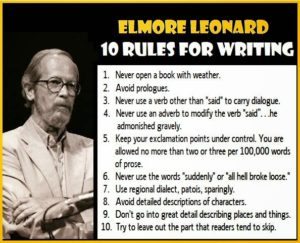
On Facebook I belong to a number of different writers’ groups. Recently, this meme was posted on one of them.

Elmore Leonard on writing

There is nothing more likely to have me doing expletives deleted than seeing a list of “thou shalts” telling prospective authors that this is how they have to do it. Especially with a famous name tagged on to the end. Don’t get me wrong, GENERALLY speaking, I would agree that each of these points deserves consideration. But the only one that is really, absolutely, no-holds-barred, TRUE is number…

See if you can work it out.

I particularly object to the word NEVER in these ‘rules’. Never is black and white. Let’s look at the ‘nevers’ in this list.


Read the full post on Spacefreighters Lounge.


Are You an Overworked Freelancer? 10 Key Moves to Avoid Burnout

This post by Carol Tice originally appeared on Make A Living Writing.

Many writers tell me they wish they could find even one client. But today, I want to talk about the other side of the coin.

Once you get rolling in freelance writing and word starts getting around about your talents, you can quickly find yourself overbooked, overworked, and exhausted.

I recently had a chat with freelance writer Alyssa Ast about this on my Facebook chat — she was getting overloaded, and her personal passion writing projects were sitting idle. She’s got a passel of young kids to care for, too.

And she was nearing her breaking point.


A tale of overwork

Here’s Alyssa’s story:

“Basically, things have taken off, which has left me working 16 hour days — and I don’t know how much longer I can keep it up.

“I’ve cut all of the small fish and narrowed it down to three well-paying clients– two full-time contracts and a part-time one. I don’t want to put all of my eggs in one basket [and cut down to one client], as the main breadwinner. We NEED my income.

“I refuse to outsource, because I don’t trust anyone to produce the quality I expect or my clients expect. I thought cutting out the small clients would help more than it has. I’ve scheduled everything out to a T, but as soon as I start to get my head above water, I get slammed again.

“How can I keep my sanity without losing my income? I am open to just about anything at this point.”

This is a good problem to have — you’re in demand! But we all need a personal life, too, and some downtime.

How can you turn this around and stop being an overworked freelancer? Here are my tips:


Read the full post, which includes specific tips for coping with burnout, on Make A Living Writing.


Should you be a full-time writer?

This post by Mary Robinette Kowal originally appeared on SFWA on 3/5/15.

A lot of writers have a goal of being a full time writer. I think there’s this image of your life continuing exactly as it is, except that now your job is writing. Sure, you know you won’t go into an office, but it will be so nice to have no demands on your time, except writing.

Yeah… so, about that.


Writers are freelancers.

As someone who has spent most of her adult life as a freelancer, let me speak to those of you who have conventional day jobs. How comfortable are you with not knowing where your next paycheck is coming from, or even how big it will be?

Being a freelancer means that you have to constantly be hustling to get work. You get big checks when you turn in projects and nothing in between. Royalties? Twice a year and unpredictable in size.

When you are not writing, you are unemployed.

If this idea makes you uncomfortable, think very carefully before quitting your day job.


Your quality of life will change

You no longer need to leave the house. You won’t see people unless you make the effort to do so. Ah…. solitude. At first, yes. It’s glorious. But if you are even a minimally social creature… it can get really isolating really fast.

If you are a midlist writer (likely), you will have less money for indulgences. You might have to move to somewhere less expensive. Or travel less. Or you might have to travel more to promote the book. The only thing that is certain is that your life will not look the same as it does with the regularity of a dayjob.


There is no guarantee you will sell the next book.


Read the full post on SFWA.


Which Authors Do Subscription Services Benefit?

This post by Dana Beth Weinberg originally appeared on Digital Book World (DBW) on 4/28/15.

Expert publishing blog opinions are solely those of the blogger and not necessarily endorsed by DBW.

Subscriptions services may yet turn out to be a next game-changer in publishing, but for the moment that market is in a state of flux and expansion.

Oyster recently added an ebookstore loaded with Big Five titles, a move that could in turn bolster the subscription model, potentially attracting new readers and making the brand more competitive with Amazon. Scribd is steadily bulking up on audiobooks. Two major publishers added ebooks to new the multimedia subscription platform Playster in recent weeks. Meanwhile, Amazon continues to grow Kindle Unlimited yet continues to pay participating indie authors at rates similar to those that spurred grumblings late last year.

What do these services mean for authors? Since, on the one hand, ebook subscription providers typically pay authors less than an individual book sale, they could ultimately undercut authors’ earnings in a market where so few are “making it.” But on the other, subscription services may encourage readers to take risks on new authors, aiding certain authors’ discoverability over the longer term.


Read the full post on DBW.


How Writers Can Grow by Pretending to Be Other People

This post by Joe Fassler originally appeared on The Atlantic on 4/22/15.

The author and editor Kate Bolick found that “imaginary time-traveling”—projecting herself into the life of someone else—helped her feel closer to women she admired.

By Heart is a series in which authors share and discuss their all-time favorite passages in literature. See entries from Jonathan Franzen, Amy Tan, Khaled Hosseini, and more.

In 2011, Kate Bolick’s much-discussed Atlantic cover story “All the Single Ladies” made a case for the unattached life, decrying the lack of affirming cultural narratives for single women. In a new book, Spinster: Making a Life of One’s Own, Bolick combines memoir, literary biography, and cultural history to continue her examination of what it means to remain alone. Spinster studies the lives of five groundbreaking, independent women—Neith Boyce, Maeve Brennan, Charlotte Perkins Gilman, Edna St. Vincent Millay, and Edith Wharton. As Bolick considers how these historical figures triumphed, faltered, and made tradeoffs, she explores the pleasures and consequences of long-term solitude, as well as her own competing desires for freedom and attachment.

When I spoke to Bolick for this series, she chose to discuss an overlooked short story by Gilman, one of the five “awakeners” depicted in the book. “If I Were A Man,” falls somewhere between Freaky Friday and Franz Kafka’s “Metamorphosis”: the story’s female narrator, Mollie, wakes up one day to find herself inhabiting her husband’s body. We discussed different forms of projecting oneself into another person’s experience, and what’s revealed in our personal fantasies about freedom, relationships, and the future.


Read the full post on The Atlantic.


Dip Happens—What Do We DO When Nothing Seems To Change?

This post by Kristen Lamb originally appeared on her blog on her blog on 4/27/15.

Often I blog about things I am going through. Sometimes just writing things down, sketching out a plan of action, recalibrating MY perspective helps a lot. Hey, if nothing else, I have a blog post 😀 .

Lately, I’ve been in what Seth Godin calls…The DIP. In fact, I am even talking about The Dip over on my Dojo Diva blog for those who want more (and also a better chance of winning my 20 Page Death Star Critique).

*dangles carrot*

What is THE DIP? The Dip is that span of suck before the breakthrough. The Dip is where character develops, where dreams grow, where WE grow. Bad news is this is also the place where most people give up.

I’d love to say I’ve never given up when faced with a particularly tenacious Dip, but I am a terrible liar. Dips are tough. Why are Dips so hard?

Dips Come Out of Nowhere

We are zooming along and then it is as if an invisible force field comes out of nowhere. Maybe you started eating healthy and were losing weight steadily. Then…nothing. Another week? Nothing. Another week, I gained three pounds? WTH? And another and another and pretty soon, why bother?


Read the full post on Kristen Lamb’s blog.


12 Writing Tips I’ve Learned After 20 Books and 3,000 Articles Over 20 Years

This post by Andrew Griffiths originally appeared on Inc.

As much as we might think the written word is slowly being phased out in favor of video, right now we are writing more than ever before, both in general communication and in sharing information through content. But very few people are actually taught to write the type of copy that we have to produce these days.

I write a lot. I write books, blog posts, magazine articles, newspaper columns, and much more. I’ve learned a lot, to the point where now I teach people to write and publish everything from books to blogs.

The following 12 tips have really helped me over the last 20 years, and they might prove helpful to you.


1. Always visualize a person who is your ideal niche whenever you write

For example, when I am writing an article for a small-business audience, I put a picture of three small-business owners whom I know on my computer and I write as if I were sitting and talking to them (in fact, as if I were sitting and having a cup of coffee with them).


2. To keep continuity with your writing voice, at the beginning of each session, go back and read what you wrote last time

This is a great tip to ensure that your writing style and voice stay constant. Great writers and popular columnists have a consistent voice and your writing will develop the same style if you follow this tip.


3. Don’t waste a whole session on a piece that isn’t working


Read the full post on Inc.


Why Can’t We Read Anymore?

This post by Hugh McGuire originally appeared on Medium on 4/22/15.

Or, can books save us from what digital does to our brains?

Last year, I read four books.

The reasons for that low number are, I guess, the same as your reasons for reading fewer books than you think you should have read last year: I’ve been finding it harder and harder to concentrate on words, sentences, paragraphs. Let alone chapters. Chapters often have page after page of paragraphs. It just seems such an awful lot of words to concentrate on, on their own, without something else happening. And once you’ve finished one chapter, you have to get through the another one. And usually a whole bunch more, before you can say finished, and get to the next. The next book. The next thing. The next possibility. Next next next.

I am an optimist

Still, I am an optimist. Most nights last year, I got into bed with a book — paper or e — and started. Reading. Read. Ing. One word after the next. A sentence. Two sentences.

Maybe three.

And then … I needed just a little something else. Something to tide me over. Something to scratch that little itch at the back of my mind— just a quick look at email on my iPhone; to write, and erase, a response to a funny Tweet from William Gibson; to find, and follow, a link to a good, really good, article in the New Yorker, or, better, the New York Review of Books (which I might even read most of, if it is that good). Email again, just to be sure.

I’d read another sentence. That’s four sentences.

Smokers who are the most optimistic about their ability to resist temptation are the most likely to relapse four months later, and overoptimistic dieters are the least likely to lose weight. (Kelly McGonigal: The Willpower Instinct)

It takes a long time to read a book at four sentences per day.

And it’s exhausting. I was usually asleep halfway through sentence number five.


Read the full post on Medium.


8 Common Facebook Mistakes To Avoid

This post by Donné Torr originally appeared on the Hootsuite blog. It’s targeted to social media managers, so if you’re an author acting as your own “social media manager” this will be valuable information.

Among the many tasks social media managers face, one is learning how to navigate the ever-changing world of Facebook. Previously on our blog, we discussed the most common social media strategy mistakes. Today, we want to focus on specific Facebook mistakes social media managers need to avoid.

To put it plainly, there is much anxiety surrounding the do’s and don’ts of social media, especially when it comes to what social media managers should do. In light of the recent changes to Facebook’s algorithm, the following are 8 common mistakes that can be avoided on Facebook.


8 Facebook mistakes social media managers should avoid

Overly promotional posts

According to the recent changes with Facebook, they will be reducing the number of overly promotional page posts in users’ News Feeds. This is as a result of an ongoing survey with Facebook users, in which the most common feedback was that people wanted to see more stories from friends and Pages they care about, and less promotional content. An overly promotional post is one that solely pushes people to buy a product or install an app, enter promotions and sweepstakes with no real context, or reuse the same content from ads. The best way to avoid creating overly promotional posts is to leave product promotion to Facebook Advertising.

Example of this type of post:


Read the full post on the Hootsuite blog.