Z Winters: YA Dystopians

For a long time I’ve thought about trying my hand at writing YA dystopian novels. It’s a genre I really enjoy and I have a ton of creepy ideas for them. I hadn’t pursued it because I felt like I’d need to create ANOTHER identity. And really, there are only so many separate brands I can maintain. It gets difficult, especially when you are building brands and not having crossover/cross-pollination. But for some reason there seem to be a lot of paranormal romance readers who also read YA dystopian. I have no idea why this is. And I fit into that camp as well. I enjoy reading both genres.


So I thought I didn’t really want to create a whole other identity somewhere, just a slight branding distinction. Like if I’m going to write both genres, I don’t want someone to pick up a PNR from me expecting YA dystopian or vice versa. But since there is a lot of crossover potential, as long as it’s easy to tell which is which at a glance, there should be no problem with keeping it all in the family so to speak.

I set up a Facebook fan page for Z Winters. Yes, that’s my sad little fan page with nothing on it.

On Twitter, I am Z_Winters (Don’t forget the underscore.)

And I also purchased Zwinters.com and Zwinters.net

So I’m ready to roll with that when I get ready to. Please note, I am NOT changing my name. I am simply adding a new brand identity. Zoe Winters will still be there and she will continue to write paranormal romance. (No, that didn’t sound schizophrenic at all!) Z Winters will write YA dystopians. I will be cross-promoting the names also.

Those who are waiting for more Pretverse, don’t worry. I am not writing my dystopian until I get Dark Mercy (the novella/novelette coming in November), The Catalyst (tentative title for book 3) and LifeCycle (book 4), out the door to you. I just have this awesome idea that’s been percolating and really want to write it. And even though there are some dystopian type themes in Pretverse which will be expanded upon, this particular idea won’t work in that world and doesn’t fit a paranormal structure.

I’m not sure how many dystopians I’m going to write. I’ll probably publish them less frequently unless I just get on a tear with ideas. But by keeping the pen names so closely linked together, I feel like it will be less stressful/overwhelming trying to build a totally separate brand with a totally new readership because I anticipate a lot of the Zoe Winters readers will also read Z and vice versa.

And that’s all I have to say about that. :)


This is a reprint from Zoe Wintersweblog.

Amazon Author Page

This post, by Publetariat founder and Editor in Chief April L. Hamilton, originally appeared as a guest post on the BookBuzzr Blog on 10/21/11.

Amazon has been instrumental in the rise of the indie author. Amazon provides do it yourself publishing platforms both for ebooks (Kindle Digital Publishing platform) and print (Createspace), as well as its own imprint for a print and ebook publishing model. But that’s just the beginning. Amazon takes things a step further by treating indie authors the same as mainstream-published authors when it comes to marketing and promotional opportunities on the site. One example of this is Amazon Author Central, through which anyone who has authored content offered for sale on Amazon can have his or her own, dedicated Amazon Author page.


An Amazon Author page can be a surprisingly robust plank in your author platform, especially considering that they’re offered totally free of charge. Your Amazon Author page can include all of the following:

• Author Photo
• Author Brief Biography
• Author Bibliography (of books/content for sale on Amazon)
• Author Blog Posts
• Dedicated Discussion Board
• Integration With Facebook, Twitter, and Email

Here’s my Amazon Author page:

Setting up your Amazon Author page is very, very easy, and it’s an opportunity that’s open to all authors, mainstream-published and indie alike.

First, you need to have an Amazon account. It doesn’t matter whether you have one set up as a consumer or self-publisher, either type of account is fine to use for Author Central sign-up. Just go to the Amazon Author Central page, login, and fill in the provided form to have an Amazon Author Page created for you. On the U.S. site its URL is http://authorcentral.amazon.com, and on the U.K. site the URL is http://authorcentral.amazon.co.uk . This page shows the options and tabs available to you once you’re logged in:


Read the rest of the post on the BookBuzzr Blog.

Is It Apple Forcing Down Apple’s Hardware Prices, or Amazon?

Apple’s Lower Prices Are All Part of the Plan,” ran the headline for an interesting piece yesterday by Nick Wingfield of the New York Times.

Really?

Wingfield believes that Apple, “once known as the tech industry’s high-price leader,” is carrying out a major strategy change to the point where it is now competing with, and often beating, its rivals on hardware prices.


I’ll have to admit that despite some interesting anecdotal pricing comparisons made by Wingfield, I’m not feeling him. Yes, Apple has certainly shown some signs that it is pulling back some on its hardware prices, and those prices could soon collapse by 30% or more due to forces entirely outside Apple’s control. We’ll get to that, but it is unlikely that such a collapse would reflect Apple’s strategy.

To conclude that Apple has a real commitment to competitive pricing in its corporate DNA, we’d have to see a lot more evidence of significantly  lower prices on mainstream hardware items like the iPad, the iPod Touch, and the various workhorse Macs (as opposed to boutique products like the MacBook Air or carrier-subsidized products like the iPhone.)

It could happen. But to suggest that Apple management will be in the driver’s seat applying the gas on such a strategic transformation is to ignore a number of powerful forces that leave Apple few options.

For starters, let’s look at the tablet market, which it is entirely fair
to say was created through the innovative brilliance of Apple and its
late leader Steve Jobs. The brilliant success of the iPad — both in its elegance and in its acquisition rate by the public — made fierce competition inevitable. So while iPad sales continue to grow dramatically quarter over quarter, iPad’s overall tablet market share fell from 95.5% a year ago to 66.6% in the third quarter of 2011, FierceWireless reported Friday. Nothing truly stunning there; it’s a pattern one could expect to see in any new market as it begins to mature.

A little more of a jaw-dropper is that the market share for the various Android tablets on the market — including devices from HTC, LG, Motorola, Samsung, Acer and Dell — grew from 2.3% to 26.9% in the same period.

Now, in the fourth quarter of 2011, the Android market share is likely to grow even more dramatically with the launch of the Kindle Fire tablet, priced at $199 and capable, Amazon clearly believes, of doing everything an iPad can do except for the things that only a few people really care about.

If the Kindle Fire hits the hardware sweet spot once people have it in their hands, it could quickly become the single most coveted holiday gift for smart grownups this year at that $199 price, and that price and popularity would constitute a very powerful if traditional pressure on the $499-to-$829 iPad price structure.

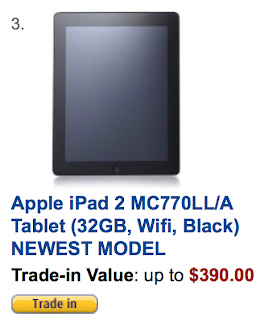
But there is another set of pressures forming just now that could totally pull the rug out from under iPad prices. As we reported last week in our post Interested in Trading Up for a New Kindle Touch or Kindle Fire Tablet? Pull Your Clunker In to Amazon’s Super Lot, Amazon is now investing website real estate and an aggressive marketing campaign to create its own secondary marketplace for virtually all tablets and ebook readers. If Amazon can succeed at enticing thousands of the customers whom it shares with Apple to trade in their iPads and iPod Touches for the 30% to 40% offers now on the Amazon website, those trade-in units could stake Amazon or its “Warehouse Deals” subsidiary to an off-price inventory that might, in time, create an entirely new form of downward pricing pressure on Apple.

What’s really going on here? Obviously, an important part of Amazon’s motivation is to give its customers as much incentive as possible to buy its latest-model Kindle Touch and Kindle Fire units, and regardless of what you paid originally for an iPad it’s a compelling proposition to be able to trade it in now for a brand new Kindle Fire and actually have money left over.

But there could be another mission for Amazon, one that could well influence the economics, the retail pricing, and perhaps even the share price for a competitor such as Apple over the next few years. It’s easy at this point to think that Amazon’s new two-way hardware market will be dwarfed in scale by Apple’s front-door production and retail power.

But Amazon knows better than anybody the effects that its Amazon
Marketplace secondary market for new and used books had on competing
booksellers and publishers over the past decade. Some in the publishing
industry believe that Amazon’s customer-friendly innovations actually
destroyed billions of dollars in corporate wealth
, even if it also
fueled tens of thousands of small and often home-based businesses.

“Some companies,” Amazon CEO Jeff Bezos is fond of saying, “do everything they can to raise prices for their customers. Other companies do everything they can to lower prices for their customers.”

It is clear that Amazon has always been the latter kind of company, and equally clear that Bezos feels that Apple has been the former kind of company both generally and in its activities with the Big Six publishers to create the “agency model” to fix ebook prices at higher levels than Amazon wanted to charge.

If Apple now seems to be in a state of transition from the former kind of company to the latter kind of company, it remains to be seen whether the transition is “all part of Apple’s plan” or, at least in some significant part, the result of an impressive array of economic pressures that Amazon’s innovations are bringing to bear on Apple.

Note: it happens every 90 days or so, and this afternoon Amazon will report its quarterly earnings after the close of the markets, with the usual conference call scheduled at 5 pm Eastern. Apple reported its earnings last week and apparently disappointed investors. Amazon may well do the same in the short term, but the company’s commitment to low margins could well be leading it to a promised land in which it could gain as much as 50% of the U.S. trade book market by 2013.


This is a reprint from Stephen Windwalker’s Kindle Nation Daily, where you can find real-time listings of free and quality 99-cent Kindle books in Amazon’s Kindle store, as well as book reviews, news and commentary about the Kindle and ebooks in general.

Drink The Kool-Aid

This post, by J.A. Konrath, originally appeared on his A Newbie’s Guide to Publishing blog on 9/30/11.

Yesterday, an agent blogged about a speech she recently gave to Sisters in Crime. Some of the advice was fine. Some was archaic (no, writers don’t need to attend conventions or volunteer for anything), but this was just downright awful:

"Do NOT drink the kool-aid on E-publishing. It’s too early to be making sweeping statements about any of it. We’re all learning this as we go and the right answer to almost everything is "we’ll see what happens."

I threw up a little in my mouth when I read that. It’s terrible advice, especially coming from someone who should have writers’ best interests at heart.

Here are some sweeping statements I’ll make, which can be verified:

1. Ebooks sales are going up, paper sales are going down. This trend WILL continue. This means that you need to worry less about who handles your paper rights, and more about who handles your erights.

If you handle your own erights, you keep 70% of the list price (that you set.)

If you let a publisher handle your erights, you get 17.5% of the list price (which they set.)

2. There isn’t much a publisher can do for you that you can’t do for yourself (or hire someone to do.) In other words, paying a publisher 52.5% to create cover art and do some editing is crazy.

3. More and more self-pubbed authors are doing well. And more and more legacy pubbed authors are trying self-pubbed. On this blog I’ve had dozens of guest posts, and listed hundreds of authors by name, who are making good money. Some are getting rich. None of them would be making bupkis if they didn’t drink the Kool-Aid.


Read the rest of the post on J.A. Konrath‘s A Newbie’s Guide to Publishing.

Top 8 Tactics to Power Your Online Book Launch

Okay, you’ve finished your book, filled out all your book metadata, and gone through the publishing process. Soon, your book will become available for sale online. For many authors, this is a critical time in the lives of their books.

Why? When your book is new, it’s the natural time to do a book launch. In fact, it’s possible to re-launch a book any time there’s a reason to do so, but the vast majority of book launches are, appropriately enough, at the time of initial publication.


The idea of a book launch is to turn the publication of the book into an event. Events, by their nature, draw more attention from the public. Your event is one-time-only, happening live, and the more ways you can attract attention during the launch period, the more eyeballs you will attract to your book (and your other books, if you have related books in print already).

Let’s look at the elements that can go into a book launch. You won’t be doing all these things, so don’t immediately become overwhelmed. Think of this more as a menu of options you can choose from.

8 Ways to Make Your Book Launch Take Off

First, decide whether you want to run all of your activities on a single day, over the course of a week, or extending to a longer time period. Any of these options is workable, and I encourage you to spread them out if your time is already at a premium. Remember that you’re in charge, so you get to decide the exact parameters of your book launch. Here are some things you might include in your book launch:

  1. Media Kit – This is essential. It’s the established way for you to get your information to book reviewers, media contacts and other bloggers. I won’t go through the whole media kit here, but it should include your book launch media release (see below for more information), photo of your book cover, photo of the author, marketing information, sample interviews, and a concise cover letter.
  2.  

  3. Guest Posts – One of the best ways to bring your message to new groups of readers is by offering to write guest articles for other bloggers. This can be done as part of a blog tour or on its own. In any case, by introducing yourself and your subject to new networks of readers, your book will get more of a boost at its launch.
  4.  

  5. Book Trailer – Short videos that act like movie trailers for your book have become more and more popular in the last couple of years. Some books seem to lend themselves to this treatment more than others, and some of the most effective I’ve seen are for fiction, like thrillers and romances.
  6.  

  7. Media Contacts – One way to help your book get off to a good start is to get the attention of the media. This might be through an interview with the local newspaper or radio station about your book, or it might be articles you submit to magazines or online periodicals in your niche. Developing a list of media contacts who are interested or who have reported in the past about your topic will be very useful for this effort.
  8.  

  9. Book Reviewers – Planning your review campaign well in advance will allow both print and online reviewers plenty of time to prepare a review about your book. Although we can’t dictate the schedule on which these reviews are released, let reviewers know when the launch will be happening and other events scheduled for the time period of the launch.
  10.  

  11. Contests & Giveaways – One of the techniques that’s been used to good effect by lots of authors is to give away a set number of books during the launch period. These may be offered by lottery, for leaving comments on your blog, for posting Tweets about the book launch, or any other way you can dream up to attract people’s interest. Free anything is still a powerful pull for lots of people, and getting your book into as many people’s hands as possible is the aim of your launch, so get creative here.
  12.  

  13. Blog Tour – A blog tour organizes the guest posts, giveaways and blogger networking into a formal schedule during your launch period. Setting up guest appearances on blogs, which allows the bloggers to introduce you to their readers, is a terrific way to grow your own reader community and enhance your relationship with lots of bloggers in your niche. You can promote your tour schedule on your own blog and through social media to create some excitement for all the events you’ve planned.
  14.  

  15. Media Release – Although your media release is an integral part of the Media Kit I mentioned at the beginning, it’s really a key piece of your book launch as well. Why? A well-written and targeted media release will bring together all the best reasons people should be interested in your book, your subject, you and your book launch. And if your book legitimately addresses more than one audience, take your basic media release and re-write the headline and first paragraph to highlight the connection to other groups.

Taken together, putting together a book launch can be a lot of work. But there are a lot of tangible and intangible benefits you get from going through all this trouble. And while our basic aim is to sell books, if you’re in this for the long haul, you’ll recognize that these benefits will repay your efforts in many ways. For instance, by going through the launch, you can:

  • Create better relations with other bloggers in your field
  • Better understand your readers and why they respond to you
  • Explore aspects of your subject that might be of interest to different groups of readers
  • Learn which approaches work best in driving traffic, and interest, about your book.

Running a book launch can be a demanding, exhausting and exciting adventure. You’ll learn a lot, and you’ll be able to use that learning for your next book. So give it a try.


This is a reprint from Joel Friedlander‘s The Book Designer.

7 Social Networking Mistakes to Avoid

Everyone says you must social network as part of your author platform.

Publishers, agents, self-publishing marketing people, other authors. It now seems part of the non-negotiable author platform for indie authors and those wanting a traditional deal.

But there’s more to social networking than just marketing.

I started blogging, tweeting and Facebooking over two and a half years ago and consider it a life-changing experience. I have made some fantastic online friends, connected with peers in the industry, gained an online platform that now reaches thousands of people and my novel, Pentecost, is still in the Amazon bestseller rankings after six months, based on a launch fueled by social media. Twitter in particular is an important part of my social life as well as my work and I am a passionate evangelist for the platform.

It doesn’t matter what social network you want to jump into, there are principles that apply to all and some basic mistakes that you can avoid which will make it a much more effective place for you to be.

Here are the top 7 mistakes authors and writers make in social networking.

(1) Not being useful/interesting/entertaining.

If you want to stand out in a crowded market online you have to offer something to people. Remember the phrase ‘what’s in it for me?’ Everyone wants to know things that will help them, or interest them or make them laugh. If you’re not offering that, then you won’t get attention. If you don’t have attention, it won’t lead to interest in you or action in terms of buying your book. So focus on being one of these things as the main pillar of your social networking. For example, I tweet useful links to blog posts on writing, publishing and marketing @thecreativepenn .

(2) Not understanding generosity and social karma.

There is an understanding online that we are not competitors, that this isn’t a zero sum game, that the pie just gets bigger. In fact, those of us in the same niche post on each others blogs, share posts that aren’t our own and promote other people’s products, even if they overlap with ours. The blogging and social media world is all about being generous with links, with information, with help. It makes the community a very positive place to be and we all benefit. It’s important to do this for it’s own sake but it also generates social karma, as in you will receive back in the measure you give. I don’t mean this in any spiritual manner, just that ‘what goes around, comes around’ as in any community.

(3) Not being personal enough.

Yes, you have to be useful but you also have to be a real person. Don’t just tweet information all the time. Intersperse some updates about your life, your writing, maybe your pets or interests, some photos. People connect with people, not info-streams. Use pictures and also link to multi-media that you create or participate in. Remember that people buy from those they know, like and trust so you have to earn that. I also recommend using a picture of your face throughout your networking. It’s much more personal to connect with someone specific rather than an avatar or random picture. Using the same picture all over the web is a good idea and will help people recognize you across the networks.

(4) Being too personal or too marketing focused.

Of course, personal does need balance. You can’t just have personal updates as no one is interested in that. Also, do not just tweet about your new book. The fastest way to get blocked by people is if you are just interested in selling your stuff. There’s a time for that but it’s AFTER you’ve built up some social karma and goodwill with the online audience. Also, if you want to get retweeted, or Liked so your post is shared across other people’s networks, it needs to resonate. That generally means it should have a good headline. I frequently rewrite headlines from blogs in order to get more Retweets. Basic copywriting skills will serve you well here. I recommend Copyblogger as the best place to learn about this and much more on internet marketing.

(5) Expecting short term gain.

Social networking is basically hand-selling to people around the world. You have to connect with people over a longer period of time, before you try to sell them your book. Many authors dive into social networking just before their book launch and then try to sell immediately, or try desperately to grow their following at the last minute. But it doesn’t work like that. You need to work on it consistently, putting in the effort to create relationships over time. This is a long game. Luckily, authors are used to long term projects!

(6) Not being consistent with niche and timing.

People tend to clump together around their interests online, so people will follow your twitter stream for several reasons. They like what’s in your profile (writer/author/loves books!) or they like your tweets/updates, or both. It follows that you need to be consistent with the topics you share because those people will be turned off if you start in a completely new direction. So I tweet about writing, publishing and book marketing @thecreativepenn. I can be tangential e.g. creativity, books I’m reading, things that relate but I won’t be sharing on things really outside the niche e.g. weight loss/ TV programs etc. If you stick to your niche, you will develop a nice, tight community who share your interests. Consistency is also important in terms of timing. If you don’t tweet/update/post for months, people won’t follow you. Simple as that.

(7) Not being global enough with tweet timing and book availability.

Online social networking opens up the world to your books. That is truly exciting…but only if you take advantage of the opportunity.  I’m based in London but 70% of my traffic comes from the US and 15% of my podcast audience is in China, and there are many others represented in my twitter stream and blog traffic stats. The only way to reach people everywhere on social media is to use a scheduler for your tweets. I use Su.pr but you can also use SocialOomph or Hootsuite. Scheduling in multiple time zones means you can appear in streams at different times of day. It’s what I used to specifically try to network with Americans (and it works! Hello American friends!) However, you should also remember that there is only a point in connecting internationally if your book is also available everywhere i.e. on Amazon.com and also in ebook format.

So, those are the top mistakes I see people making on the social networks. If you have any more lessons to share, please add them in the comments below.

 Do you need some more in-depth help with social networking?

Many people want to be successful at social networking but they are afraid of wasting time and not being effective, as well as the concerns of privacy and just not knowing where to start. So I have launched a multi-media mini-course that will help with this.

It has a 59 page ebook, plus audios and 4 behind the scenes videos on all the major social networks. I share all my top tips and strategies for building your social network and using your time most effectively. I help you through the process saving you time and effort in jump-starting your social networking platform.

It’s just US$39.99. Click here to learn more about it .


This is a reprint from Joanna Penn‘s The Creative Penn. Images: iStockphoto.

E-Book Cards Will Change The Way You Sell E-Books: Transform A Digital Book Into A Physical Product

Publetariat welcomes author Cheri Lasota. In this guest post, Cheri introduces the idea of using physical gift cards as a means of ebook distribution through brick-and-mortar and other offline outlets.

Have you heard of e-book cards? If you haven’t already, I think you will soon. They are a new book marketing technique making headway and headlines around the country now. 

I heard about them from author Dean Wesley Smith. The idea stems from this simple question: how do authors and publishers sell a digital product in a physical store? 

So many of us are releasing e-book only versions of our fiction. In such cases, how do we sign our books at events? How can we hand-sell our books at conferences, speaking tours, or to the neighbor next door? How do we start to educate the paperback public that e-books are both the wave of the future and the here and now? E-book cards can accomplish all this.

These plastic cards are the same size as your credit card or the gift cards you might buy at the store. Why that size and shape? 

·      You can fit them into your wallet or purse.

·      You can slip them into larger sleeves or envelopes that can display even more content about the book.

·      You can put them in a display holder that has a slot for business cards.

·      You can sign them at events because the plastic makes them durable.

·      You can mail them in a standard envelope for promotional packages because they are so small and compact. 

And just think about how little space they would take up on the bookstore shelf, as opposed to a 600- to 800-page paperback?

SpireHouse Books released my novel on Sept. 13, 2011 and we have wholeheartedly embraced e-book cards in our marketing campaigns since then. 

Thus far, we sold many of the cards at my book launch, I’ve sold some by hand, several stores are displaying and selling them, many have bought them as gifts for their friends, and I have used them as giveaways at events and elsewhere.

In the future, we plan to mail them out to book reviewers,continue to use them for giveaways and to sell at events, give them as gifts for holidays and birthdays…the possibilities are endless.

You can tailor your e-book cards for your own needs. For my cards, my publisher put the book cover on side 1 and included two important notes on it:  “E-book Card Edition” and “Read On Any Device.” On the accompanying display, we mention that the e-book card edition is cheaper than anywhere else the book is sold, which gives bookstore owners a clear incentive to stock them and gives readers a great reason to buy in-store as opposed to buying online. Our e-book card edition also contains exclusive content.

On side 2, we included a “tagline” as well as a short synopsis of the storyline; clear, concise instructions on how and where to download the book; an ISBN/barcode; and a unique scratch off promotional code,which the buyer plugs into my publisher’s website.  

We see this as an incredible opportunity for bookstores as well as authors and small publishers. Spread the word to other authors. Talk about this with your local bookstore managers. Think outside the box and you may find that these cards give you access to readers you never thought you could reach. 

Have questions? Just comment on this post.


[Publetariat Editor’s note: more of the how-to nuts and bolts, and costs, of getting ebook cards produced are covered in this linked post from Dean Wesley Smith, which was referenced by Cheri near the beginning of this post.]

_______________

SpireHouse Books just launched Cheri Lasota’s first novel, Artemis Rising, this fall. The book is a YA historical fantasy based on mythology and set in the exotic Azores Islands. Currently, Cheri is writing and researching her second novel, a YA set on the Oregon Coast. Over the course of her sixteen-year career, she has edited fiction, nonfiction,screenplays, and short stories for publication. Cheri also has twenty-four years of experience writing poetry and fiction. Learn more about Artemis Rising at http://www.cherilasota.com or buy it at http://bit.ly/ArtemisRisingNovel.


Guest Post – Piracy and Free Content with Foz Meadows

This guest post, by Foz Meadows, originally appeared on Alan Baxter’s The Word on 10/11/11.

Today I’ve got a guest post from author Foz Meadows. A discussion elsewhere led to this very lucid and, to my mind, accurate post on the nature of piracy in the digital age and the pros and cons of authors offering free content. It applies equally to all forms of digital media. I agree wholeheartedly with Foz on this and hope it makes some interesting reading for you guys.

Piracy and Free Content
by Foz Meadows

solace and grief front cover Guest post   Piracy and free content with Foz MeadowsNeil Gaiman tried the free giveaway experiment a little while back – the readers of his blog voted which novel of his they most wanted to recommend to friends (it ended up being American Gods), and then he made it freely downloadable for a month, after and during which time his publishers monitored his sales to see what happened. Similar to Cory Doctorow’s experience, sales of ALL his books (and not just American Gods) went way, way up, which I think Gaiman compared to something of a library/lending effect, i.e.: most people discover new authors because someone, be it a friend or a library, loans them a copy of the book, thereby encouraging them to buy that author’s works in the future but without the initial risk of paying money for a product they might not like.

What I took away from the whole endeavour (apart from the fact that, when it comes to any experimental sort of book sale process, it is very helpful to already be a megastar) is that it seems to work best for writers who already have a published back-catalog. Putting up one book for free, for a limited time, draws attention to all your works together; and if people like the free product, then they’re more inclined to pay for your other stuff, because you are now one of Their Authors. Which could work as a promotion for a second book if done right, I think – but the call is yours.

Regarding people who download, I do think there’s something to the argument that the majority (or at least, a significant proportion) of DLs don’t actually constitute a lost sale, per se, so much as a parallel form of consumption. Allowing for the 10% of assholes who will always rather steal than pay even when they can afford it, I know there have been myriad reported instances where people who already own physical copies of books have sought out illegal digital versions because of region control issues in the legal versions, such as someone from Australia not being able to buy an ebook version of a novel they already own because it’s only published in America.


Read the rest of the post on Alan Baxter‘s The Word.

Let's Talk About The Author's Journey

My first book, Southern Cross, falls under Historical Fiction. It is a spy/murder/mystery that takes place in 1938 and 1939. The journey from writer to self-published author has been long and interesting for me, but not without its potholes. I am beginning to see that promoting my book is going to be more difficult than writing it. Southern Cross is listed on Amazon in England, Germany, and France. So far one copy was sold in England. Nice, but how did they find me and how do I reach other potential readers? I have a webpage, listed on page one of a Google search. I just started a FaceBook page. So far I have been able to do it all myself and would like to keep it that way. What methods have worked best for you?


Will Book Publishers Be Able To Maintain Primacy As Ebook Publishers?

This post, by Mike Shatzkin, originally appeared on his The Shatzkin Files blog on The Idea Logical Company site on 10/9/11.

Being on the road in London and on my way to Frankfurt, where we have two Publishers Launch Conferences coming up on Monday and Tuesday, I don’t have time for what my British friends would call a “proper” blogpost, with a bit of research (I admit I never do much) and some links. But I’ve been thinking about something over the past month which I ran by a marketing VP at a major house last week. It looks like one of the really big questions facing the major houses in the next couple of years, so it seemed worth airing in the run-up to publishing’s largest global gathering.

Here’s an assumption that is not documentable; it is my own speculation. I think we’re going to see a US market that is 80% digital for narrative text reading in the pretty near future: could be as soon as two years from now but almost certainly within five. We have talked about the cycle that leads to that on this blog before: more digital reading leads to a decline in print purchasing which further thins out the number of bookstores and drives more people to online book purchasing which further fuels digital reading. Repeat. Etcetera.

We’re already at the point where new narrative text units sold are well north of 25% digital (percent of publishers’ revenue is lower than that, of course) and we are still in a period that has lasted about five years (soon to end) where the penetration of digital has doubled or more annually. (I italicized that to emphasize that what I’m talking about doubling is the percentage of sales that are digital, not the absolute number of digital sales. Several people misinterpeted that when I made to it previously.)

Of course, penetration will slow down before it reaches 100%. I’d imagine we get to 80% in 2 to 5 years, then then to 90% in another couple of years, with the last 10% stretching out a long time. How long did it take after the invention of the car before the last person rode their horse to town?


Read the rest of the post on The Shatzkin Files.

Literary Agency Sells 520 Books In One Deal, Raising Questions

Editor’s Note: while most Publetarians are indie authors and small imprint owners, this article is still worth a very close look from all of us. It touches on the indie authors’ and small imprints’ new competitors, companies which are a hybrid of literary agency and publisher. Plenty of indies have a mainstream-published backlist, and those indies need to be particularly wary of the kinds of business practices revealed in this article.

This article, by David Gaughran, originally appeared on his Let’s Get Digital site on 10/19/11.

Last week, Curtis Brown (UK) signed a deal for 520 of their authors’ backlist titles to be published by Pan Macmillan’s new imprint Macmillan Bello.

120 titles will be released between November and the end of the year, with 400 more coming in 2012, and the books will be available in both digital and POD formats.


Regular readers might remember that, in May, Curtis Brown were considering a move into publishing after fellow-agent Ed Victor launched his own imprint Bedford Square Books.

At the time, Jonathan Lloyd, the managing director of Curtis Brown, was quoted by The Bookseller as saying, “Where Ed Victor leads, others follow – and we are right behind him, but with a rather larger list.”

However, Mr. Lloyd may not have expected what happened next. Ed Victor’s move created a firestorm, with angry reaction from publishers, authors, and even other agents – including calls for his expulsion from the UK’s representative body, the Author’s Association of Agents (scroll down to comments for quote)

In addition, later that month, one of the first UK agents to move into publishing – Sonia Land – was dramatically cut out of a publishing deal by one of her own authors – Tom Sharpe – who made a backlist deal directly with his publisher.

It seems that Curtis Brown decided to rethink their move into publishing.

Instead, they have announced a deal to sell 520 books en masse to a new imprint owned by Pan Macmillan created especially to house these books. Naturally, with a deal of this size and nature, questions are being asked. Here is what Passive Guy (a lawyer) had to say:


Read the rest of the article on David Gaughran‘s Let’s Get Digital site.

Trip Report: Emerging Writers’ Festival, Digital Writing Conference, Brisbane

I spent this weekend in Brisbane at the Emerging Writers’ Festival Digital Writing Conference and it was a top weekend of excellent information and quality company.

The event started on the Friday evening, with a meet and greet of attending writers, editors, artists and organisers at Greystones Bar. It was great to put 3D fleshforms to Twitter personas, some of whom I’ve known online for a long time, as well as making new friends right off the bat.

The Conference itself started the following day at the Queensland State Library. Lisa Dempster (@lisadempster) opened proceedings and we were then supposed to cut to a video presentation from Christy Dena (@christydena). However, library technofail meant there were problems with the wifi. For me, a certain degree of technofail at a digital writing conference seemed somehow fitting. So we had a presentation from Morgan Jaffit (@morganjaffit) on writing for videogames.

This presentation was excellent, especially as I’m involved with some game writing now. One of the simple yet very important things Morgan said in reference to game writing was that, whereas with prose writing we’re told to “Show, not tell”, with games it’s “Do, don’t show”. In other words, let players actively participate in the story rather than showing them all the story in elegant cutscenes. Gamers remember the stuff they do in a game more than the stuff they watch. This is a Very True Thing.


Then we kicked into the first panel.

Sophie Black (@sophblack), Andrew McMillen (@niteshok), Jason Nelson and Sarah Werkmeister (@fourThousand) discussed the nature of writing online, hosted by the wonderful Alex Adsett (@alexadsett). It was interesting and varied stuff. Andrew McMillen told a tale of caution when it comes to the organic nature of online journalism and how important it is to fact-check and maintain your integrity and ethics as a writer. Jason Nelson blew us away with a variety of interactive online poetry and games that has to be seen to be believed. He’s also on the board offering grants to digital writers, and it’s worth your time investigating that as it seems very few people are applying and there’s money to be had. Real spending cash. A rare treat for any kind of writer. Sophie Black, editor of Crikey, talked about how online journalism is different to the print journalism of old, and how they source material from all over the world. Sarah Werkmeister drew interesting comparisons as well. And this is, of course, only a fraction of the stuff covered.

Following that panel was another moment of technofail (which, I should point out, was again the fault of the venue, not the conference or organisers!) and so we had an early break. Then we came back to the next panel, which included myself, Simon Groth (@simongroth), Charlotte Harper (@ebookish), and Festival director, Lisa Dempster. It was hosted by the inimitable Karen Pickering (@jevoislafemme). We were talking about using the online environment to promote your work, to get work and to work for you. I used my own website as an example of how to manage a central online hub, where people can find you and your work and contact you if they want to. Of course, it was also a moment of shameless self-promotion, with my site projected behemoth-like behind me. Here’s a photo from Amanda Greenslade (@greensladecreat):

presentation Emerging Writers Festival, Digital Writing Conference, Brisbane

From L to R – Karen Pickering, Lisa Dempster, Simon Groth, Charlotte Haper, and me at the lectern

The other panelists presented very interesting stuff, important to all writers – concepts like “Know your niche”, “be an expert”, “define your audience”, “don’t be a dick”, “don’t spam people”, “engage with people online, don’t preach to them” and so on. The panel and subsequent Q&A wandered all over the place and covered a lot of ground, which I won’t try to replicate here.

Suffice to say that these two 75 minute panels were jam-packed with juicy tidbits of writerly wisdom and, judging by the feedback when I was chatting with people afterwards, most attendees got a lot out of it. I certainly learned some new stuff and had some old stuff reaffirmed. The truth is, no matter how emerging or emerged you may be as a writer, these things are invaluable.

After that panel we recovered somewhat from earlier technofail and had Christy Dena’s video speech – “7 things I wish I had known at the beginning of my digital writing career”. I’ve embedded that video here as it’s fucking brilliant. Absolutely solid advice, well worth your 15 mintes:

See, how good was that?

Then we mingled and drank, often the best part of any writers’ event as people are the engine of this industry and socialising with them is invariably fascinating and entertaining.

The following day there was a talk at Avid Reader bookshop (@avidreader4101), where Karen Pickering and Chris Currie (@furioushorses) talked to writers about writing about writing. Yes, all very meta. Here they are, in the sunny courtyard out the back of the bookshop/cafe. There were periodic pigeon attacks to keep them on their toes:

writingonwriting Emerging Writers Festival, Digital Writing Conference, Brisbane

It was a fascinating chat, but sadly I had to leave early to catch my flight. However, due to the frenzied tweeting throughout the entire conference, I was still able to keep a bit of an ear to what was happening. And I got to follow the excitement of the spelling bee that evening, which rounded out the Festival.

A truly spectacular event that I was proud to be a part of. Given that most of my conference activity is quite genre-focused, I always enjoy these wide open writers’ events, with everyone from journalists to fiction writers and beyond all mixing together, all styles, all media, all slightly crazy. It’s inspiring and motivating in so many ways, I can’t recommend it highly enough. If you want to be a writer or you already are one, get out there and mix with these overlapping tribes. We’ve all got our love of writing and reading in common, after all.

You’ve hopefully noticed that throughout this post I’ve been linking Twitter handles. Go and follow them all – they’re very interesting people.

If I got one over-riding thing from this conference it was that right now is an exciting and invigorating time to be a writer. I couldn’t agree more with that perception. Vive le Worditude!


This is a reprint from Alan Baxter‘s The Word.
6 Tips and Tricks to Use Kindle for iPad, iPhone and iPod Touch

Kindle for iOS has just been updated to version 2.8 (iTunes link), which complies with Apple’s new in-app purchase rules.

Kindle Store button was removed from the home page – it was obvious. I’ve also checked endings of free samples to see what Amazon did with their Buy Now link, which in older versions was switching to book’s Kindle Store page in Safari. Buy Now button is still there (as well as See details for this book in the Kindle Store). However, both links show an alert: “We’re sorry. This operation is not currently supported.”

Apple and Amazon are playing games, which are more and more annoying. Status for today: Apple won’t earn money, Amazon won’t lose money. The only losing part is the reader.

Below you’ll find tips on how to make the most of Kindle on your device – especially after making our lives harder by removing any option to buy a book from within the app. A good thing to do is to change attitude: Kindle on iPad or iPhone is not only about using a Kindle application


1. Browse Kindle Store in Safari

After 2.8 update it will be reasonable more than ever to browse and buy books right away from Safari browser (without bothering to open Kindle app). Never tried it? Don’t worry. Amazon mobile site looks really well on iPhone/iPod Touch. On the iPad a regular site is displayed, works well, I haven’t noticed any flaws.

2. Add Kindle Store to your Home Screen

Add Kindle Store to your Home Screen

It’s good to add Kindle Store either to a list of bookmarks in Safari or to a Home Screen. On the iPad just go to Amazon site and select Kindle Store from a drop list.

If you’re on the iPhone/iPod Touch, go in Safari directly to this address http://amzn.to/fW2ffk. It’s Kindle Store’s site optimized for small screens – not the same as regular one. You can add it as a bookmark to Home Screen (see picture on the right) and a nice icon will show up.

Find more information about it here.

3. Browse free Kindle books in Safari

In fact, you can use the browser to add books from other sources than Kindle Store. What’s very important, you can add them directly to Kindle for iOS. This is possible since 2.5 update.

What you have to look for is books in mobi format, without DRM. To add a book to Kindle app, tap on a link to a book file, ending with .mobi.

Best sites with free Kindle books, optimized for mobile reading, are: Feedbooks, Project Gutenberg, Smashwords and ManyBooks.

Read more about this topic here.

4. Add books to your Kindle for iOS – not only via iTunes


iTunes is a default way to add content to applications, but happily it’s not the only one. As I’ve written above, you can add books from Safari.

There are two more options available: via e-mail (just send a file to yourself and open it with a native Mail app) and via cloud storage apps like Dropbox.

Find out more about the topic here.

5. Discover books on Twitter and add them instantly to Kindle app

It’s my favorite topic. If you spend a lot of time on Twitter, using Twitter iOS applications, why don’t you try to find Kindle books there? It’s actually pretty easy. Just look for a keyword Kindle or a tag #kindle and you’ll find out a lot of tweets with amzn.to links.

Or if one of Twitter friends is recommending a Kindle book, just tap on a link and you’ll be redirected to mobile Safari (either within Twitter app or outside it) and you’ll decide whether to download a free sample or buy a book.

For more information read this post.

6. Use Kindle application as a free dictionary

Finally, Kindle for iOS can also work as a great dictionary application, so there is no need to buy another one. This is possible thanks to the The New Oxford American Dictionary installed.

You’ll find more information about it here.

* * *

I hope you enjoyed the tips. Please share in the comments what’s missing. If you want to keep up with what’s going on with Kindle on iOS devices, get free updates of Ebook Friendly Tips (via RSS or e-mail) where I focus on sharing simple Kindle tips.

If you liked this article, please share it with your friends. Get free updates by e-mail or RSS, powered by FeedBurner. Let’s meet on Twitter and Facebook. Check also my geek fiction stories: Password Incorrect and Failure Confirmed.


This is a reprint from Piotr Kowalczyk‘s Password Incorrect.

There’s Something Odd About Self-Publishing Books

Here’s something that’s mystified me for a long time:

Most books about self-publishing look a lot worse than they ought to.

I’ve often said that it doesn’t cost any more to produce a good-looking book than it does to produce a bad-looking one, but people aren’t listening.

When I first started blogging a couple of years ago I thought one good service for readers would be to review books about self-publishing.

Like lots of things, I set out with good intentions, and had barely gotten started before I tripped up on those same intentions, and had to abandon the effort.

The first book I reviewed was such a shambles from a book design point of view, I couldn’t hold back from criticizing the author/publisher.

Afterwards, I felt stupid. What was the point of the criticism? I unpublished the article, one of only 2 I’ve ever taken down, and stopped reviewing the design of the books I was covering.

Lately though, with the onrush of more and more self-publishers, the flood of books about self-publishing has also reached a flood.

Michael N. Marcus Weighs In

A frequent commenter here on the blog, Michael N. Marcus has his own selection of bad books, although his aren’t just about self-publishing. He recently published a book of these under the title Stinkers! America’s Worst Self-Published Books. And boy, he’s found some doozies.

self-publishingThe book is basically posts from Marcus’ BookMaking blog, where he often skewers self-publishers and self-publishing companies for their bad practices, oversights and other errors and omissions. He’s added a number of sections in a Appendix including a glossary and various tips for new self-publishers.

Here’s the kicker: six of the nine books profiled in “Stinkers!” are about self-publishing. Isn’t that sad? And Marcus, who has tried to improve the look of his books, delivers this news in a book that is competent but very obviously the work of an amateur, if an enthusiastic one. Although he is strict about correcting errors in his text, graphically “Stinkers!” is nothing to write home about.

Like a lot of self-publishers, having control of lots of neat things like tinted boxes, type run-arounds, drop caps and automatic bullets apparently makes people think you need to use them all. On almost every page.

Perhaps they think that an unadorned page of type would, by itself, be so boring no one would read the book.

But it seems to me that all the books I remember most brilliantly, the ones I can never forget, are made up of unadorned pages of type. That’s because it’s the words and the story and the ideas that remain, when they are allowed to, not the fancy rules and type ornaments and drop shadows. That stuff just gets in the way.

Cluttering your book pages with stuff is pretty much the opposite of my idea of book design. I think self-publishers would do themselves a favor by creating very simple pages instead of fancy ones. Their readers will thank them.

Not Alone, No Sir

Books sold for the value of the information in them have often looked like they just came off a typewriter or were dashed off in Microsoft Word without any formatting at all.

The best of these books are clean and competent, done by a professional, although typographically uninteresting and generally uninspired. They deliver the information, and that’s about it. The only good looking self-publishing book I’ve seen recently is The Complete Guide to Self-Publishing by Sue Collier and Marilyn Ross, and that’s because it was not self-published, but issued by Writer’s Digest Books.

Left With a Question

So I suppose it’s the rule that books about self-publishing that are self-published themselves look bad because the authors are attempting to follow the DIY (do-it-yourself) route to show just how easy it is to publish a book.

And maybe that’s the problem: it’s dead easy to publish a book, it’s just a bit harder to publish one that looks decent, or one that looks just as good as a book from a traditional publisher.

But does that mean all these books have to use bad clip art, pedestrian typefaces, awkward layouts, three or four fonts per page, and covers that look like they came straight out of the template cover generator?

When I look at a book cover with 6 lines of type on it, and every line is a different font or weight, with type that’s been digitally distorted, with big chunky drop shadows, I have to take a few deep breaths.

And that leaves me with a question: Why are the self-published authors of books about self-publishing so unconcerned with how their books look? Why are they convinced they don’t need a book designer? Why don’t they want to create a book that looks great?


This is a reprint from Joel Friedlander‘s The Book Designer.

Amazon Kindle The Fire. Ebooks Go Mainstream.

This has got to be the moment.

Ebook sales have been steadily growing over the last 2 years and those of us readers who converted early are almost entirely ebook consumers now.

For authors, the global ebook sales market has meant we can sell direct to customers and every month receive a cheque from Amazon. We can log on and see our sales by the hour. It has been life changing for me and so many others.

But ebooks have been far from mainstream. Until now.


These new Kindle devices change everything.

 Amazon has unveiled a new family of Kindles including one at the magic price of $79. This is what happened with the iPod when the price came down low enough that it was a no-brainer purchase. Those people who had been on the fence about new-fangled digital music went out and got one, just to see what the fuss was about. I was one of those people (with the ipod) and it hasn’t left my side since.When did you switch to digital music?

Kindle sales growth almost vertical (Image source: Business Insider)

I was one of the first people in Australia to buy the Kindle when it (finally) become available. I converted to 90% ebook reading within weeks and the number of books I bought at least trebled. I am unashamedly an Amazon fan but this is a massively exciting development for any author who can see what’s round the corner.

These new Kindles will ship in October and November. There will be many of them in Christmas stockings and ebook sales go up over Christmas because people have time to read, and of course, play with their new gadgets.

So what does this mean for you?

  • If you don’t have a Kindle yet and you are a writer or want to be. Get off the fence and buy one of these (affiliate). Experience for yourself what the digital revolution means. Even if you still love the smell of a new book, there are millions of people converting to ebooks and you want to sell to them. You are not your market. You have to see this to believe it.
  • If you are a traditionally published author and your publisher has not put your book on the Kindle with global rights, then go see an IP lawyer and see what you can do to get the rights back or ask the publisher to get your books up there. It’s not rocket science.

Trust the market

People want to read. They want to find books that will inspire them, entertain them, educate them, take them out of their world for just a few minutes. These book lovers are people like me. I devour Kindle books. I download samples several times a day. My biggest entertainment expense is ebooks. I love reading. Chances are, so do you, and so do millions of readers. Maybe they will like your book. But they won’t find it unless it’s on the Kindle platform.

I’m sure there will be the usual lamentation that this attitude will flood the market with more self-published books of bad quality, but I trust the market. I am a heavy Kindle user. I am the market. I always download a sample unless I trust the author. I always delete the sample and don’t buy if the formatting is bad or if the book is not enjoyable or useful. I only buy books that pass this sample test. I go by reader recommendations and how many stars there are. I buy based on recommendations from my friends on twitter. Crap books with crap covers do not sell. They don’t rank on the bestseller list. They do not get recommendations.

Stop with the excuses about why you think ebooks will fail, or how they are destroying publishing. Enough already.

This is no longer the future. This is right now. You need to act.


This is a reprint from Joanna Penn‘s The Creative Penn.