Authors of the Digital Age–What It Takes to Be a Real Author CEO

This post, by Kristen Lamb, originally appeared on Kristen Lamb’s blog on 4/12/13.

I do a lot of reading of other blogs, particularly blogs that aren’t about writing. I think this keeps my information fresh. As many of you might know, financial blogger Steve Tobak is one of my favorites, and he regularly inspires my writing.

This past week he had a neat post What It Takes to Be a Real CEO, and there were so many of the principles that applied to being a Digital Age Author. We are now Author CEOs, no matter what path we take. So what does it take to be a REAL Author CEO?

Passion for Work

We must have a passion for writing and a willingness to work hard. To be blunt, being a professional writer is a lot of HARD work. Writers are CEO of a company of one, and many times our writing work is on top of a day job, family, children, and other responsibilities. Going pro isn’t all floating around on a unicorn cloud hanging out with the muse.

All professional authors have to read, learn the craft, make work count, finish the books, and be ruthless and relentless in our edits until the work is complete. We have to build a platform, promote, keep up with taxes, accounting, deductions, receipts, spending, write-offs, mailing lists, etc.

This means we need to get up earlier and stay up later than most people, and we will have to sacrifice a lot. This is why we need passion. Passion takes the sting out of sacrifice. While others are whining, we are working.

Relentless Pursuit of the Dream, Even When Others Think You’re Nuts

In the beginning, this is particularly important. No one will take you seriously. Accept it and sally forth. Brush the dust from your feet.

Others want us to fail, because if we succeed, then we are proof success is a choice. Others will resent us because they want to believe they aren’t in control of their futures. They want to keep their victim mentality because it’s safe and absolves them of personal responsibility for their own futures.

Expect push-back.

Courage in the Face of Adversity

The new paradigm is changing and can be just as scary as the old one. Those who choose a traditional path know the odds of finding an agent and landing a publishing deal are not the best. Most writers who query will fail.

When it comes to a non-traditional path, we have to learn so many new things and wear frightening and unfamiliar hats. Again, the odds are better, but competition is staggering, discoverability is a growing nightmare, and the workload is daunting to even the best of us. But, we must have the courage to do what scares us if we want the dream.

Stickwithitness


Read the rest of the post on Kristen Lamb’s blog.

Authors Guild's Scott Turow: The Supreme Court, Google, Ebooks, Libraries & Amazon Are All Destroying Authors

This post, by Mike Masnick, originally appeared on TechDirt on 4/8/13.

from the old-man-yells-at-cloud dept
We’ve written more than a few times about Scott Turow, a brilliant author, but an absolute disaster as the Luddite-driven head of the Authors’ Guild. During his tenure, he’s done a disservice to authors around the globe by basically attacking everything new and modern — despite any opportunities it might provide — and talked up the importance of going back to physical books and bookstores. He’s an often uninformed champion of a past that never really existed and which has no place in modern society. He once claimed that Shakespeare wouldn’t have been successful under today’s copyright law because of piracy, ignoring the fact that copyright law didn’t even exist in the age of Shakespeare. His anti-ebook rants are just kind of wacky.

However, in his latest NY Times op-ed, he’s basically thrown all of his cluelessness together in a rambling mishmash of “and another thing”, combined with his desire to get those nutty technology kids off his lawn. For the few thousand members of the Authors Guild, it’s time you found someone who was actually a visionary to lead, rather than a technology-hating reactionary pining for a mythical time in the past.

First up, a confused reaction to the Supreme Court’s protection of first sale rights in Kirtsaeng.

LAST month, the Supreme Court decided to allow the importation and resale of foreign editions of American works, which are often cheaper than domestic editions. Until now, courts have forbidden such activity as a violation of copyright. Not only does this ruling open the gates to a surge in cheap imports, but since they will be sold in a secondary market, authors won’t get royalties.

First of all, no, this was not a “change” in US law. Courts had not forbidden this particular situation in the past, because the specifics of this hadn’t really been tested in the past other than a few recent cases with somewhat different fact patterns. The point of the Supreme Court’s ruling was to reinforce what most people already believed the law to be: if you buy a book, you have the right to resell it.

As for the “surge” in cheap imports, let’s wait and see. It might impact markets like textbooks, which are artificially inflated, but for regular books? It seems like a huge stretch to think that it would be cost effective to ship in foreign books just for resale. And, of course, secondary markets have existed for ages, and studies have shown that they actually help authors because it makes it less risky to buy a new book, since people know they can resell it. Turow admits that secondary markets have always existed, but then jumps to what this is all “really” about in his mind:

This may sound like a minor problem; authors already contend with an enormous domestic market for secondhand books. But it is the latest example of how the global electronic marketplace is rapidly depleting authors’ income streams. It seems almost every player — publishers, search engines, libraries, pirates and even some scholars — is vying for position at authors’ expense.

Yes, that’s right. The Kirtsaeng decision isn’t just about first sale, it’s really about the evil “global electronic marketplace” sucking authors dry. Of course, Turow fails to mention that Kirtsaeng had next to nothing to do with the internet. Yes, Kirtsaeng ended up selling his books via eBay, but tons of books sell on eBay. That had no impact on the ruling at all. The issue in the ruling was about books legally purchased abroad, and Kirtsaeng did that without the internet — he just had friends and family back in Thailand buying books for him. To blame that on “the global electronic marketplace” is just completely random and wrong. It seems like the kind of thing someone says when they just want to blame technology for everything. Turow has his anti-technology hammer, but he’s got to stop seeing nails in absolutely everything.


Read the rest of the post on TechDirt.

7 Publishing Tips I Learned at Writer’s Digest Conference East 2013

This post, by James H. Duncan, originally appeared on his site on 4/7/13.

I recently attended Writer’s Digest Conference East in New York City — my first writing conference in almost seven years — and aside from the standard (though invaluable) advice on craft, career, and publishing options for writers, I picked up these seven tidbits of info that I found especially fascinating. You might too, so enjoy!

1. Bookmarks: Every reader needs them. Heck, I have about thirty around my apartment lying in wait and I still take more when I can. So think about creating some with your name and book title on them. They’re easy to make, inexpensive to print, and they can help spread the word about your book, name, website, or twitter handle long after someone has finished your book. It’s a great tip I picked up from Eric DelaBarre (former writer for Law & Order and author of the hit children’s novel Saltwater Taffy).

2. Author Pages: I’ve used CreateSpace/Amazon to publish a collection of poetry, and I plan to use them to publish my upcoming collection of short stories, but I had no idea that they allow any author—no matter who has published the book—to create and modify an author page at Amazon.com. You can even link blogs and twitter accounts to the page. It’s like having a second website for free. Might have been common knowledge before, but it was cool news to me, and I thank Jon Fine, the director of Author and Publisher Relations for Amazon, for that great tip.

3. Blog to Website: Despite their wide use by industry professionals and writers, many blogs and websites that have the tags .blogspot and .wordpress retain a slight stigma as being “less professional” than a website. So the $10 a year (or so) that these sites charge to turn it into a strictly .com operation is well worth the money to dispel any doubt that you are taking this seriously. It’s on my 2013 To Do list for sure.


Read the rest of the post on James H. Duncan’s site.

Am I Good Enough?

This post, by Steven Ramirez, originally appeared on his Glass Highway site and is reprinted here in full with the author’s permission.

Douglas Adams had a name for it. In fact, it was the title of one of his books: The Long Dark Tea-Time of the Soul. Sounds dreamy, right? Adams used the phrase in the service of his second detective novel featuring Dirk Gently. In the book, Adams deals with man-made gods who, no longer worshipped, have become destitute, as well as with Gently’s crippling guilt.

For me, though, the phrase aptly sums up that miserable time between two and four in the morning when your eyes fly open suddenly from a troubled sleep, you sit straight up and ask yourself, “Am I good enough?”

If you’re a writer, you know exactly what I’m talking about. All that nonsense about opening a vein and finding your muse—it’s rubbish. What really matters to a writer is Do they like me? Consider this quote from Adams’ book:

There are some people you like immediately, some whom you think you might learn to like in the fullness of time, and some that you simply want to push away from you with a sharp stick.

We all want to be that first guy, but will grudgingly settle for the second. And, God help us, we live in horror of third when it comes to our books.

It’s All Amazon’s Fault
In the world of traditional publishing, publishers actually saved you a ton of time with something called a rejection letter. It was short, painful and private. No one else in the world needed to know that you just had your kiester handed to you because you were not deemed good enough to have your words committed to paper. Over the years, you collected these things like parking tickets and continued writing till you actually produced something that a publisher would accept. You were, according to these great and powerful Wizards of Oz, good enough.

Now it’s actually worse, and it’s all Amazon’s fault. Indie publishing has made it possible to put whatever you want out there in no time at all. Never mind that the cover is cheesy and the text is filled with mistakes and sloppy prose. Never mind that you rushed to finish the last third of the book. Just hit the Publish button and you’re golden! Now the entire world can—well, not reject you, of course. No, it can do something much worse. It can ignore you. Ouch.

The Thrill of Failing
It’s precisely because I am planning to publish my new zombie novel this summer that I am plagued by thoughts of inadequacy. During the daylight hours, I go happily about my business, revising my manuscript, finalizing the book cover and experimenting with eBook formatting. But it’s at night when The Doubt hits me. And it hits hard, son, let me tell you. Sure, I’ve published a number of short stories that have gotten some lovely reviews. But this is a novel we’re talking about. It’s the majors, and I don’t know if I’m good enough.

Nothing ventured, nothing gained. Remember that one? I keep telling myself that I need to try this. The book, regardless of how well or poorly it’s received, will give me the courage to try another, and another. And that’s a writer’s life. You keep at it because you have no choice.

Nevertheless, failing still sucks but it’s instructive. No one ever does a post mortem on their successes—only the failures. And with failure, you pretty much have a nice blueprint of what not to do next time.

Stay the Course
So what do you do? You keep going. One thing that’s important to remember is to keep your doubts and fears from sabotaging your current efforts. Writing is something you have to work at every day. And every day, if you’re doing it correctly, you get a little better. This is what I tell myself.

Here’s a final thought. There’s nothing more thrilling than thinking you’re going to fail and succeeding wildly against all odds. That’s an experience worth having. Just make sure that whatever it is you’re slaving away ends up with a better title than Romeo and Ethel the Pirate’s Daughter. Come to think of it, the right title may be the key to the whole thing.


4 Obstacles to Self-Publishing Success

Are you one of those authors who keeps meaning to get to publishing your own books, but somehow never manages to actually get all the way to the finish line?

Hey, you’re not alone, it happens to lots of people.

Gathering information from many talks with authors, it seems to me there are 4 big obstacles that trip authors up, and that get in the way of their goals.

What are they?

  • Rejection–Thinking that you’re just not good enough, that people will hate your book—and you—because you’re actually a no-talent hacker with no business publishing your own book.
  • Worry–Feeling overwhelmed by how big the project is, that you will never be able to do it all.
  • Fear–Feeling that no one will notice your book and no one will buy your book and the people that do read it will hate it and write bad things about you on the internet.
  • Confusion–Becoming so totally confused about just what to do and where to start that you never end up doing anything.

Let’s face it, these are powerful human emotions. Putting our work out into the world can bring up lots of resistance and make us question the value of our message, the quality of our writing, and the passion we bring to our work.

That’s why I hate to see authors trapped in these emotions, because they just keep you stuck.

New Video: “Self-Publishing Mistakes, Screw-Ups and Disasters”

I’ve got another video for you that addresses this subject head on, and suggests ways you can get over the traps if you happen to be caught in one at the moment.

In the video I also look at some common mistakes new self-publishers make, and go over some of my own classic goofs just to reassure you that even professionals can screw up big time.

At the end of the video there’s a story I call “The Most Important Book of All,” and I think you’ll get something out of it.

It describes some of the things that happened to me when I first overcame my own resistance and succeeded in publishing a book I knew there was a need for.

Getting that book out into the world wasn’t easy, and it wasn’t cheap either. But I had no idea when I published it just how much it would change my life.

I would have to say that nothing was the same afterwards as it was before.

But better yet, go over and have a look at this video. It runs about 21 minutes and it’s packed with content.

Here’s the link: Self-Publishing Mistakes, Screw-ups and Disasters

If it brings up issues for you (I just watched it again, and it brought up issues for me!) leave me a comment below the video. I’d love to hear from you.

Here’s the link one more time, this will be 21 minutes well spent: Self-Publishing Mistakes, Screw-ups and Disasters


This is a reprint of a post that originally appeared on Joel Friedlander‘s The Book Designer.

Book Buying Trends

[At] the end of the year [it’s] time for my wife, Barbara, to sum up our bookstore’s sales. There are some interesting results that I’d like to share with all of you.

First of all, the typical customers are in their forties and older. The younger people are, the less likely they are to buy books. Of course some younger people still do, but overall, the book buying populations tends to be older.

The preponderance of children’s book buyers are grandparents. The parents tend to buy electronics. One interesting factor is how many grandparents want to buy books they read when they were kids. Although a few are still in print, they don’t hold the interest of the younger population.

Another interesting fact: 55% of young adults books are bought by adults who prefer reading that genre. So many adults do not have enough time to read as much as they would like. They find young adult books are easy and quick reads with fast developing plots. They are easier to fit into their schedules.

My last article addressed the trends of ebooks, which are having a definite impact on shopping habits. Internet sales are also taking their toll. The current group of young readers, our potential future group of shoppers, are actually being given tablets or readers by their schools. There are some youngsters who have never read a printed book. This does not bode well for bookstores or major publishers.

One interesting trend has been major publishers who have insisted on charging as much for ebooks as they do for printed paperbacks. To me, that is simply greed, because it costs much less to publish an ebook than a printed version, especially since they are producing a printed version anyway. One device they have invented is the “Agency” model, where they dictate to bookstores a 30% rather than a standard 40% discount rate and no discounting the standard retail price. This has come under fire by the Federal Trade Commission in several court battles.

Yes, the book industry is in turmoil. The only easy prediction to make is that the ways to publish and market books will be changing drastically. It is my guess that the days of independent bookstores are numbered. Oh well, I’ve been trying to talk my wife into retiring for several years now.


This is a reprint from Bob Spear‘s Book Trends blog.

Decrying the Evil Empire of Publishing While Piloting One of Its Battle Cruisers?

This post, by Bob Mayer, originally appeared on his Write on the River site on 4/2/13.

Amazon, it appears, is the Death Star, the evil empire, that is devouring the publishing universe. At least according to a lot of people who are publicly proclaiming it. That makes Jeff Bezos the Emperor and, hmm, let’s pick Jon Fine, as Darth Vader, because he’s always out there at writers’ events representing Amazon. Behind that long hair and charming smile, lies his true, twisted face. We won’t even get into where he hides his light saber.

The recent Amazon purchase of Goodreads has rattled all these ‘rebels’ out of the encampments and have them polishing up their swords and powering up their own light sabers to . . .

Uh wait. Actually, when you check, you find that most, if not all, of these people, whether they be authors or work for publishers, have books on Amazon for sale. Huh? Are they then not part of Amazon? I mean, Amazon has to sell something. Right? And if these same people are supplying that product and making money off it, aren’t they either Imperial Storm Troopers (the little ones, you know, let’s say a midlist author at a trad publisher who generates probably 60-80% of her eBook royalties and 35% of her print royalties via Amazon) or piloting an Imperial Battle Cruiser (let’s say a Big 6 Publisher that sells a considerable number of books through Amazon, both digital and print, and oh yeah, audio).

How can both be true? How can Scott Turow use his bully pulpit as president of the Authors Guild to decry Amazon over and over again, yet still sell his books on Amazon? I think there’s a word for that.

Hypocritical?

I understand that its Scott’s publisher who sends the book metadata to be sold on Amazon and not Scott himself, but if Amazon is truly the Death Star, why is everyone feeding it?

I’m all for everyone having an opinion. I remember Barnes & Noble when it was the Evil Empire destroying indie bookstores. I also remember B&N when it was one store on 18th in New York City that I visited on Sundays growing up in da’ Bronx. I remember in 1994 when there wasn’t an Amazon. I remember the early part of the last decade as the music business imploded because of digital and NY blithely stuck to business as usual. Now it’s imploding and people are crying FOUL! Not preparing for the future isn’t your competition being unfair, it’s running your business poorly.


Read the rest of the post on Write on the River.

Latest Status of EBook Usage by Bob Spear

[On 12/28/12] Publishers Weekly sent out the latest figures for ebook vs print book usage and readership in general between last year and this year based on a survey by the Pew Research Center’s Internet & American Life Project:

Adult readers fell from 78% to 75%.

16 year old and up readers of ebooks rose from 16% to 23%.

Print book readers fell from 72% to 67%.

Owners of readers/tablets rose from 18% to 33%.

Library borrowers of ebooks rose from 3% to 5%.

Library users aware that ebooks are available to borrow rose from 24% to 31%.

We’re headed toward the inevitable future of ebooks. As the owner of an independent bookstore, this does not bode well for us. I am beginning to feel like I’m sitting in the middle of a buggy whip factory in 1900. All this points out the importance of self-publishing authors learning facility in turning their works into the ebook formats and environments. More than ever, authors must become self-promoting business people to get their products seen and accepted.

May 2013 become a successful year for you!

This is a reprint from Bob Spear’s Book Trends blog.

Publishers Behaving Badly, Part… I’ve Lost Count

This post, by David Gaughran, originally appeared on his Let’s Get Digital site on 3/13/13.

There seems to be a view in certain self-congratulatory circles that publishers have finally got to grips with the digital revolution, that they have weathered the fiercest part of the storm, and that they are well-placed now not just to survive, but to thrive.

There are innumerable problems with that view, of course, but today I’d like to focus on one core truth of this brave new world that publishers have failed to grasp.

Namely, there are only two essential components to publishing in the digital era: the writer and the reader.

All of the old middlemen – agents, publishers, distributors, retailers – have to justify their cut, as the writer can now bypass them and go direct to readers. The only middlemen (IMO) currently making a compelling case for their cut are retailers. Self-publishers are more than happy to fork over 30% to Amazon to access their ever-expanding customer base.

Publishers seem determined to move in the opposite direction: making the proposition of publishing with them less attractive rather than more attractive, reducing advances, worsening contract terms, and treating writers as marks rather than partners – despite whatever guff accompanies the launch of their latest initiatives.

The recent actions of two of the largest trade publishers have drawn criticism from all across the writing community – not just self-publishers – and are thus not as easily dismissed as the rantings of a jaundiced indie zealot.

Let’s start with Random House; the rest can wait in line.

Digital-First Imprints Put Authors Last

By now, you have probably heard of the scandalous terms Random House offered authors via its new digital-first imprints – Hydra, Alibi, Flirt & Loveswept – before being forced to revise some of the terms in an embarrassing climb-down.

If you are already familiar with this part of the story, you can skip to Problems Still Remain below. For those who missed it, or want a quick refresher, here’s a recap.

The original terms offered by Random House were:

  1. No advance.
  2. Assignment of all rights and subsidiary rights for the lifetime of the copyright.
  3. No meaningful reversion clause, meaning you’ll never get any of these rights back – even the ones they don’t use – unless Random House deign to return them.
  4. A 50% net royalty rate. Which sounds okay until you realise that “net” doesn’t just mean what the publisher receives from the retailer, but that amount minus all the costs of publishing and promoting the book.

Watchdog group Author Beware broke the story, and a few days later John Scalzi eviscerated Random House in this excellent post. (The latter especially is worth reading.)

It should be obvious to all of you why you should never sign anything with terms like this. But just to hammer the point home, it combines the worst of both worlds: no print distribution (but you give up your print rights), no advance, you sign your rights away forever, and you have no reasonable means of getting them reverted at any point.


Read the rest of the post on Let’s Get Digital.

100 Essential Sites For Voracious Readers

This post originally appeared on the Masters in English site in March of 2013. For authors who want to know where the readers are, and where the influential book bloggers are, this list is indispensible.

The advent of e-readers has allowed people to carry a lifetime of books in their backpack for convenient, backlit reading anywhere. This proliferation of reading gadgets has not only been a boon for passionate readers, but for writers as well. It is easier and less expensive than ever for independent authors to publish their works to a possible audience of millions. This is a huge benefit to both writers and readers, and has led to an outpouring of independently published e-books for lovers of all genres. This list is a celebration of reading and writing for both academic and general audiences.

General Literature & Publishing

From e-publishing gurus to literature critics, authors, and bookshop owners, many people in the business of selling words have blogs and online storefronts to reach an ever more electronically connected audience of voracious readers.

  1. Project Gutenberg

    Project Gutenberg

    Project Gutenberg provides a library of over 42,000 free eBook titles in the United States due to expired copyrights. The project categorizes the free e-books that are available and offers links to download locations.

    Must Read: eBook Catalog

  2. New York Times – Books

    NY Times Books

    The well-known New York Times Review of Books is one of the largest and accessible sources concerning literature. You’ll find countless interviews, reviews, and exposés of some of the finest contemporary authors.

    Must Read: Harvest by Jim Crace

  3. The American Literary Review

    The American Literary Review

    The American Literary Review was created through the creative writing program at The University of North Texas and publishes a wide range of poetry, fiction, and non-fiction from writers with varying degrees of experience. Spring 2013 will feature the final issue in print before exclusively embracing the digital medium.

    Must Read: American Literary Review Current Issue

  4. The American Literary Blog

    The American Literary Blog

    The American Literary Blog focuses on 19th century literature, encompassing not only very popular books of the period, but more obscure titles as well. The blog includes links and dates to various talks and appearances.

    Must Read: Curry: The Better Years Begin

  5. Reader’s Almanac

    Readers Almanac

    The Readers Almanac is the official blog of The Library of America, a nonprofit publisher whose goal is ensuring the most significant works of American literature stay in print.

    Must Read: Forthcoming From Library of America

  6. The Elegant Variation

    The Elegant Variation

    Mark Sarvas runs this acclaimed literary blog that has a casual tone, while still maintaining a substantive style.

    Must Read: Five Authors to Watch in 2013

  7. TeleRead

    Teleread

    TeleRead features “news and views on e-books, libraries, publishing, and related topics” with special emphasis on reading related technologies such as e-readers, e-book managers, and the general creation and distribution systems used by Amazon and others to purvey written media in electronic form.

    Must Read: Amazon Isn’t Evil

  8. Maud Newton

    Maud Newton

    Maud Newton’s literary blog is colored with a significant amount of cultural commentary. The depth of the blog is furthermore accentuated due the amount of travel he does and his ability to blend history into his reviews.

    Must Read: Letters From Jerusalem

  9. Girlebooks

    Girl E Books

    Girlebooks has a 21st century view on being a book blog and exclusively handles ebooks, particularly those with women as authors. The blog aims to take a more active role in breaking out of the cycle of women being the only readers of literature authored by women.

    Must Read: Summer Promotion 2012

  10. The Bookshop Blog

    The Bookshop Blog

    The Bookshop Blog is an in-depth blog compiling Top 100 lists for various genres, bookstore profiles, and general musing over different philosophies concerning how we read and interact with books.

    Must Read: Remembrances of Bookstores Past


Read the rest of the post, which includes 90 more sites categorized by type, on Masters in English.

Ether for Authors: Goodreads. Badreactions.

This post, by Porter Anderson, originally appeared on Publishing Perspectives on 4/1/13. It gives an excellent overview of the facts about Amazon’s intended acquisition of Goodreads, a roundup of reactions, and some analysis from cooler heads.

To many, Amazon is an evil corporation hellbent on destroying the world. They have made these intentions clear by paying authors a shitload and fighting to lower the price of books for readers. I think we can all agree that authors and readers are scum, and this preferential treatment on the part of Amazon should be looked at with complete distrust.

Hugh Howey writes about the destruction of the world for a living. In this instance, he’s on his site, in Amazon and Goodreads.

And by Thursday afternoon, around 4:45 p.m. Eastern, he had a lot to write about. The Amazonian Apocalypse indeed was upon us. We were up to our digital derrieres in that greatest of all booky community blessings: reach out and share the hysteria.

In four sections of this edition of the Ether, I’m going to focus on this new development at length, here at Palpitating Perspectives.

The event, in and of itself, is of genuine interest, certainly. But also worthy of our attention is the fact that it’s not cause for the self-defenestration you’d think was contemplated by some of our colleagues on hearing the word.

We didn’t just get news Thursday. We also got a fever dream’s descent into alarmist indulgence.

I was reminded of a typo in the Sunday bulletin at one of my father’s churches many years ago. We were posted at the time to the Methodist church in Denny Terrace, a suburb of Columbia, South Carolina. The listing was for a parish picnic that afternoon: 4 p.m. today: Church-Wide Panic. Please be prompt. Well, here was Goodreads being acquired by Amazon. The panic surely started promptly. And now was the fimbulwinter of our discontent made glorious slapstick by such loud reactions.

Never mind Goodreads founder Otis Chandler’s statement on his site’s blog, Exciting News About Goodreads: We’re Joining the Amazon Family!

It’s important to be clear that Goodreads and the awesome team behind it are not going away. Goodreads will continue to be the wonderful community that we all cherish. We plan to continue offering you everything that you love about the site.

The angry faithful blew off those niceties with the ease of Amazon Certified Frustration-Free Packaging. It didn’t seem to matter what Chandler said. This man who 30 minutes earlier was thought a hero by his lit-legions now was pictured with his wife, both of them holding Kindles with Goodreads stickers on them.

Read the rest of this very lengthy and in-depth post on Publishing Perspectives.

Indie Author Branding: How to Figure Out How to Brand Yourself

This post, by Elizabeth Barone, originally appeared on her site on 3/24/13.

It took me about a year to figure out how to brand myself as an author. This was after I decided to be a professional novelist. Before I figured it out, I worried about it almost all the time. After all, I used to work with non-profits and small businesses to create their web presence—a form of branding.

I couldn’t figure out how to translate those principles to my own company. It just didn’t work. For example, a company has a mission statement and a logo. While I have a few reasons for writing and morals when it comes to being a writer selling a product, I couldn’t convince myself to put an official mission statement on my website. That just seemed silly! In the same vein, it seemed weird to develop a logo for myself.

Meanwhile, I read articles about choosing a genre and establishing yourself as an author of a niche. “How can I pick one genre when they’re all so fun?” I would wonder, staring at the screen. Picking one seemed more committal than a manwhore getting married. What if I wanted to write romance down the road? What if I decided horror was really my thing? I couldn’t very well keep changing genres.

The only thing I had going for me was a website: elizabethbarone.net. While I really would have preferred the .com, I made this place my home base for my books, news, and blog not long after deciding to work toward being a full-time author. I did very little to brand it, other than experiment with WordPress themes, and play with headers in Photoshop.

Then I stumbled upon an interview Joanna Penn did with CJ Lyons, who calls her books “thrillers with heart.” I liked the term immediately because it not only perfectly described her books, but gave her room to write in all genres. If she wanted to, she could even write horror under that term, as long as there was some heart in it. That got my wheels turning and then branding made sense to me. I didn’t have to pick a genre. I could write “drama with grit”:

stories powered by strong, intricate characters who are plagued by realistic problems and situations.


Read the rest of the post on Elizabeth Barone’s site.

How to Set Up Google Authorship (and Why You Really Should)

If you write any online content, Google Authorship is something you can’t afford to ignore.

Authorship is Google’s program for verifying the identity of online writers. Once you have claimed Authorship, any time one of your articles or blog posts appears in someone’s Google search results, they will see your picture and a link to your Google Plus profile.

You can see an example linking to one of my blog posts below.
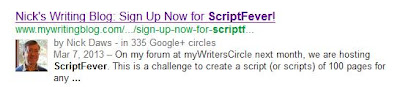
This has obvious advantages in terms of giving your posts added visibility and increasing the likelihood they will be clicked on.

In addition, though, using Google Authorship will boost your credibility and expert status with Google in topic areas you write about regularly. It will also help your original articles rank higher than sites that have (legitimately or otherwise) copied your content.

A further advantage is that if a user returns to their results list after reading an author-tagged search result for a certain period of time, Google will add three additional links to similar articles from the same author below the link they originally clicked. How cool is that?!

So far there is no evidence that articles with Google Authorship automatically achieve higher placings in search results – but as Authorship helps build your reputation, it is likely that in the longer term it will assist you in achieving higher search-engine rankings as well.

Before you can set up Google Authorship, you will need two things: a Google Account and Google Plus (also written Google+) membership.

If you use any Google services that require you to log in – Gmail being the best-known – you will have a Google Account already. Otherwise you can sign up here. It’s free and only takes a moment.

Google Plus is Google’s attempt to create its own social network to rival Facebook. Although it has failed to capture the public imagination in the way Facebook has, according to this recent article on ZDNet it now has over 343 million active users. That puts it ahead of both Twitter and YouTube (which Google also owns, incidentally).

Google Plus is already tightly integrated with other services such as Google search, which is a good reason to open an account in itself. You can check out my Google Plus page here, incidentally.

Assuming you have a Google Account, joining Google Plus is simple (and free). Just visit the Google Plus website to sign up. The Digital Unite website has detailed step-by-step instructions to joining Google Plus, if you need them.

With that done, you are almost ready to set up Authorship. There is just one more thing to do, which is to ensure that you have a good quality portrait photograph that Google can display in search results. You can upload or change this via your Google Plus profile page.

Setting Up Authorship

There are two main ways to set up Authorship. The first, and simplest, can be used if you have an email address on the same domain as the blog or website you want to claim Authorship for.

For example, if you want to claim Authorship for articles you write on www.mywebsite.com and you have an email address of writer@mywebsite.com, you could use this method.

In that case, visit the Google Authorship page and submit your email address to Google via the online form. Google will send you an email containing a link to click in order to confirm that this is indeed your account. Once you have done this, Authorship will be set up for the domain in question. The root domain will also be added to the list of items in “Contributor To” on your Google Plus profile page.

No matter how many articles or posts you publish on this domain, you should only need to do this once. For Authorship to work, however, it is essential that every article or post you write includes the word “by” (without the quotation marks) followed by your name exactly as it appears in your Google Plus account.

Note that doing this will also add your email address to the Work section of your Profile. By default this is viewable only by your Circles (people you have chosen to follow in Google Plus). You can keep your email entirely private if you wish, however, by editing the visibility settings in the Work section.

Of course, this method can’t be used where you don’t have control over the root domain, as is the case with many blogs on free hosting services such as Blogger and WordPress.com. The same may apply with blogs you have written guest posts for. In that case, you will need to use a two-step method.

First, go to your Google Plus profile page and click on “About”. Scroll down a bit and you should find a box headed Links. I’ve copied mine below…

As with all the images in this post, you can see a full-sized version by clicking on the image concerned.

Click on Edit at the foot of the box, and click on Add Custom Link in the “Contributor To” section. You will then be able to add the website concerned to the list of sites there.

That’s not enough for Authorship to work on its own, however. This is where Step 2 comes in. You will need to add a piece of code on the web page concerned that identifies you as the author. Here is the code I use:

The URL in the middle is that of your Google Plus Profile page, so you will need to navigate to this and copy it from your browser’s location bar. Obviously, the reference number of your page will be different from mine, but otherwise if you are on the correct page it should look similar.

The other crucial element to include is the ?rel=author tag directly after your Profile page URL. This tells Google that you are claiming Authorship for the post or article in question. The anchor text you use doesn’t really matter. I’ve used my name in the example code above, but you could put “Google Plus” if you prefer. In that case it will render as in the following example: Here is an Authorship link to Nick Daws’ Google Plus page. Either way, it should work without any problems.

To test that you have set up Authorship correctly, go to Google Webmaster Tools Structured Data Testing Tool. Enter the website’s URL in the box and click on Preview. A results page should then appear showing whether Authorship is working or not (and how it has been verified, using email or rel=author markup). Here are the results I got for this blog when I tried doing this just now:

As you will see, it wasn’t possible for me to use the email method for my blog, so I used the rel=author method.

Naturally, with guest posts you have written in the past, Authorship won’t work unless the necessary code is inserted. You might therefore want to write to the owners of the blogs concerned asking if they would be kind enough to add a link to your Google Plus page using the “rel=author” tag.

And that’s it, really. In this post I have tried to show you all the basics you need to know in order to claim Authorship of your blog and guest posts. If you need more help, Google Webmaster Tools has pages titled Author Information in Search Results and Link your content to a Google+ Profile using “rel=author”.

Good luck setting up Authorship. I hope that in this article I have convinced you that it’s worth doing, and it isn’t rocket science!

If you have any comments or questions, please post them [in the comments section on the original post, here], and of course I’ll help if I can.

This is a reprint from Nick Daws’ My Writing Blog.
Why I Chose An Assisted Self-Publishing Service

This post, by Debbie Young, originally appeared on How to Successfully Self-Publish on 3/28/13.

Horror stories of indie authors ripped off by unscrupulous assisted publishing services companies are enough to propel any author on the road to becoming a one-man self-publishing band. But in my view, you should no more let these few rogues tarnish the business of ethical service providers than allow your perception of banks to be dictated by hoaxters who email you for your pin number in order to empty your bank account.

Nor should you assume that the safest way forward is to go it alone unless you are prepared for some serious multi-tasking.

DIY self-publishers must add to their job title of writer all of the following positions of responsibility: copy-editor, proofreader, typesetter, graphic designer, cover artist, print manager, e-book formatter, legal services manager, distribution manager, delivery boy, sales-person, promoter and PR.

This demanding job description does not suit everyone, especially those who are already juggling a day-job, family responsibilities and a social life – oh, and writing their next book!

If you prefer to outsource your book’s production, you should feel free to do so — while still retaining the status of indie author. It’s just a question of choosing the right partner.

To help you do this, I’ve compiled a comprehensive checklist (below), with the help of my friend, Helen Hart. As the author of nine traditionally published YA novels, and director of my own preferred publisher, SilverWood Books, Helen completely understands the writer’s viewpoint and how important each book is to its author.

It doesn’t surprise me that her company has amassed an extensive list of clients who value her expertise, including well-known traditionally published authors who have turned indie (prize-winning author and broadcaster Sarah LeFanu, USA Today bestselling historical novelist Helen Hollick), established self-publishers of multiple books – Harvey Black and Gael Harrison, and many debut writers.

1) HIGH STANDARDS

On the shelf of a bricks-and-mortar bookshop, their books should not be stand out as self-published. Cover design, paper quality, format, blurb, internal layout – all of these features should equal those of traditionally published books. Ask to see samples of your prospective partner’s books. Touch them, hold them, read them. Download their e-books to check for layout and typos. Are they up to scratch?

2) CLEAR COMMUNICATIONS


Read the rest of the post on How to Successfully Self-Publish.

Publishing and Bad Publishing Are Not the Same Thing: A Publisher's Response to "An Agent's Manifesto"

This post, by Peter Ginna, originally appeared on Dr. Syntax on 4/1/12.

The London agent Jonny Geller stirred up a lot of discussion, and a flurry of Twittering, by posting “An Agent’s Manifesto” a week or so ago. Jonny contended that in the “maelstrom” of the current book business, authors are being forgotten, taken for granted by booksellers and, in particular, by publishers. The original post seems now to be behind a paywall but it’s extensively quoted here and here. He writes:

The author is not an object which a publisher has to step over in order to achieve a successful publication. If they have a problem with the cover, blurb, copy or format, then something isn’t right…Remember, we don’t have a job without [the author]. For those of us still working in the legacy business of publishing books, here’s a reminder of the primary mover in this chain.

A great many people retweeted his column or commented on it using words like “fantastic.” And his dim view of publishers was echoed elsewhere. At her blog, the novelist and ghostwriter Roz Morris had even more negative opinions of my colleagues:

It is common, behind the scenes, to hear editors talk about authors with undisguised loathing – not just individual ones who may be difficult, but all of them, authors as a breed. There is a culture that authors must not be listened to.

I have to say that I don’t buy these generalizations about our business.

I have worked at publishers large and small–two Big Six houses, a literary indie, a university press, and currently a house I’d describe as mid-size. Never, ever, at any of them, have I heard authors discussed with “loathing.” At all of them it was fully understood by editors, marketers, and management that the author is, in Jonny’s words, “the primary mover” in the publishing firmament. The whole enterprise would not exist without authors. To put it another way, as one of my colleagues says, “the author is our customer.” I simply don’t know anyone in publishing who thinks of an author as “an object we have to step over to achieve a successful publication.”

At Bloomsbury, we regard the author as a key partner in marketing the book, because as Jonny correctly observes, “the author is the expert” on the subject, setting, and likely readership of her book. We want to tap into that expertise, and use the author to help mobilize the networks of readers who are going to respond to what she’s doing.


Read the rest of the post on Dr. Syntax.