Top Self-published Kindle Ebooks of 2011 [Report]

This report, by Piotr Kowalczyk, originally appeared on Ebook Friendly on 1/14/12.

Will self-published books continue to expand? Is $0.99 price tag wearing out? Can we expect new success stories from independent authors?

2011 was an exciting year for publishing, full of events changing the landscape of the industry. Self-publishing exploded and became one of the most important factors to shape digital publishing in the near future.

I’m excited to share the report with as much facts and figures as possible to help forecast how the self-publishing phenomenon would evolve in the years to come. To get the bigger picture, read also 2011 self-publishing timeline.


The report is based on figures from Kindle Store bestsellers archive and consists of five parts. You can jump directly to each one of them from the links below:

1. Highlights – most important facts & figures
2. Tables & charts – based on yearly and monthly lists
3. Description – how the data was collected
4. Overview – analysis of important events and trends
5. Conclusions – predictions for the future

1. Highlights

Average price of a self-published book in 2011 was $1.40, vs. $8.26 for all books in Top 100

There is a downward trend in both the number of books and the average price

John Locke is the author with the highest number of books in a single monthly list – 8 titles

Five authors stayed in Top 100 for at least 6 months – Barbara Freethy, Darcie Chan, John Locke, J.R. Rain and Michael Prescott

There are 18 self-published titles in a yearly Top 100 for 2011 (not a single self-published book in Top 100 for 2010)


2. Tables & charts

Table 1: Self-published books in Top 100: Summary Jan-Dec 2011

Data collected from Kindle Store Bestsellers Archive monthly lists. Click on months for detailed tables.
  Jan Feb Mar Apr May Jun Jul Aug Sep Oct Nov Dec
No. of self-pub books in Top 100: 13 26 27 26 22 13 17 26 20 20 18 13
No. of self-pub books in Top 50: 8 17 17 16 5 7 9 13  10 12 11 4
No. of self-pub books in Top 10: 2 3 4 1 0 1 1 4 4 3 0 1
Best self-pub book ranked at: 6 4 1 6 19 6 9 2 2 2  12 6
No. of $0.99 self-pub books: 7 17 16 16 18 10 11 19 12 11 14 11
Share of $0.99 self-pub books: 54% 65% 59% 62% 82% 77% 65% 73% 60% 55%  78% 85%
Average price of
a self-pub book:
$1.99 $1.72 $1.62 $1.62 $1.58 $1.61  $1.71 $1.68 $1.53 $1.70 $1.38 $1.34
Most expensive self-pub book: $3.99 $3.99 $3.99 $3.99 $4.99 $4.99 $3.99 $3.99 $2.99 $4.61 $2.99 $3.49

Chart 1: Number of self-published books in Top 100: Jan-Dec 2011

Based on data from Table 1.

Number of self-published books in Kindle Store Top 100: Jan-Dec 2011


Read the rest of the report, which includes many more tables and charts as well as detailed analysis, on Ebook Friendly.

Lazy Book Designing

My eyes are stinging and my brain is dizzier than usual. I just finished reading for my bookstore’s review two excellent young adult books for consideration of including them on our shelves and hand-selling them once we do. OK, so why the physical impacts?

Both books were interior designed using serif-less fonts. They’re OK for ads or internet usage, but they are horrendous for reading on paper. Why? and Why were they used? Ah, here is my best guess. It may all be about laziness on the part of the interior designer/typesetter. Follow along as I explain more:

Text fonts that use serifs are easier to read. The serifs, those little tittles that come to points on each letter’s lines, bring closure to the letters. They let the eye know what the each letter is (try to figure out if a letter is a capital I or a small L in a sanserif font). Reading the text in a book without that help is daunting at best.

The two books I read were The Eleventh Plague and Cinder, and both were excellent, except for the typesetting. I know whereof I speak. I am an interior designer for books and a design judge for the Ben Franklin Awards. Neither books would have made it to the Ben Franklin finals but would have been rejected out of hand immediately.

So, why would a designer use sanserif fonts for his text paragraphs? I don’t know for sure, but I’d guess it was done out of sheer laziness or for a publisher’s cost cutting guidance. Many people prefer using sanserif text fonts for computer screens, where serifs can become too complex for screen resolutions. For this reason, many ebooks are set with sanserif text fonts. OK, so the designer makes the ebook version first thing since they are cheaper, easier, and quicker to publish. Why go back through and change all the text paragraphs to serifed fonts. After all, they are wider (which may add to the page count) and may create some widows and orphans that weren’t there before (again screwing up the layout throughout the book).

It’s my guess that is what happened with these two books I just struggled through to read with my aging eyesight. I think that many self-publishers may fall into this trap as well (both these books were from major publishers). Give your readers a break and design your books correctly. There is a reason for every designing tradition and standard practices.


This is a reprint from Bob Spear‘s Book Trends blog.

The End of Bookmarks?

I was packaging a book for my editor and realized I only had one [promotional] bookmark left. I wrote on my to-do list: Order more bookmarks? The fact that I put a question mark after the notation indicates just how much this industry has changed. Even a year ago, having bookmarks on hand seemed essential. I would have never let myself even run low, let alone run out completely. Yet now, I’m not sure I should spend money to buy more.

In the past, many of my bookmarks went out with books I mailed—review copies, contest winners, gifts—or with books I sold at events such as the Holiday Market and at book signings. I’ve also given away hundreds at conferences like Bouchercon and Left Coast Crime and at literary events in Portland, like the Library Association’s annual meeting.

But I send out fewer print books with every new release. I recently published Liars, Cheaters & Thieves and only sent out seven review copies in print. Two years ago, I would have sent thirty. But I no longer waste money mailing books to organizations that have never reviewed my work. I used to think it was worth the $8 each ($5 for the book, $3 for mailing), in the off chance that I might get a national print review. Now I don’t bother. And most of my regular reviewers want digital copies instead.

I also used to drop off bookmarks at our Borders store every two weeks, but we all know what happened to that.

In addition, I’m attending fewer conferences and events. For example, I no longer drive to Portland (five hours on the road) to sit at a table in the Willamette Writers booth for two hours passing out bookmarks. It’s simply not worth it. (Driving and sitting in bad chairs are very hard on my knee.) And I did my last bookstore event in late 2009 (seven hours on the road!). Last year, the only conference I attended was Left Coast Crime, and that will likely be true again this year.

Don’t get me wrong. I love conferences! I love meeting people and hanging out with my writer/reader friends. But conferences are expensive, and travel out of Eugene is a royal pain. To get to Bouchercon, I have to take three flights, and each descent makes me physically ill. I can’t justify the financial or physical costs anymore. And people at conferences are not picking up bookmarks like they used to.

If I buy bookmarks, what am I going to do with them? Most of my readers purchase ebooks and have no use for bookmarks any more. Yet I can’t stand the idea of not having any, because I also pass them out to people I meet instead of handing them a business card.

So I’ve decided to buy a few. But this time, I’ll order 200 instead of 2,000. And it will likely be the last time I purchase bookmarks—another staple of the industry disappearing.

It makes me a little sad. What about you? Do you still use bookmarks?


This is a reprint of a post that originally appeared on the Crime Fiction Collective blog, and it is provided here in its entirety with the site’s permission.

The Death of Canadian Book Publishing

This post, by Thad McIlroy, originally appeared on The Future of Publishing on 1/10/12.

Cultures die symbolically.

Canadian culture took a major hit on Monday with the sale of Canada’s most important book publisher, McClelland & Stewart. Canada’s largest university, the University of Toronto, took a gift horse and sold it to the Bertelsmann AG, the fifth-largest book publisher in the world, via its proxy, Random House of Canada. Random House of Canada is owned by Random House in the United States which felt that news sufficiently important to fail to issue a press release today. Likewise the University of Toronto.


Why do I feel that I’ve seen this film before? But that last time it had a happy ending.

As reported in The Canadian Encyclopedia, “Widespread publicity and concern was aroused by the announcement in 1971 that M&S was for sale. The Ontario government decided to provide a $1-million loan to prevent its sale to American interests. In 1984 the government again stepped in, freeing M&S from its debt obligation (some $4 million). This action depended on McClelland being able to raise over $1 million from the private sector; his success at this endeavour was an acknowledgement of M&S’s contribution to Canadian culture.”

As reported in The Globe & Mail today: “Before announcing the transaction, Random Canada quietly approached the office of Minister of Canadian Heritage and Official Languages James Moore to seek an exemption from long-established provisions of the Investment Canada Act, which specifically outlaw such takeovers. The company reported that Mr. Moore granted the approval ‘on the basis of the commitments we made that demonstrated that this investment is likely to be of net benefit to Canada.’”

What a difference 40 years makes.

For more information, see Roy MacSkimming’s The Perilous Trade: Book Publishing in Canada, 1946-2006.

Perilous indeed.

By coincidence the ebook will be published tomorrow by McClelland & Stewart (div. Random House of Canada). It’s available tonight for pre-order on Amazon.com, but sadly not on Amazon.ca, nor on Chapter/Indigo, “Canada’s online bookstore,” Canada’s remaining national book chain (the one that’s getting out of books).

But, you say, how can that be? Even before today the very capable Random House was in charge of sales and marketing for McClelland and Stewart. Yes, I know. And they spell Macskimming with a lower-case “s”.


Read the rest of the post on The Future of Publishing.

Ten Bold Predictions for Book Publishing in 2012

This post, by Jeremy Greenfield, originally appeared on the Digital Book World site on 12/19/11.

It’s been a stormy year for book publishing, with many major players in the industry making big changes. In 2011, Amazon became a publisher, more best-selling authors sprouted out of what once was the slush pile and publishing companies migrated business from print to digital at an accelerated rate.


Some of the events of 2011 were of the “you coulda seen it coming” variety – Borders closing or Random House going to the agency pricing model. Much of it, however, was shocking – think big-six publisher HarperCollins acquiring Nashville-based Christian publisher Thomas Nelson.

Now that 2011 is coming to a close, what’s on tap for 2012?

We spoke with book industry experts, observers and players to get their bold predictions on what extraordinary events await us in the coming twelve months.

Hear more insight into the future of the book business at Digital Book World Conference + Expo 2012, this January 23-25 in New York. More>>>

1. We will see more self-published best-sellers next year with an exponential rise in the number of million-selling authors.

In November of 2011, the Kindle Million Club – a list of authors who have sold over 1 million paid copies of their books on Amazon’s Kindle store – swelled to 14 with the addition of David Baldacci, Amanda Hocking and Stephenie Meyer.

“This may have serious implications for traditional publishing houses,” said Dr. Windsor Holden, research director at Juniper Research and one of the authors of Juniper’s recent report on the future of the book publishing industry. “By facilitating publishing, Amazon, Barnes & Noble and others are eroding the position of the publisher in the value chain in much the same way Apple eroded the gate-keeping role of the carriers when it introduced the app store.”


2. Large publishing companies will go through major restructurings, creating new positions and redundancies of all shapes and sizes.

As more of what publishers do falls outside of what publishers used to spend the vast majority of their resources doing, people who work in publishing will likely have different roles, new positions or find that they are out of a job altogether.

“In 2012, we’ve had a number of years of digital under our belt,” said Peter Balis, director of digital content sales for John Wiley & Sons, the Hoboken, NJ-based professional, academic and trade publisher. “In a challenged economy, you’re going to see some big changes.”

Some of the changes might include hiring more marketers and in-house software, e-book and app developers, and slimming down sales departments and having fewer acquiring editors, according to Mike Shatzkin, a long-time book-industry expert (and, full disclosure, partner with Digital Book World on the upcoming Digital Book World Conference and Expo in January 2012).

“Print sales are going to decline and e-book sales are going to rise and that is going to result in organizational changes,” Shatzkin said.

3. Amazon will come out with a larger tablet with an 8.9-inch screen and it will be priced at $299 or lower.

The seven-inch Kindle Fire tablet has burned up the sales charts, with over 1 million per week being sold, according to Amazon. Yet, there has reportedly been some user disappointment with the product, much of it centered around a too-small screen.

“If you look at the critiques that have come in on the tablet, there have been a significant amount of users who feel the device is too small to do everything they want to do,” said Rhoda Alexander, senior manager for tablet and monitor research at IHS iSuppli, an El Segundo, Calif.-based technology research unit of global research firm IHS.

But don’t count Apple out, because…

 
Read the rest of the post, which includes 7 more predictions, on Digital Book World.

Some Things That Were True About Publishing For Decades Aren’t True Anymore

This post, by Mike Shatzkin, originally appeared on his The Shatzkin Files blog on 1/9/12.

Back when my father, Leonard Shatzkin, was active with significant publishers — the quarter century following World War II — he observed that very few books actually took in less cash than they required. That is not to say that publishers saw most books as “profitable”. Indeed, they didn’t. They placed an overhead charge of 25% or 30% or more on each book so most looked unprofitable. But that didn’t change the fact that the cash expended to publish just about every book was less than the cash it brought back in.


The exceptions were usually attributable to a large commercial error, most commonly paying too much of an advance to the author or printing far more copies than were needed. But, absent that kind of mistake, just about every book brought back somewhat more revenue than it required to publish it.

This led Len to the conclusion that the best strategy for a publisher was to issue as many titles as the organizational structure would allow. That was a lesson he passed along to the next generation of publishing leadership that came under his influence. And the leading proponent of that business philosophy was Tom McCormack, who worked for Len at Doubleday in the late 1950s, then went on to Harper & Row before he ascended to the presidency of then-tiny St. Martin’s Press in 1969. Tom often credited the insight that publishing more books was the path to commercial success as a key component of the enormous growth he piloted at St. Martin’s over three decades.

(I checked in with Tom, who is long-retired as a publishing executive but a very active playwright, about how many books didn’t claw back the cash expended. He told me that his “non-confirmable recollection” is that the percentage that did at least get their money back ranged from 85% to 92%. He recalls “incredulity” from his counterparts in other houses, whom he believes simply couldn’t “wrap their minds around the meaning of the statistic: revenues minus disbursements.” He went on to tell me that this number “seemed effectively irrelevant to them. They had an overriding and deeply flawed notion of something they called title-profitability. They thought they were analyzing the profitability of a title with their ‘p&l’.”)

Despite the apparent immutability of the fact at the time that most titles brought in incremental margin, many publishers who were losing money would come to the opposite conclusion. They would decide they should cut their lists, pay more attention to the titles they published, and create more profits that way. I remember discussing the futility of that approach in the 1980s with my friend and client, Dick McCullough, who was at that time the head of sales at Wiley. When I observed that the publishing graveyard was littered with the bones of publishers who pursued cutting their lists as the path to profits, Dick said of their efforts to cut “yes, and very successfully too”.

I got another lesson about this reality in the late 1980s when a company I consulted to (Proteus Books) sued its distributor (Cherry Lane Music) for a failure of “due skill and competence” in the sales efforts for Proteus Books. One of Proteus’s expert witnesses was Arthur Stiles, who had been Sales Director at several companies, including Doubleday, Lippincott, and Harper & Row. Stiles confirmed that big and competent publishers routinely put out thousands of copies of titles in advance of publication, with extremely few failures in terms of getting the initial placements. He was testifying in a time that was still like what my father experienced: the industry’s title counts were growing, but so were the the number of bookstores in which they could be placed.

Those days are over. And, coupled with the ebook revolution, the implications of that are profound.


Read the rest of the post on The Shatzkin Files.

The Publishing Cart Before the Storytelling Horse

This post, by Chuck Wendig, originally appeared on his terribleminds site on 10/5/11.

I got a little rant stuck between my teeth. It’s like a caraway seed, or a beefy tendon, or a .22 shell casing (hey, f*** you, a boy’s gotta get his vitamins and minerals somehow).

Self-publishers, I’m talking to you.

[Publetariat Editor’s Note: strong language after the jump]

And I’m talking to the pundits, too. In fact, I’m talking more to the pundits than to those actually walking the self-publishing path. Not everybody. Just a handful.

If you get a little froth on your screen, here — *hands you a squeegee* — just wipe it away.

Here, then, is the core of my message to you:

It is time to upgrade the discussion.

Let’s talk about what that means.

First, it means: we get it. Self-publishing is the path you’ve chosen and further, is a path you believe is lined with chocolate flowers and hoverboards and bags of money and the mealy bones of traditionally-published authors. Self-publishing is a proven commodity. You can stop selling the world on its power. This isn’t Amway. You don’t get a stipend every time another author decides to self-publish. You’re not squatting atop the pinnacle of a pyramid scheme. (And if you are, you should climb down. One word: hemmorhoids.)

Instead of trying to convince people to self-publish, it may in fact be time to help people self-publish well. While self-publishing may by this point be a proven path it doesn’t remain a guaranteed path. In fact it’s no such thing: I know several self-published authors out in the world with great books, kick-ass covers, and they are certainly not selling to their potential. In fact, if they continue to sell as they appear to sell then I would suggest these books would have done much better had they been published — gasp — traditionally. Succeeding in an increasingly glutted space is no easy trick. Every bubble pops. Every gold rush either reveals a limited supply or instead ends up devaluing the gold one finds there. The reality is that it’s going to become harder — note that I didn’t say impossible — to succeed in that space and so it behooves the Wise Pundits With Their Long Beards to acknowledge the realities and help authors do well.

It may then be a good time to acknowledge some of the challenges of self-publishing rather than ignoring them. Filter, for instance? Dogshit. Total dogshit. Discovering new self-published authors is left almost completely to word of mouth or to the marketing efforts of one author’s voice. The discovery of just browsing a bookstore and finding great new stuff to read is gone. Amazon offers little in recompense: browsing there is like trying to find a diamond in a dump truck full of cubic zirconiums. Marketing as a self-published author is a whole other problem: it’s tricky as hell. Half the self-publishers out there still manage to sound like Snake Oil Salesman — myself included — and so why not try to discuss the best practices? Why not talk about the way forward?


Read the rest of the post on terribleminds.

4 Nifty Apps to Organize and Store Ideas

The need to organize your thoughts and store new ideas isn’t just a writer’s thing. I find myself needing to capture ideas for all kinds of things, as does DH (who knew there were so many Star Wars hobby ideas? :) ).

If you’re cruising the ‘net on your laptop or smartphone and come across a cool web site you want to find again, it’s pretty easy to simply email yourself a link. But what happens when you go back to your inbox? Lots of clutter and the need to shift all those self-mailed emails into various folders (or you can do what DH does and just leave them in the inbox. Type A personality nightmare! :o )

There’s a better way.

If you’re a little tech savvy and prefer having your ideas accessible at any time from any computer or gadget, I suggest signing up for a free Evernote account.

What makes this app great is the ability to clip web articles, add tags and comments, and save it all to one of several notebooks you set up. Not only can you save things from the web, you can include pictures you’ve taken on your smartphone and do the same thing.

Oh! And did I mention you can take a picture of restaurant menus, wine labels, anything with text and do a search for a word in the picture? No tags necessary. Cool!

I’ve even used it to keep track of things I planned to get for the Blonde Blur (formerly Tiny Tot) for Christmas. Just take a picture of the item at the store, tag it, and save it to the appropriate notebook. Voila! No more trying to explain to DH what toy I was talking about when we were narrowing the ideas down to fit the budget.

These things alone make Evernote a great app to have. You can use it as a writer’s tool or for any thing you can think of that needs ideas easily accessible.

What about brainstorming?

Creative types, especially writers, often have ideas for their current project at odd hours. Often times, those ideas are just bits and pieces that may or may not link to other bits and pieces of a given project.

For example, I’m brainstorming ideas for my second work of fiction (Apprentice Cat is in the “resting” stage).

Roz Morris suggests in her book Nail Your Novel using a hatbox method. Basically you scribble your idea on a piece of paper and throw it in a hat box for later. I loved the idea, but, being a geek and a Type A personality, I wanted something just a bit more structured and digital.


Enter Free Mind and Thinking Space (now called MindJet, apparently).

Both are mind mapping software. Free Mind works on my laptop, Thinking Space on my smartphone.

The only hitch to this perfect solution is that they don’t work together and I’m not willing to pay for a program that will.

At least not yet.

And for those longer items?

I like to be able to access my blueprint for a book and what I’ve already written anywhere at any time. For those times I depend on the cloud.

Until I read Joel Freidlander’s post Life in the Cloud, I hadn’t really given it much thought. I just carried a big bag with everything printed out. Not very efficient, but what else could I do?

Then I heard about “the cloud” and I had to know what it was. When I discovered it was a way to save just about anything in the etherworld and there were free options, I jumped on it. I’d already begun using Evernote for my notes, why not find something to do the same with my documents?

I won’t say Google docs is the perfect solution. I lose nearly all my formatting from my Word documents, at least for the comments and such, but it’s great for just reading what I’ve already done.

It’s also a great way to simply store documents, like a backup drive that’s available at any time for any computer or smartphone.

There are many other apps available for our organizational needs. It’s just a matter of a little research and the willingness to test them out.

What apps or gadgets have you discovered to fit your needs?


This is a reprint from Virginia Ripple‘s blog.

Upcoming Book Awards and Contests

Publetariat Editor’s Note: Publetariat is not affiliated in any way with the awards or competitions mentioned in this article, offers no specific opinion on any of them, and receives no compensation for their mention on this site. 

Deadlines are coming up soon for several book award competitions.

Winners of the Amazon Breakthrough Novel Award will receive a publishing contract with Penguin Books. Entries are accepted from January 23 through February 5, 2012, and it’s best to enter as early as possible. Unpublished manuscripts and self-published books are accepted.


If you published a book during 2011, consider entering one or more book awards programs to generate recognition and publicity for your book. There are a number of these competitions, and the entry fees can really add up, so you’ll want to be selective. Here are deadlines for several popular award programs:

The Ben Franklin Awards, sponsored by IBPA, is considered by many to be the most prestigious award for independent publishers. The deadline for entries has been extended to January 15, 2012.

ForeWord Book Awards – $1,500 cash prize, sponsored by ForeWord, a book review publication (January 15)

Nautilus Book Awards – for nonfiction books (January 31)

Next Generation Indie Book Awards (February 24)

IPPY Awards  (March 15)

National Indie Excellence Book Awards (April 15)

Writer’s Digest Self-Published Book Awards – $3,000 cash prize (April 20)

There are also award competitions geared toward specific types of books. See this list for ideas. Be sure to read the eligiblity and submission instructions carefully when entering. 


This is a reprint from Dana Lynn Smith‘s The Savvy Book Marketer.

Goal Setting for Writers

So many of us become interested in a fresh start at this time of year. We want to do better, get more done, become more successful, etc. For writers, this can include a number of approaches such as:

  • Work or projects accomplished
  • Entering new areas
  • Improved skills
  • Improved discipline
  • Greater recognition

Work or Projects accomplished– This pertains to getting the work done. Goals in this area are focused on various combinations of word counts, pages, number of articles or projects such as books written. Whatever it is, try not to bite off more than you can chew. Be realistic and plan ahead. In the military, we use a method called backwards planning. If you want to plan an attack for a certain time, start at that time and work backwards as to what must be done before that attack is accomplished in reverse order. For example: Let’s say you want to write a book and submit it to an agent/publisher or begin the self-publishing process. What’s the last thing you’ll have to accomplish in that process. If it is to submit the manuscript first, you’ll need to write a query letter or proposal package. Before that happens, the ms will need a final proofing. Before that, you’ll need a professional edit. Before that, you’ll need to go through the self-edit process. Before that, your final draft needs to be finished. Before that, you will need to write the book. Before that, you should outline the book. Before that, you will need to come up with a character bible/data-base. You should have conducted a good bit of your research before that. Before that, you will need to come up with a problem(s) to be solved or a theme and context.

Note, each one of these steps takes time. Some can be done simultaneously with others. Each takes a finite amount of time and effort. By doing a planning process like this, it will insert a degree of reality as to what is doable. It will also provide a series of sub-goals and steps to be accomplished and you will be forced to consider most of what needs to be done.

Related to all of this is setting realistic work effort goals such as when you will work, how long you will work, and how much you will get done each time you do.

If you’re working on projects of lesser scopes, such as magazine article, you can still use a similar planning process, but do it multiple times.

Entering new areas– Lets say you have been writing mysteries or thrillers but would like to try your hand at a different genre this year, such as paranormal romance. Lately, a number of well-established writers have been doing this when they depart from adult writing, changing over to young adult or mid-grade level writing in an attempt to capture more of a market earlier on. There are several important things which must take place before doing that, specifically: read, read, read. Become familiar with what that new genre or form looks and feels like. What kind of structures and language are used? Who are the big-gun writers in the new field and what are their reputations based on?  What’s done and what’s not done and why? Who in the industry specializes in the new area and how should they be approached, be they agent, publisher, reviewer, or market segment. You probably did something like this when you initially began writing in your specialty. Now you have to do it again.

Improved skills– So you want to be a better writer, then you need to learn to do so through self-study and with help from professionals. Although I have written several screenplays, I knew I wasn’t writing them as well as I could be. I had read “Screenwriting for Dummies” and several other good books on the subject. I had also read a number of screenplays of successful movies. I watch a lot of movies and TV episodes on Netflix. Still, that wasn’t enough. I finally signed up for and took a 10-day intensive internet course in subtext writing. I count the tuition I had to pay as an investment in myself. Do you see a pattern here? I did my due diligence with my self-study at several levels and still paid for professional guidance. I’m not saying I will now write great screenplays, but I know what I write will be much better than when I first began buying formatting software and trying my hand at it back in 1997.

Improved discipline– Be firm with yourself. If you set goals, work toward them on a regular, systematic basis. It’s just like setting weight-loss goals. You have to do it the right way and work at it constantly. The key word here is “work.” Have you ever met someone who is constantly talking about their someday dreams but who do nothing to actualize them? All the dreaming in the world will be for nothing if you don’t make the efforts to make them happen. New Years always puts people in the frame of mind to set goals, but that’s the easy part. The hard and meaningful part is attaining them.

Greater recognition– The most successful writers understand how important it is to gain recognition. They are always marketing themselves through the social media, industry organs, public appearances, and creating a fan base. The book industry is like the music industry. Who knows of you and who will buy your product? As iffy as this business is, the powers that be will always consider someone with a strong fan base or platform before they will consider a complete unknown.

OK, this may not be everything, but hopefully it will give you a few things to consider when setting those New Years goals.


This is a reprint from Bob Spear‘s Book Trends blog.

Finding Photographs for a Book or Blog Gets Better

I wrote about where to find free or inexpensive photos for your blog or book back in February 2010. Since that time I’ve mostly used Flickr and iStockphoto, where you can buy credits as you go and many web-size images are very inexpensive.

For the first time, I’m starting to use both Flickr and paid-for stock differently. Here’s why.

A few months ago I got a free month’s worth of downloads at Fotolia, the huge online stock photography and art site. They have websites in 11 languages and in 15 regions of the world.

What’s more important, Fotolia hosts 15,547,533 royalty-free photos, the last time I looked. I had a great time browsing images for covers, and found some great ones.

But what really pleased me were a couple of little interface enhancements. These types of things make a big difference. When researching images for book covers, it’s not unusual to look through 500 or 600 photos at a session. Something that’s inconvenient once becomes maddening when repeated enough.

Here’s the detail screen from iStockphoto. Just below that is the one from Fotolia.

istockphoto-detail

^  The iStockphoto image size chart for downloads

fotolia-detail

^  The Fotolia image size and download chart.

Using iStockphoto I always have to calculate what the image is going to cost me, converting “credits” to dollars. Fotolia makes it much more clear, once you realize these are the lowest possible prices. Typically you’ll pay about twice as much if you buy credits as you go.

The best deal is the subscription, if you use a lot of images. During the month I had the Fotolia promotional subscription I used it a lot, since you could download as many images as you wanted, and most images seemed available.

The other enhancement is the hover tool. Placing your mouse cursor over an image thumbnail in search results gives you an enlarged view of the photo. Here are the hover boxes from both services:

istockphoto-hover

^  iStockphoto hover box


fotolia-hover

^  Fotolia hover box

The iStockphoto hover gives you the name of the image and little else. The Fotolia hover box includes the sizes available for license, the credit requirements for the smallest image, the number of times the image has been viewed, and the number of downloads. This can save an incredible amount of time.

Flickr Out in the Open

Another approach to saving time on image search is a nifty utility called Compfight (Compfight.com).

Using Flickr’s programming interface, Compfight has built a search utility that’s quite a bit faster than Flickr’s own advanced search.

Compfight.com

^  Compfight interface – click to enlarge

Compfight is a beautiful example of a single-use interface that’s been refined by people who actually use it. With a few clicks you can set your search parameters and get a beautifully-presented and customizable screen full of image results, mostly from Flickr.

Compfight.com

^  Compfight in hover mode

Notice in the search results that many images have a blue stripe at the bottom, indicating they are available on Flickr. Hover your mouse cursor over one of these, and Compfight will helpfully show you the image size in pixels, another great timesaver.

Compfight has become by far the easiest way to use the amazing collection of images on Flickr, and Fotolia has enough enhancements and beautiful images that it might well surpass iStockphoto. If you use stock images, make sure you take a look at these services.

Note: Be careful with the licensing of images on Flickr. Amateur photographers may not realize you need model releases from recognizable private individuals to use their likeness in commercial ways.


This is a reprint from Joel Friedlander‘s The Book Designer.

Moving Toward Amazon Only

And the craziness continues. Yesterday The Sex Club, which is now selling well again, was suddenly being discounted on Amazon from $2.99 to $.99. Which means, I was suddenly making a third of the money. After cursing loud and long, I tracked down the culprit. Kobo was selling the title at $.99—even though I requested they take it down two weeks ago.

I requested the takedown because I enrolled The Sex Club in the Kindle Select program and it requires exclusivity. So the fact that it’s still selling there could also get me kicked out of the program. I’m doing everything possible to correct this, but retailers are notoriously slow about taking down books, especially if they’re selling.

I distribute to Kobo, Sony, and various other retailers through INgrooves, and this is not the first time I’ve had to deal with the discounting issue. For those not familiar, here’s the short version: Amazon will not be underpriced. If a competitor puts an ebook on sale, Amazon matches the price. This can be a serious problem for authors who make most of their money from Amazon and need to control what price their books sell for on Amazon.

When I starting losing money on Amazon, I see my mortgage payment for the next month disappearing. Which leads me to strongly consider withdrawing all my books from INgrooves. The small amount of money I make from other retailers is offset by the profit I lose from the discounting issue.

My only hesitation, as always, is readers. I want them to have full access to my books, regardless of their e-reader device. But I’m running a small publishing business (Spellbinder Press), and I have to make smart business decisions. I have to be able to track and predict profit.

Also, I have to remind readers that my ebooks are available for purchase from my website.

Other writers tell me I should upload to Smashwords as my distributor, but that doesn’t fix the discounting issue. And I’m tired of continuously having to scan the other retailers to ensure they’re not undercutting my ability to make a living from Kindle sales.

Pulling my books from INgrooves would leave me with ebooks available on Kindle and Nook only. But what I sell on B&N/Nook every month won’t even pay my cell phone bill.

After I see my first bonus payment from Amazon for enrolling in the Select program, I’ll have to decide whether keeping my Detective Jackson books on B&N is actually worth it. I predict I’ll be exclusive to Amazon by the end of the next year. Some people may see this as a sell out. But I have to make a living, and I’m worth more than minimum wage.

Readers: Can you sympathize with this decision?

Writers: How do you deal with the discounting issue?


This is a reprint from L.J. Sellerssite.

2011 Round-Up. Achievements, Reflections And What Could Be Improved

I’m one of those people who thrives on goal-setting and measurement. I’m always setting new goals and although I often change direction, I tend to achieve more than if I set none at all.

It is important to celebrate achievements so this is my annual round-up. It’s not meant to be horn-tooting, more of a record of the year.

I hope you have learned a lot from The Creative Penn in 2011 and I look forward to serving you further in 2012. I’d also love to know if you achieved your goals this year before we all set new ones in the coming days.


Fiction Writing

Pentecost, my first novel, was published in Feb 2011 and has now sold 16,034 copies.

Prophecy, the 2nd in the ARKANE series was published yesterday on the Kindle. Print, Nook & other versions to come in Jan but I still got it out in 2011! I won’t be officially launching it until January 20th but it is available on the Kindle store if you’d like to purchase!

I’m pretty excited about the future of fiction with digital publishing. I’ll be exploring more in this arena in 2012 and onwards. I have so many creative ideas I want to explore.

I have also started a blog for my fiction fans, JoannaPenn.com where I will be adding information about my research and more.


The Creative Penn

This blog has now reached it’s 3rd birthday (hoorah!) It has won the Top 10 Blogs for Writers for the 2nd year running (as one of the Top 10 after 2100 nominations and comments). I’m really pleased with that so thank you if you nominated me.

In terms of growth and online platform, I shall record figures here for posterity as it’s good to revisit these regularly and this has become my annual checkup.

There are currently 3162 subscribers to this blog on Feedburner, 6585 subscribers to the newsletter, 23,279 followers on Twitter, 2418 on Facebook/TheCreativePenn and 1034 on Google+. Considering I’ve only been on Google+ for a few weeks, I’m interested to see how fast that is growing and the engagement over there. I may well give up Facebook in 2012! (but never Twitter!)

The Creative Penn podcast has now reached 113 episodes. There have been 41,358 downloads, at around 3400 per month in the last few months. The top listening countries are US (53%), China (12%), UK (10%) and Australia (7.4%).

In light of all this, I may be looking for some sponsorship for the podcast in 2012! If you’re interested, please do email me direct.

The most popular podcast has been On Changing Your Life, Writing and Marketing a Book which just happens to be an interview with me! You can download the backlist here – there’s over 60 hours of free information on writing, publishing and book marketing with more every week.

My YouTube channel The Creative Penn has 395 subscribers and has had 63,997 views of 122 videos. The top videos have been Tips for Publishing on the Kindle (3690 views) followed by Pentecost Book Trailer (2544 views). The top countries are US, UK, Australia and Canada. Demographics: 51.4% male, 48.6% female. Over 50% in the 45-54 age bracket. Although this isn’t spectacular, I will continue to invest in video as I think it is a growing market and the more I do, the more I enjoy it!

Transition to full-time author-entrepreneur
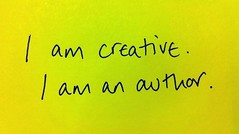
This wasn’t even something I thought would happen this year but a combination of circumstances have made it so.

I left my consulting job of 13 years for the more precarious, but rewarding, life of an author-entrepreneur. I have also moved hemispheres from Brisbane, Australia to London, England.

For the full story, read “I am creative, I am an author. From affirmation to reality.”

For this transition, I primarily thank Amazon Kindle for the KDP publishing platform, and WordPress for enabling this blog as well as Twitter for my network. Together, those services have changed my life!

If you’d like to invest further in your education, I now have the following products available for sale, with a focus on mini-modules, not full-blown courses:

I shall be expanding this digital product range in 2012 and rewriting the Author 2.0 Blueprint and modules in order to update everything to this ever-changing market.

How did I do against my goals for 2011?

Here are my New Year’s resolutions from Jan 2011.

  • Publish Pentecost – achieved.
  • Go to ThrillerFest in New York in July & pitch a publisher. I cancelled this trip as we moved from Australia to London in May which changed the budget somewhat. I would still love to go to ThrillerFest and the flight would be cheaper from London. I’m not so bothered about pitching to an agent now though. I am very happy being indie at the moment. I do have a goal of 50,000 book sales and then I may decide to approach an agent.
  • Finish Prophecy – achieved.
  • Launch a new blog for mystery & thriller lovers. I did launch MysteryThriller.tv but to be honest, I have now stopped doing reviews on video and am just reviewing books I like on Amazon & Goodreads. I don’t have the bandwidth for more reviews in general. The aim was to get some advertising revenue from the blog but it wasn’t justifying itself in terms of time and effort. I can make more income from writing fiction and this blog, so I won’t be continuing with that. So yes, I achieved it, but it was a misplaced goal. You can follow my reviews on Goodreads here.
  • Enjoy 1 day unplugged a month. Hmm, I don’t think I achieved this … I continue to be a driven person who isn’t very good at stopping. My husband says I am like a Ferrari with no fuel gauge. I only stop when it all falls apart. This is my natural rhythm. I have tried meditation again this year but it stops after a few days. I continue to journal a lot though, which is a kind of meditation. I definitely do unplug, but not regularly enough.
  • Learn more about grammar, language and the craft of words. I have specifically read prize-winning literature and poetry in order to glean more about language. I continue to listen to podcasts and do training as well as read books and of course, interview people. I also learn A LOT from having my own work edited. If you read Pentecost and then Prophecy, I hope you can see improvements in my writing. So, achieved.
  • Continue to expand The Creative Penn. I’ve definitely achieved this but it’s not a stretch goal. It’s more of a maintenance activity now. I LOVE this blog, it brings me so much enjoyment to be useful to you and to share the journey. So please do keep commenting and keep emailing me with your questions.

[On January 2nd] I will be sharing my goals for 2012.

How did you do with your goals for 2011? Please do share your achievements and how it went. Let’s keep each other honest!


This is a reprint from Joanna Penn‘s The Creative Penn.
Shifting Parameters: Editing Genre and Experimental Writing

This post, by J.P. Hansen, is a reprint of an article that originally appeared on his The Art of Polishing Words site on 11/26/11. It is reprinted here in its entirety with his permission.

Recently, I had the privilege of editing a fantasy novel. The job, it turned out, was fairly easy: I had to make suggestions about the delineation of characters, creation of vivid scenes, and formation of quality sentences.
 
Why was this job easy? Because it involved a genre novel which conforms to clearly defined characteristics. The novel’s very category provided me with parameters for editing. What are the expectations of fantasy? The characters need to seem larger than life and involved in epic-like dramas.  The scenes need to convey intense drama and action. And the sentences need to be clear and plainly written.

 
Next, I edited an experimental, mixed-genre manuscript, and all parameters went by the wayside. In fact, experimental literature by definition is writing in search of parameters, writing that establishes its own particular forms and means of approach. Sometimes, experimental writers, as did the author I was working with, even play with grammatical and spelling norms. At the level of proofreading, I needed to discuss with her whether or not some misspellings were intentional.
 
How is an editor to approach such a work? The only answer I can come up with is through empathy (See my post On Editing: a Dialogue Between Evaluation and Empathy on this blog.) My approach was to read through the manuscript once simply to catch on to the norms, forms, and expectations she was establishing. While I do something like this with all manuscripts, only in mixed-genre or avant-garde work does the first read-through involve trying to understand how this writing asks to be read.
 
In such a situation, I rely less on traditional editorial apparatus—the publicly accepted rules and expectations for good writing—and more on instinct and aesthetic taste. My feel for the piece of writing, and my feel for language in general, must be in deep accord with the author’s. For instance, I can’t just learn that she desires a certain "misspelling"; I need to understand why she wants it and how it partakes in her larger writerly palette.
 
The difference between editing genre work as opposed to experimental writing comes down to degrees. In genre work, editors are much more involved in honing the final product for public display.
 
Editors of experimental work are more involved in working with the writer to realize an artistic vision. Editors act as sounding boards rather than skilled and knowledgeable conventional language workers. This distinction is not, of course, absolute. Genre editors get involved with artistic vision, but not to the extent they do with experimental works.
 
As a general activity, the goal of editing in both works remained the same—to help make writing sing—but the feel of the work I did differed greatly.
 
About the Author: J.P. Hansen runs J.P. Hansen Writing & Editing Services and is the author of the Vanilla Lawyer Mystery series. He also blogs at Kindle Mystery and On Polishing: the Art of Editing, where this post originally appeared.


Self-Publishing vs Sushi

This post, by Emily Casey, originally appeared on her blog on 12/27/11 and is reprinted here in its entirety with her permission.

Picture a small town in Pennsylvania where the Amish ride horses through the streets and sell quilts at the market. A place where the locals have names for things most people in the country have never heard of. I went to a writer’s conference in this town and met aspiring writers, top agents, and best-selling authors.

On the first day of the conference, a New York agent asked the locals of this small Pennsylvania town where to get some good sushi.

The response from everyone was pretty much the same: Sushi?!
 
We all had a good laugh about it and the agent handled the faux pas with grace, but it got me thinking. This agent is wonderful at her job. I’d have loved to have her represent me (only she didn’t work in my genre). I don’t think she’s out of touch with readers. But I don’t think she’s in touch with every reader.
 
Agents represent books that they like and think they can sell to publishers. Publishers buy books they like and think they can sell to booksellers. Booksellers buy books they like and think they can sell to consumers.

But shouldn’t that mean that there are books out there that would appeal to readers, but didn’t make the cut because they didn’t appeal to everyone else in the chain?


Readers like books from every part of this Venn Diagram.
Except that little grey circle. Nobody likes those.


You may or may not like sushi. But if you were stranded and hungry in New York City, I’ll bet you could find plenty of delicious food. Still, you probably won’t find a gumbo that compares to the real thing from Louisiana, or real, honest-to-goodness Georgia peaches. 

If you’re reading this, odds are you love to read. Odds are, you’ve read hundreds of great books and are searching for your next. Imagine all those books, the great ones that didn’t make the cut because a publisher didn’t think it had "mass appeal". 

That’s why I want to self-publish. Because just like Georgia’s peaches, I have a story to tell that you can only get from me. 

I’m not doing this because I think agents are bad people, or that publishers don’t know what they’re doing, or that chain bookstores are soulless. On the contrary. I think as readers, we’re indebted to them. They’ve made so many good books available to us. They don’t just shape the world of literature; they BUILT it. 

But the publishing world is changing. 

I’m not trying to find readers that hate all the books ever published so far. That’s crazy. It’s like saying you couldn’t find a single decent thing to eat in New York. I’m looking for hungry readers, the readers that might also like a book from a different source.  

Think of my book as a new food or recipe. Are you willing to try it?