No Man Is An Island…Unless He Has A Facebook Fan Page

Today I made the permanent and irreversible decision (I wanted to phrase it that way because it sounds more dramatic), to convert my Facebook profile into a page. Basically today was the last straw.

I got one too many friend requests from people who don’t know me but who immediately upon my accepting their request started trying to “network” with me. What, to many, this ends up meaning is that they asked me to join their group or like their book page or something that no one is going to do with someone they don’t know. Basically I felt “advertised to”.

In addition to that kind of thing, I’ve gotten spam messages, game and app invites, being added into people’s groups without my permission, etc. Facebook has been ONE obnoxious thing after another. Also, the more friends you get on Facebook, the more you have to “manage” everything. Like if I was away for a day or two I’d have 32 friend requests to approve. Oh, and event invitations I couldn’t freaking opt out of!

For me, I’m SO happy to be done with that. But your mileage may vary.

Facebook now has a conversion tool where you can turn your Facebook profile into a fan page. There are pros and cons to doing this.

First I’ll say that it’s a violation of Facebook’s TOS to use your personal profile to sell anything. Authors, that means you, too. I know we all like to network and socialize, but if you’re selling things from a profile and don’t convert to a fan page, you could later be in deep dookie. Or maybe not. It may be a slim risk for you, but there it is. I just learned that today, actually. And it had nothing to do with my choice to convert. My choice to convert was because of all the obnoxious shit mentioned earlier.

So if you convert… there are some pros and cons.

PROS:

With the conversion tool on Facebook (and you can find this by going to Facebook Help and typing “converting to fan page” in the search box), all of your friends automatically become fans. So you don’t have to “start over from scratch” in your platform building.

You will not have to deal with ANYTHING super obnoxious like unauthorized group adds, spam, advertising from your fellow authors (sorry, but this happens a LOT and it’s annoying. Please please stop doing it. We are not your target demographic. We are your competition.), and really all the crap I listed above. you don’t get event invitations or friend requests or game invitations or basically any of the crap that makes Facebook crappy.

You get analytic tools that let you see the demographic that is visiting and liking and interacting on your page.

You can create Facebook ads conveniently and directly from your page account to help promote your page and get people to “like you”

You don’t have to worry about the dreaded 5,000 friends limit.

Everyone can see your page. It may be more search-engine friendly for that reason. You can allow people to post comments on the wall as well as photos and video. If anyone abuses this privilege, you have the ability to block them from making posts.

You can make status updates just like before and your fans will see them and can make comments.

CONS:

While the conversion process lets you keep all your friends as “fans”, you pretty much lose everything else. Photos, videos, posts, comments. This wasn’t a big issue for me. I enjoy the idea of a fresh start, and I never post anything on Facebook that is so important I don’t have it in fifty other places anyway.

You will suddenly become an island. You won’t get other people’s status updates anymore. (If you were busy like me and didn’t get to see them a lot anyway, you might not miss this. If you were actively social and interfacing with other people’s walls and comments, you might.)

People will have to come to you because you will no longer be able to post on their walls or send them private messages or whatever. (I think actually you can message “all” your fans at once, though this is not a feature I intend to use because I don’t believe Facebook is or should be a newsletter. I have a newsletter for that.)

CONCLUSION:

For me, someone who often hates Facebook, this full conversion is a good thing. (Or potentially so. It remains to be seen.) For others, this may be too extreme. However, it’s still true that if you are selling something you need a fan page and even if you didn’t know about the TOS issue, you probably have had this idea lurking in the back of your mind that you should probably get around to creating that fan page. What stopped you was likely having to “start all over”.

This is especially daunting if you had over 2,000 Facebook friends like I did.

A good compromise might be to have a personal profile for personal engagement with those you talk to a lot in a social capacity and to have a fan page for readers. If you have a small following right now, you might just want to go ahead and create a page and keep your profile and just start segregating your content more.

If you have a huge friend list and it’s WAY too much drama to do it the other way, you might convert your profile to a page like I did. You DO have access to the list of people following you, even though you can’t post on their walls or comment to their posts. You could simply create a second account for personal use and re-add those friends who are actually friends that you talk to a lot.

For me, for now, I’ve chosen to just have the fan page. I get enough social interaction with online friends via Twitter, IM, and email, that I’m not sure I really need more on Facebook. What I can get through a fan page is about what I was doing on Facebook anyway.


This is a reprint from Zoe Wintersweblog.

8 Myths About Reading Books On Mobile Phones

According to Wikipedia there are 4.6 billion mobile phones in the world. It’s a huge number. But people don’t try to read books on them. In this post I’d like to address some of the most popular reasons, which prevent us from doing it.

The screen is too small
This is true – if you still own a 5-year old phone with black&white screen large enough to show in full length only a phone number (if you’re lucky). But things change, and one of the quickest developing ones are mobile phones. More and more people buy smartphones. They have screens large enough to make their producers cry: “Hey you can even watch movies on this phone!”

I’ve heard many times that reading on a mobile phone is a disaster. Now try to watch a movie. It stops every 5 seconds, as it takes a lot of time to download it. THIS is a disaster.

Let’s compare sizes. For a book, you have an A5 format (average paper book) vs a phone screen. For a video, you as a reference we can use a 21″ TV screen. If we can shrink our video world that much, why we can’t do the same with books?

Another comparison. On average the screen of a smartphone has the width of a text column in a newspaper. If the size of a text field in a paper edition of The New York Times is not enough for you, then you can also complain about a mobile phone.

This is bad for eyes
This is truly mysterious point of view. If you read on your 21″ desktop computer monitor – this is bad for your eyes. But the smaller the device is, the less it affects your eyes.

The font is too small
This argument comes usually with a first one, but I guess it’s also connected in some way with a general perception of what the e-book is. There are still a lot of people who think, that an e-book is a fixed pdf document, and that you need to scroll and zoom a lot to see anything.

It’s not true any more. More and more e-books are made with mobile devices in mind. They have a proper format (like ePub), which enables a user to change a font size, among many other features. That means you can enlarge a font to the size you want. Kid book size needed? There you go.

There are few books available
People with the knowledge of modern e-book formats, still think that the number of publications is very limited and they are hard to find.

The truth is that any major e-bookstore now offers books in mobile friendly formats. Do you have an account at Amazon? All books in Kindle e-bookstore are well readable on smartphones. That means you log in to your Amazon account from your cellphone and start reading an e-book in minutes. Same with Barnes&Noble or Borders. What’s more important, there are sites devoted to mobile reading, like Feedbooks or Wattpad. Go there and you’ll see how many good books you can download to your mobile phone – for free.

Extra effort is needed to get a book
If you have a smartphone, you can easily turn it into an e-reader – I wrote a short post about it. What you need is to choose your favourite method. The most popular and the easiest way is to download an application. For iPhone OS you have Stanza. Free books for Android are available via Aldiko application. Kindle and Kobo have apps for both mobile OS-es.

Another way is managing and reading books via a mobile browser. This is what Google Editions is going to bring to an e-book world in the coming days. Reading books will be even easier. No special app needed, you’ll use your smartphone’s browser.

One thing is clear. You absolutely don’t need to learn anything about format-to-format conversions to start reading books on your mobile phone.

It costs money
Most e-book reading apps are free of charge. What you need to pay for is books themselves. So if you think, that turning your mobile phone into an e-reader will cost you an extra money –  you’re just wrong.

What you may want to know is that there are two kinds of apps in the applications markets. One is a program to read and manage books downloaded to it. The other one is a book-app – a book sold as a separate application.

If you want to give the e-books a try at no cost the best way is to download Stanza for iPhone or Aldiko for Android. They both give you the access to free resources from Feedbooks – public domain books as well as new titles from self-published authors.

It’s inconvenient to manage a book library
Some of us think, that building a book library based on a mobile phone is a useless work. Managing all the books from a small device is hard to imagine.

You don’t need to assume that any more. With cloud-based services you can access your library from a lot of devices, like a computer, a tablet, an e-reader – and a mobile phone.

You don’t need to manage your library from a mobile phone – just pick up the most convenient device for that.

Phones will be replaced by better-suited devices anyway
Not true. Tablets, e-readers and phones will be used simultaneously. I’m sure that with the availability of bookshelves in the cloud, anyone will want to have a comfort to access books from whatever device he’s got at hand. The big decision to make will be “tablet or e-reader”, but smartphones? We have them anyway, they can be easily turned into e-reading devices.

And they can be used to read books on the go, anywhere where there was no reason to take a bigger device – but there is time to read books.


This is a reprint from Piotr Kowalczyk‘s Password Incorrect.

Nothing Happens Over 4th of July Weekend, Except This Year

This post, by Mike Shatzkin, originally appeared on his The Shatzkin Files blog on the Idea Logical Company site on 7/4/11.

Monday, July 4, was supposed to be a quiet day in the publishing business. It turns out it wasn’t. Three developments reported as special holiday bulletins by Publishers Lunch have strategic implications worth pondering that will have trade publishing people all over the world conferring with their friends and colleagues as soon as they shake the sand off their shoes and settle in to read the weekend email.

First of all: Amazon.com bought The Book Depository. What? You’ve never heard of The Book Depository? Well, then you’re almost certainly one of my US-based readers (about 60-70 percent of you.) The Book Depository is really the other global bookstore. They don’t do ebooks, but they’ve bult their global book business to more than $150 million. No, that’s not as big as BN.com, but they have built a sophisticated many-to-many supply chain (they don’t do it holding stock in distributed warehouses like Amazon), have been growing by something like 30-40% per year for several years, and might even make money.

They’ve even invested heavily in untangling the metadata challenges of global book sales, with a large team in the Middle East tackling the problem.

If anybody were going to mount a global challenge to Amazon as a single consolidated book (and content) distribution business worldwide, The Book Depository was the platform to do it from.

This move by Amazon reminds me of when they acquired Mobi-pocket early in the last decade. In the dawn of the ebook-on-devices era, there were two formats competing as pawns of a hardware competition. Microsoft pushed MS Reader, Palm pushed their own format. Mobi had the clever idea of being able to play on either.

So Amazon acquired Mobi. That meant that they owned the only single-file solution; any other retailer trying to serve the market would have to offer both Microsoft and Palm as a choice to reach all the devices. Palm quickly took that option off the table by insisting it would serve all its files itself. That’s when B&N went out of the ebook business, not to return in a serious way until after Kindle launched in late 2007.

It sure looks to me like The Book Depository would have been a great launch platform for Barnes & Noble to go global.

Second: Pearson, owner of Penguin, became a book and ebook retailer by the purchase of the relevant assets from the bankrupt REDGroup. It appears they will run the business, web sites under the Borders and Angus & Robertson brands, with a minimal staff.

Read the rest of the post on Mike Shatzkin‘s The Shatzkin Files blog on the Idea Logical Company site. 

Will Children’s Book Self-Publishers Survive CPSIA?

Do you know about the Consumer Product Safety Improvement Act of 2008? No? Do you think you ought to?

It’s absolutely critical that you know about this law if you—or your clients—produce books or other products for children.

I found out about the implications of this law only today. Jacqueline Simonds, who I interviewed here last year about indie book distribution, sent an email to a group of people concerned with indie publishing explaining her experiences learning about this law. She’s posting about it on her blog.

When I realized the impact this law can have on self-publishers, I knew I had to get you this information right away, and Jacqueline was kind enough to take time out of her day to do an interview with me.

Here’s some background on this law:

The Consumer Product Safety Improvement Act of 2008 is a United States law signed on August 14, 2008 by President George W. Bush . . . The law . . . increases the budget of the Consumer Product Safety Commission (CPSC), imposes new testing and documentation requirements, and sets new acceptable levels of several substances. It imposes new requirements on manufacturers of apparel, shoes, personal care products, accessories and jewelry, home furnishings, bedding, toys, electronics and video games, books, school supplies, educational materials and science kits. The Act also increases fines and specifies jail time for some violations . . . Because of the wide-sweeping nature of the law, many small resellers will be forced to discontinue the sale of children’s products.—Wikipedia

Just to reinforce the possible effects on indie children’s book publishing that this law could have, here’s a response to Jacqueline’s email from Dan Poynter, author of The Self-Publishing Manual and many other books on writing and publishing:

“The future of four-color children’s books is the iPad (and whatever comes next.) This is because of the cost of four-color printing, ship and truck transportation, carrying inventory, processing orders and Postal expenses. CPSIA will only accelerate the migration.”—Dan Poynter, ParaPub.com

You need to know about this. Here’s the interview with Jacqueline.

TheBookDesigner: What is CPSIA?

Jacqueline: The Consumer Products Safety Improvement Act (CPSIA) was developed to make sure testing was done on products intended for children under the age of 12. Specifically, it is aimed at toys and bedding that a child might put in their mouth. Books somehow got swept into it, possibly because of board books for toddlers.

How did you get involved with this subject?

I first heard about the CPSIA via the Self-Publishers Discussion Group. One of the members, who makes toys as well as books, picked up on it in the early stages. Since we are distributors, my first reaction was simply not to take on children’s books.

However, a new client approached me with one of the most extraordinary projects I’ve seen in a long time. I couldn’t turn it down. Well, yes I could.

The first thing I asked him is, “Is it CPSIA compliant?” Um, what? he replied. And that’s when he told me that the book files were in Southeast Asia about to print. I had him hold the print run until we could get certification lined up. It’s not inexpensive!

Can you tell us what a publisher has to do to comply with CPSIA?

A publisher must:

  • Place the name of the printer, their city and country and “batch number” (work order number) on the Copyright Page.


  • You must have a lab report (or a statement from the printer in lieu of a lab report) stating that the book contains lead that is not in excess of 300 part per million.


  • The printer or print broker must fill out a Certificate of Conformity (a sample is here: http://www.cpsc.gov/about/cpsia/faq/elecertfaq.pdf). For Question #2, which asks under what sector of the CPSIA the printer/broker is certifying, the answer seems to be “Section 101” which covers lead content.


  • You must submit the lab results and certification to your distributor (if you use one) or wholesaler when you enter a new children’s book into the book databases.

Wow, that sounds like a lot of complicated requirements. Are they for real?

It seems pretty ridiculous, doesn’t it? There’s a point at which well-intentioned laws go feral, and this is one of those moments. We all know that there have been several incidents of children’s toys imported from Asia that have been tainted. However, books are another matter.

When does all this take effect?

The law was supposed to go into effect August 2009 – and did for children’s toys. For books, the official date has been moved to December 2011.

So, no one is demanding this yet, right?

Unfortunately, the big wholesalers have taken this law very much to heart, and are demanding CPSIA certification NOW for new children’s book titles, even though the law doesn’t officially take effect until December. This makes some sense if you consider that a book being sold now will most likely still be in the system when the law goes into effect.

Is there any chance this will be overturned or delayed?

The Association of American Publishers has been riding herd on this since the beginning. They are hoping they can get Congress to modify the legislation so that it only covers books with toys or trinkets attached. The chances of this Congress doing anything in a timely fashion before the law takes effect in December is vanishingly small.

What do you think the response of the book manufacturers is going to be to this new requirement? Will they provide the materials and testing so individual publishers don’t have to do this all themselves?

I have discovered that American printers are taking on the responsibility of testing their inks, paper, glues and cardboard themselves, for all the materials they use in all books (that way they don’t have to do separate testing for individual books). For instance, Lightning Source International has testing on-file and has a standard letter of compliance. They also print their name, state and batch number on the back of the book.

However, foreign book printers don’t have any such program. I have a client who is being charged $600 to prove his book is in compliance.

I would recommend that people contact printers for their RFQ (request for quote) and require that the lab test be paid for by the printer. What will likely happen is that the price of your books will probably have a hidden testing fee attached.

Where can people find out more?

You can go to the main website http://www.cpsc.gov/about/cpsia/cpsia.html Pack a lunch. It takes a while to sift through all this.

Can I hire you as a CPSIA consultant?

Jacqueline Simonds Beagle Bay Books self-publishingYes. I’m available for consultation on this, as well as many other questions about publishing. You can e-mail me at jcsimonds@beaglebay.com or call me at 775.827.8654 (please take into account that I am on Pacific time). I’ll quote rates depending on how much work you need.


Jacqueline Simonds is a book shepherd/publishing consultant, publisher, author and book distributor. She is available for consultations and presentations on many aspects of publishing.


Data

Jacqueline Church Simonds
Beagle Bay, Inc.
Books That Enlighten and Inform
http://www.beaglebay.com
Follow Jacqueline on Twitter: http://www.twitter.com/jcsimonds


This is a reprint from Joel Friedlander‘s The Book Designer.

Why People Buy Ebooks: A Comparison Between Countries And Kindle Marketing Techniques

So I’ve just moved from Australia to England and it’s fascinating to me how different ebook and Kindle sales are here, on the other side of the world, albeit in a similar culture. In the video I explain the different reasons to buy ebooks in Australia vs UK, and there is text below.

In Australia, the Kindle justifies itself on the price of books. A brand new print book is usually $30-$40 and a Kindle book $11 – so you can read 3x as many Kindle books and indeed, I found getting a Kindle reinvigorated my fiction reading amazingly after years of being very careful about what I bought because of the cost. So that was my main argument to people – it’s worth it for the money.

Here it is a very different matter. For a start, there is VAT on ebooks and not on print books. I am astounded at this and just can’t understand it. This means that ebooks can be more expensive than their print counterparts. In fact, you can usually buy 3 books for the price of 2, or get amazing deals in Waterstones etc that mean ebooks are not worth it on price.

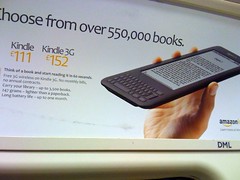
So Amazon are selling on other factors. There are posters on the London underground, in the weekend papers – they are everywhere. The Kindle is sold at Tesco, a large supermarket, similar to Walmart. So what are these factors that potentially deal with the price issue?

  • Speed and choice. Think of a book and start reading it in 60 seconds. This is indeed a marvel and I often take the Kindle to bookshops, browse and then buy on the Kindle. Super-duper.
  • Weight. This is the going on holiday, oversize luggage question. Travelling in Europe is very cheap with base costs very low and then heavy charges for luggage. If you want to read 6 books on holiday, that’s a lot of excess luggage. The Kindle solves that problem.
  • Space. Londoners don’t have much living space, and the UK is a densely populated country. If you have thousands of books, that is a lot of living space taken up, but the Kindle solves that problem.

They also mention the 3G wireless with no contract and the long battery life, now nearly a month.

I would add sampling which adds a lot to my life, and the fact I can switch between books as I travel. I am now commuting 45 mins each way on the London Underground and with a loaded up Kindle, I am never without something to escape into. Yes, I am still a die-hard Kindle fan!

How are ebooks and devices being marketed in your country? Why have you bought one – or why haven’t you?


This is a repost from Joanna Penn‘s The Creative Penn.

Writer's Block

You know you need to write, but you keep putting it off. You sit down before the keyboard, and you can’t think of anything worthwhile to write. You try to write something–anything, and it just doesn’t seem good enough. What to do?

These are typical signs of writers block. It can happen to any writer at any time–especially when you least expect it or are under the gun to meet a deadline. That last statement may provide a hint. Stress may be a major component of developing a writer’s block. The more the stress levels, the greater the block; the more the block, the greater the guilt; the more the guilt, the greater the stress, and now we’re into a dog chasing his tail scenario.

Let’s take a look at this subject from a:

•Generic point of view

•Fiction problems

•Nonfiction problems

•Some helpful tips

Generically speaking, there are several aspects that hold for all styles of writing. I’ve already mentioned stress, which is easy to understand–the greater the stress levels, the greater the blockage. Another problem is burn-out. If we have been working too hard for too long at too many things, a sudden case of writers block is nature’s way of saying, “Chill out, Baby.” Take break or even a short vacation from writing. You should be aware that it’s sometimes difficult to climb back into the saddle, so watch for that.

Another common problem among some writers is perfectionism. I used to watch one of my daughters agonize for hours over a 3-page school assignment. She would sit in front of her computer, staring at the screen and typing nothing. Why? She was attempting to write the paper in her head, trying to say and arrange everything just so before committing it into the computer. I finally would urge her to write anything, think about it, and then go into edit or rewrite mode. That seems like such an obvious thing to do, but you need to understand how obsessive perfectionists can be. They fear making any “mistakes.” If what you write doesn’t seem perfect, you need to lighten up. I was famous for saying, “It’s good enough for government work,” as a joking way of keeping a workable perspective when I labored in the Army’s bureaucracy, especially if I was under a deadline.

Now, lets look at some specific challenges to fiction writing:

Remember there are two major types of writers: outliners and seat-of-their-pants. Outliners have the advantage of a framework or road map to follow. If they fall into a block situation, it’s easier for them to pick back up where they left off. If that doesn’t seem to work, allow your muse to come into play. The blockage may have been a way for your subconscious mind of telling you to rethink your outline and its direction. Seat-of-their-pants writers can become lost in a maze of too many possibilities and fear of committing to a specific direction. Try outlining a direction and see if that helps. Maybe try comparing two or several short outlines and select one that seems interesting and feasible.

In other words, whichever style of writer you are, experiment with the other approach a little. See if that spices you up a little.

Nonfiction writing problems often come from perfectionism. Some scientists I have known had a difficult time coming to closure with a problem or issue. They would research a topic to death, looking for that perfect solution just over the next hill. There comes a time when you just have to say, “Enough!” It’s time to get on with the writing part, whether it’s a plan, a report, a thesis, or whatever. Again, outlining seems to be a good way to overcome a block. I used to free flow ideas and topics germane to my subject and its intended audience. Then I would rearrange them in some sort of logical order. I would then try to determine their completeness and add or take away that which was appropriate to the process. Once the outline was developed, it was just a matter of filling in the white spaces in between the topics. This approach tends to pull one through a project in a workable manner, lending less probability to developing writers block.

Tips for Overcoming Writers Block

Create a special space for your writing activities: my home office serves this function, and I usually can recover and remain free from blockages here. The other place I have is on the floor of my bookstore, which doesn’t work very well for the following reason.

Eliminate distractions: Ringing phones, constantly checking emails, and customers interruptions (in my case) easily can destroy a whole day of writing opportunities. I get so frazzled, I find myself playing solitaire in deference to writing.

Adjust your perspective about writing: Don’t let writing be your only reason for living. It’s only one activity of many that add meaning and spice to your life. The world won’t stop turning if you take a break occasionally.

Set goals free of guilt and remorse: Setting word-count goals are helpful for keeping on track as long as they are reasonable and flexible. Try to keep the guilt factor down. If you don’t meet your goal for the day, so what? At least you made some progress. In addition to setting goals, try to schedule down time and relaxing activities so that burn out doesn’t happen.

Chat with other writers: I’ve mentioned before that writing is a lonely career track. Try to join with other writers, both on line and in person, in a regular manner. We understand one another and are always ready to lend support.

Now, get back to your writing!


This is a cross-posting from Bob Spear‘s Book Trends blog.

Copyright Agency Limited Releases Results From Digital Publishing Trends Survey

The full article is here but I thought I’d pick out the key points and comment on them as it makes for interesting reading. And you know how I like to comment on stuff. CAL conducted a survey of members to learn more about their views of, and experiences with digital publishing in Australia. Over 2,000 CAL members responded, making this survey the largest of its kind in the Australian publishing environment. The survey was sent to all CAL members, ranging from international publishers to self-published authors, asking about their digital experiences and thoughts on the future.

Here are the key findings, in bold, with my comments after:

Both authors and publishers think the benefits of digital publishing far outweigh any of the downsides

I think this is a given now. There are very few people left, I think, who see digital publishing as a problem.

Around half of all authors and publishers create digital products

This surprised me – I thought it would be more by now. But more on that lower down.

The majority of publishers are still developing their digital strategies

This is not really a problem, but I see it more as a reaction to a rapidly changing environment. I think publishers will be constantly developing their digital strategies to keep up. It’s not something that will settle for a long time yet.

Only 15% of publishers have a competitively differentiating digital strategy

This is a problem. Digital needs to be seen as something different to the standard, existing print model of publishing and has to be treated differently. Publishers are already being left behind due to a resistance to accept this change and the longer they prevaricate, the harder it will be to catch up. Which they will inevitably have to do.

To date, 26% of publishers have no digital strategy at all

This is astounding! Just over a quarter? This is fiddling while Rome burns. It’s playing bowls while the Spanish Armada hoves into view. It’s foolish in the extreme to simply ignore the digital publishing revolution. Whether you like it or not, it is happening. It’s going to continue happening. It’s not a passing fad. There will be paper books and traditional publishing for a long time yet, but e-publishing is racing to catch up and will be rolling alongside as completely mainstream very soon.

To digress slightly, there seems to be a large proprotion of people that ask: Are you into paper books or ebooks? It’s not an either/or situation. I regularly buy both. I enjoy both. The vast majority of readers will be the same. But there are a lot of things now that I’ll buy as an ebook that I would never have bothered with in print – for cost, storage and ease of reading reasons – which makes the combination of print and digital far better than simply one or the other. Videos didn’t kill cinema, television didn’t kill radio. Ebooks won’t kill print publishing. But to completely ignore the rise of digital and have no strategy for it as a publisher is idiotic.

Digital publishing currently contributes less than 5% to the income of most authors and publishers – however, around 10% of authors and 14% of publishers currently make more than half their income from digital publishing

These are slightly rubber stats, but interesting nonetheless. Overall, the 5% figure stands, but that will be growing and will continue to grow until it is a much larger number. I’d say the authors and publishers making more than half their income from digital are the self-published, indie publishers and small press. And they will continue to grow in number as well. The digital options now make self-, indie- and small press publishing far more viable options than they ever were before and that’s very exciting.

Lower costs and improved access to markets are the greatest benefits for authors and publishers alike

See above.

Technical expertise, market dominance of multinationals and piracy are the three concerns shared by authors and publishers

This is no real surprise and is always going to be the case. Keeping up with technology and feeling the pressure from the “big guys” is a concern in all forms of business. From the corner store threatened by the massive super mall, to the indie music label threatened by the big labels, to the cottage industry threatened by the conglomerates. It’s always a battle in a capitalist environment. And piracy is something that affects all creative industries – film, music, television and publishing. Hell, I remember borrowing my friend’s Dungeons & Dragons rule books and spending hours photocopying them in the school library, because I couldn’t afford to buy my own.

But remember – the only thing worse than piracy is obscurity. It’s not going anywhere and we have to accept it as part of the digital landscape.

Low-level technical skills are the most significant barrier to market entry

I think this is more a fear than a reality. Anyone who suggested this has probably not tried to publish digitally because they think they won’t be able to. It’s actually bloody easy, and getting easier all the time.

Authors and publishers share some common views in relation to e-book royalties

Well, that’s good. We need to see the explanation to understand this point. So, from the original article:

Even in the contentious area of e-book royalties, authors and publishers shared some common views. No doubt there was some divergence of opinion, but the differences were by no means extreme. Similar numbers of authors and publishers (16.9 and 17.8%, respectively) thought e-book royalties should be set in the range of 11-20% of net receipts. Another 16% of authors and 13% of publishers thought that range should be 21-30%. Unsurprisingly a large cluster of authors (16.3%) felt the range should be 41-50% (whereas only 4% of publishers agreed). Interestingly, only 14.3% of authors felt the royalty should be 51% or greater. It should also be noted that when asked about the topic of ebook royalties, there was a significant proportion of both authors (24.3%) and publishers (38.8%) who chose not to express an opinion.

I think you’ll also find that a lot of authors are seriously considering retaining their e-rights and self-publishing their digital catalogue, so the percentage of royalties to a publisher becomes moot. But, speaking personally, if my publisher will cover all the technical aspects of design, layout, editing and so on, and leave me to write, I’m happy to split the royalties, just like regular publishing. Percentages will vary a lot, as they already do with print.

2/3 of CAL members believe that digital sales will eventually overtake print for the Australian publishing industry as a whole

And I agree with them. As I’ve said many times before, print will not die, but it will become boutique to some degree. Plus, does Print On Demand count as digital or print? Because the vast majority of paperback sales are likely to be POD before too long, in my opinion.

Of all the 2,090 CAL members surveyed, almost 19% own an iPad and over 12% own a Kindle

Given the supposed resistance to the rise of digital publishing, these are very revealing figures. There are also a lot of other ways to read ebooks and I don’t know if those were covered. It’s happening and only a handful of grumpy old bastards are really complaining.

These are exciting times and we should be enjoying the greatest change in publishing since the invention of the Gutenberg press!

Go to the original article on the CAL site and have a read. Especially check out the italicised comments at the end. So, what do you think?


This is a reprint from Alan Baxter‘s The Word.

The Future of Book Publishing

Last week I was invited to attend a fascinating presentation about technology trends, delivered to a group of hospitality industry technology professionals by Peter Leyden, who is the former managing editor of Wired magazine and author of The Long Boom, a History of the Future 1980-2020. As an author and publisher, two main themes stood out to me:

1.    The tablet computer changes everything.

2.    The use of video will continue to grow rapidly.

During his presentation, Leyden cited the huge growth in sales of ebooks and the next big trends in book publishing: apps and multi-media ebooks with images, audio, and video integrated into the text. 

I have been writing a lot about ebooks lately, with good reason. Consider these recent developments:

  • Publisher’s Weekly just reported yet another month of falling sales of printed books and surging sales of ebooks.
  • In January of 2011, Forrester Research predicted that by 2015, 82 million U.S. consumers (one-third of U.S. online consumers) will be using a tablet computer. Some analysts say that projection is too conservative.
  • Right now, the Apple iPad owns the tablet market, but a number of new competitors will soon appear. Last week, CNET reported that Amazon is planning to release its own Android-based tablet PC by the Fall of 2011. Think about what a game changer that could be.
  • Here’s a quote from a recent press release from Barnes & Noble. Notice how they refer to NOOK Color as a "tablet" and mention apps before books.

"Barnes & Noble continues to make its bestselling, critically acclaimed NOOK Color Reader’s Tablet even better, delivering customers a wide array of high-quality apps, books, interactive children’s books, magazines and more. The company announced it doubled its number of NOOK Apps since recently introducing a broad collection of popular apps."

  • Ebook publisher Smashwords recently announced that their ebooks are now available to the app marketplace through ScrollMotion, which is developing applications for mobile platforms including Apple iOS, Android, Windows Phone 7 and WebOS.

As authors and publishers, we need to capitalize on these trends by making our books available on tablets like the iPad and looking for ways to integrate multi-media features and create apps. The future is here!

Related Articles

Sales of Ebooks and Reading Devices Soar 

6 Reasons Why You Need to Publish Ebooks

How to Publish an Ebook for Multiple Platforms

Quick Start Guide to Marketing Your Kindle eBooks Like a Pro!


About the Author

Dana Lynn Smith, The Savvy Book Marketer, helps authors and indie publishers learn how to sell more books through her how-to guides, blog, newsletter, and private coaching. For more book marketing tips, get her free Top Book Marketing Tips ebooks, subscribe to her blog, follow BookMarketer on Twitter, and connect on Facebook.


This is a reprint from Dana Lynn Smith‘s The Savvy Book Marketer.

The Author As Publisher

This post, by Mary W. Walters, originally appeared on her The Militant Writer blog on 5/30/11.

(2nd in a series of articles about the new realities for writers and readers)

It seems inevitable to me now that unless they take up the sideline manufacture of weaponry or bath salts to subsidize themselves, the major publishing houses are going down. There will certainly be a role for niche publishers in future (literary presses that focus on poetry or esoteric fiction among them, teetering on the brink of expiration as they always have, and non-fiction houses that specialize in such limited areas as the flora and fauna of Paraguay or the battles of World War II), but for the majority of mainstream fiction and non-fiction book writers, independent publishing will soon become the norm.

In this post, I examine the “services” publishers have traditionally provided to writers and their books (and therefore to readers, I suppose), and then I look at how I believe these same functions can be managed—often in a more effective manner—by the authors themselves when they publish their own books. The post examines five specific areas:

  • manuscript selection
     
  • editing
     
  • production
     
  • promotion/sales
     
  • distribution

There are other areas that publishers have traditionally managed for writers, often with the help of agents. Most of them relate to subsidiary rights—e.g., translation rights,  dramatic rights, merchandizing rights, and so on. Publishers have traditionally taken a chunk of the money that accrues when a book has been translated or made into a movie. They have argued (with good reason) that after a manuscript has been accepted by a publisher and turned into an attractive book, it becomes more appealing to rights purchasers. Publishers have at times facilitated the process by presenting their books to prospective foreign publishers at the London and Frankfurt book fairs, for example, but for the most part they have simply secured some portion of the subsidiary rights without actually doing much to encourage an income flow for either themselves or the author from such sources.

So, on to the “services” they have offered and fulfilled.


Read the rest of the post on The Militant Writer for more in-depth analysis of the five specific publisher "services" in the context of the past, present and future, and also see the first post in the series.

Kindle For The Web: How It Can Be Used By Authors

In September last year Amazon introduced a new tool, Kindle for the Web, which allows users to read and share first chapters of books without leaving a web browser.

In addition to a good-looking preview interface, there are two useful features: sharing and embedding. The latter one is a very good, yet underestimated tool which can be used in many ways by authors who publish their books at Amazon.

Before I’ll list benefits and explain how to embed the preview in a blog, I’d like to point out to one very important fact. Despite the name, Kindle for the Web is not available on a page with a Kindle edition of a book. Just the opposite – you’ll see the green widget with a Read first chapter FREE button (picture 1) on a page with a print version of a book… and linking to Kindle edition.

This is misleading many people, who look for previews where they are not available. As a result they stop searching for books at all.

Why Amazon decided to profile the tool this way? A simple explanation is that by giving a chance to read a sample of a print book they want to convince people to try Kindle editions – and buy Kindles.

What’s related, and essential for authors, is that Kindle for the Web is available only for books with both print and Kindle editions.

Why it’s good to use it?

I was extremely interested in this tool since the very beginning as it opens a couple of new opportunities for authors. Let me list the most important ones.

1. It helps differentiate your social media activity

Instead of tweeting “buy my book” all the time, you can write “read first chapter of my book for free”. Remember, we never know what is the current mood of our followers on Twitter or friends on Facebook. Some of them are willing to buy, some – to test before buying (but don’t feel like downloading a free sample to their Kindle or tablet).

2. It makes your blog more attractive

If you embed a book in a blog post and stick this post to a home page, you’ve got a very inviting entry, what’s more: saying right at the beginning that this is a blog from a published author.

3. It changes the reader’s attitude

Let’s say you want to share a first chapter of your published book. The difference is that when you make a regular blog post with it, it’s just a regular blog post. When you embed Kindle preview in a post, well, that’s a different story – you are showing a first chapter of the book.

4. It helps focus on reading

This is one of my favorite topics: reading in times of distraction. If you use Kindle preview in your blog, there are bigger chances that the reader will read it, as it removes all the distractions (like banners and sidebars) after a full screen option is clicked.

5. It helps you manage your author’s profile

Some authors, including me, published a book some time ago, started a blog to support it and drifted into areas where they can be more useful – sharing experience or writing tips and advice.

You were a mystery romance writer and now you are a writing expert. Sometimes it’s hard to fight with this strong new profile. Using Kindle for the Web will make your readers more willing to accept your other face.

6. It allows to earn more money

Finally, but most importantly, you can earn extra money, if you are an Amazon associate. When you are getting a code to embed, you can also provide your associate tag. Thanks to that any book sold via link from a Kindle preview on your blog will bring you money not only from a royalty (author) but also from a referral fee (associate).

If you haven’t joined Amazon affiliate system, it’s a good moment to try. There is nothing to be ashamed of. What’s really interesting is that Kindle for the Web with a pattern to switch to Kindle ecosystem can be also a natural opportunity to sell on your blog Kindle e-readers.

How to embed a preview in a blog?

The minimum size of the embedded window is 500(width) by 325(height) pixels. Therefore the places to consider are either a page or a post.

1. Go to a print version of your book, find the green widget entitled Kindle Edition and click on a Read first chapter FREE button. A Kindle for the Web window will pop up.

Kindle for the Web window

2. Find Embed button in the upper right corner and click on it. When you expand it with a Customize option, you’ll see a window like this.

Kindle for the Web - embed box

3. Type the size of a window. Ideally the width could be exactly the same as your blog’s page/post. In the Associate Tag field, type your tag.

4. Copy the code and paste it into your blog’s new page/post (in HTML preview). Done. Now you can share it with your readers.

* * *

Although adding Kindle for the Web to a blog is a relatively easy task, there are a couple of conditions when you may not be able to do it:

– your blogging platform does not support html scripts (WordPress.com or Posterous)
– you are not familiar with html and/or don’t want to bother with it
– your blog has a very narrow page/post area – if it’s less than 500 pixels you won’t be able to do it

* * *

You can always take advantage from a feature I added to Ebook Friendly, my site designed to make browsing for e-books a more friendly experience. There is a special section called Read Online, where Kindle for the Web previews are perfectly tailored to e-reading application design. What’s important, authors can provide their associate tags and earn money as they would do it on their blogs.

If you’re interested, read more details in this post.

* * *

Kindle for the Web is a great, easy to implement and very engaging tool. Until now I’ve seen it used mainly on book review sites. I think it’s not the reviewers, but authors, who should benefit the most.

Self-Publish: Is It A Dirty Word?

This post, by Liliana Hart, originally appeared on her site on 6/26/11.

I’m new to the self-publishing world. It was a long and dirty fight for me to get to this place (mostly I was fighting with myself). What I want you to understand is that I’m proud to be an indie author. I know there are other authors in my position who have felt the same triumphs and disappointments I have over this tumultuous journey, and they’re struggling with something that slowly eats away at a writer’s delicate soul: self-esteem. It could also be called ego. All writers have issues with this. I don’t care who you are. Whether you’ve sold millions of copies or one. Writers are needy creatures. We need to be reassured. We need pats on the back and words of praise. A bad review can spiral us into the darkest depression, while a complimenting fan can make us sit down behind the keyboard with enthusiasm.

I had another author respond to that statement on another thread with derision. He said he didn’t have an ego or need pats on the back. He was only writing for the money. My response to that was, WTF? It took me by surprise because I’ve never met anyone before who said, "I’m going to start a business and get rich. What should I do? Oh, I know, I’ll be a writer." It’s absurd. Writers write because they love it. It’s too hard of a profession to just take up on a whim. So if anyone else falls into the camp of the guy above, just know you’re in the minority and good luck with your business.

That being said, I have a confession to make.

I was wrong… (I know, it’s hard to narrow this statement down. I’m wrong a lot. Mostly about haircuts and infomercials, but that’s another blog topic).

I’ll gladly admit my attitude has changed since I joined the ranks of indie authors who seem to be popping up like proverbial daisies on the Interwebs. There are more than 700,000 self-pubbed authors out there, folks. And most of them don’t sell more that a single book a month. But they’re doing it, and they have hope.

There seems to be a negativity that follows indie authors around. Maybe you’ve felt it. I’ve certainly felt it on more than one occasion–that I might as well have a scarlet letter of shame tattooed on my forehead (Insert inappropriate comments here).

Let me explain…

I finished my first book almost almost seven years ago. I was 24 years old. The idea of ebooks taking over the industry was laughable. New York agents and editors were at the top of their game. Publishing houses turned their noses up at the idea of anything being better than print copies. I was bound and determined to see my book sitting on the shelves at a "real" bookstore. Nothing else would do. And it didn’t help that the organizations I was involved in seemed to separate themselves from authors who chose a different path. Loyalties were divided. Arguments were had. Many arguments.

I fell into the camp of thinking that ebooks were an inferior product. Once again, I was wrong, so hear me out. I listened to my published friends. I listened to my various writing groups. At the time, that thinking was the majority. I was on my first agent (the first of three I’ve had in my career), and I was sure the next big contract was going to be mine. But as the rejections came, and I moved from agent to agent, my thinking changed somewhere along the way.


Read the rest of the post on Liliana Hart’s site.

Is Butt Glue Necessary When Writing?

When you want to be a career author you can’t just write when the muse is singing. Sometimes you do need a little butt glue to keep you from wandering around doing everything but writing. That’s true… except when it isn’t.

Is butt glue always necessary?

Today I learned a very interesting thing about my writing needs. I’ve recently begun putting Larry Brooks‘ instructions on Story Engineering to good use re-plotting my novel Apprentice Cat, which has been floundering for some time now.

I’ve done everything from conceptualizing to character worksheets. Today was the first full day I’ve been able to spend creating the story structure and it was a revelation in how I develop plot.

According to Larry, there are only 60 to 90 scenes in any given novel, which are broken into four parts. I decided to put together an excel worksheet with the four major plot points and divide the rest of the necessary scenes between them. That worked fine until I began having problems coming up with scene ideas.

I tried applying butt glue, but it only made me itch.

My poor brain seemed to freeze. Every character had something he or she needed me to write at that very moment. It was like being in a room full of screaming pre-schoolers all wanting my attention at once. All I could think of was how I knew I needed to be creating these scenes, but they weren’t materializing.

That’s when I realized I needed to do something un-writerly, something physical like cleaning up the mess my toddler had made of my living room or doing dishes or anything. Butt glue was the last thing I needed.

I followed my instincts to a better story.

As soon as I stopped thinking about how much I needed to write and the self-imposed deadline I was on for finishing my plot outline, the scenes started appearing. I was hearing snippets of conversation and seeing my characters doing things I hadn’t even considered.

When a scene popped into my head, I quickly went back to my laptop and slotted it into the worksheet. If nothing else came to mind within a couple of minutes, I went back to doing whatever I was doing before. Worked great and I’m now 2/3 done with the outline. Yeah!

Butt glue is great when we’re just procrastinating, but it can get in the way of the creative process if our creative selves become paralyzed and overwhelmed by the blank page.

I’m curious to know, have any of you had the same thing happen? When do you find you need to apply butt glue? When has it hampered your creative flow?


This is a reprint from Virginia Ripple‘s The Road To Writing.

Game Changer – J K Rowling, Pottermore And Ebooks Without A Publisher

The internet has been abuzz lately since mega-billionaire-super-author, J K Rowling (of Harry Potter fame, in case you’ve been a monk in a cave for more than ten years) announced Pottermore. In a nutshell, it goes like this:

After seven books and eight films and more merchandising than you can fit in George Lucas’s ego, Rowling has now announced a website which will be a complete interactive experience for all ages based on her stories. Along with that she’s announced that for the first time ebook editions of the Harry Potter series will be made available. Well, legal ebook editions that is. Rowling truly is the master at monetising her ideas and characters, having turned some books about wizards at school into an international behemoth across all media.

With Pottermore, as the press release says:

For this groundbreaking collaborative project, J.K. Rowling has written extensive new material about the characters, places and objects in the much-loved stories, which will inform, inspire and entertain readers as they journey through the storylines of the books. Pottermore will later incorporate an online shop where people can purchase exclusively the long-awaited Harry Potter eBooks, in partnership with J K Rowling’s publishers worldwide, and is ultimately intended to become an online reading experience, extending the relevance of Harry Potter to new generations of readers, while still appealing to existing fans.

It’s a pretty inspired concept. Of course, Rowling with her riches and business partners is the kind of author with the kind of clout you’d need to make something like this happen.

The real game changer among all this, however, despite the partnership comment above, is that the ebooks will be essentially self-published. Her publishers, Bloomsbury, Scholastic, etc., don’t own the eletronic rights – and I bet they’re really happy about that. So Rowling is planning to make the ebooks available directly through Pottmore. Of course, when Rowling self-publishes, she’s has a team of people behind her and her own company on the case, so it’s not like she sits there on her own and uploads files to Amazon. But the key here is the lack of a third-party publisher.

The Kindle will accept epub format ebooks soon and the announcement that the Harry Potter ebooks will be available from October seems to fit in with that, so it’s likely the books will be in epub. That certainly does seem to be the prominent format and, aside from Amazon’s mobi format, has been the industry leader all along. Once the Kindle accepts epub too, we have the first stage of industry standardisation and that’s a good thing for all of us. Perhaps we have Rowling to thank in part for forcing that change – who knows who talked to who while this was getting off the ground.

Authors leveraging their existing print success to manage their own ebook releases is nothing new – just see J A Konrath’s example for one. But nothing on this scale has happened before and we can see things shifting a little more on the axis. I’ve said it before – we’re living in exciting times in writing and publishing and the ride ain’t over yet. I wonder how many kids will get an ereader with a set of Harry Potter books on board for Xmas this year? This will be a big step in mainstreaming ereaders, which are becoming more and more mainstream anyway. On a recent flight to Melbourne I noticed several people reading from Kindles and Sony Readers while waiting for my plane.

The kind of cross-media storytelling and promotion which Pottermore represents is certainly not new, but we’ve seen nothing on this scale before. Just the official announcement video is better than any book trailer a lowly author like myself could hope for. I wonder where we go from here?

Here’s the official release video from Rowling herself.

And here’s the Pottermore site.

Interesting times indeed. What do you think? Is this a good thing or not? Where do things go from here?

This is a reprint from Alan Baxter‘s The Word.

Embracing The Entrepreneurial Spirit!

This post, by Pete Morin, originally appeared on his site on 6/2/11.

Following the oft-inveighed advice to network and expand my platform, I participate in many social media-type forums. So many of them are really, really great.  Some of them are quite useless.

Yet, like the spectator of a horrific train accident, I am drawn back to them. Sometimes it is simply to marvel at the utter idiocy of some of the people who will follow their muse to the ends of the earth with no more clue when they get there than they have today. I know that sounds rather pompous of me – but I do not profess that I am less clueless. I just hide it better.

Seriously, though. Hanging around some of them will give you empathy for literary agents.

Anyway, aside from the schadenfreude, every day I join the thousands like me, trying to follow the lurching and jiving going on in the fiction publishing business. I posted about this a few months back, and even since then, earth quake changes have occurred – the most recent perhaps being Amazon’s rapid and aggressive entry into the publishing business with their own genre imprints.

These are heady days, of course, and I’ve heard it said so many times by agents, editors and writers alike that “there is no better time to be a writer.” Why? Because our dreams of publication, of readership, are not dependent on anyone but our artistic, entrepreneurial selves.

The gatekeepers are keeping gates, but you don’t have to go through them to get to the Promised Land. It’s like the scene in Blazing Saddles with the tollbooth in the desert. We don’t need a shitload of dimes any more.

Anyway, among the less useful venues I monitor are a half-dozen of the bazillion writing-related groups on LinkedIn. Here is a place where the most oblivious of aspirants gather to ask silly questions while a few others hold court and burnish their Big Brass Badges of Blovitus. With rare exception, I have succeeded in staying away from the discussions.

It is the rare exception about which I post here.

Read the rest of the post on Pete Morin‘s site. 

Your Second Storefront

This post, by JA Konrath, originally appeared on his A Newbie’s Guide to Publishing blog on 6/24/11.

I just had a long conversation with Barry Eisler (no, we’re not writing this one down) and one of the things we touched upon was what makes a bestseller a bestseller.

I’ve argued that brands, name recognition, and fanbases aren’t as important as we’d like to think they are. In short, the authors who are famous bestsellers right now might not be famous bestsellers in the near future. Rather than repeat the reasons why, you can read the argument here.

In the legacy world, the more books you had in print, the more you’d sell, because you took up a lot of shelf space (both in a single store, and in thousands of stores.)

But in a digital world, every ebook has one slot on the shelf. You can increase shelf space by having many ebooks, but there are only a handful of stores (Amazon, BN, Smashwords, iBookstores, Sony, Kobo, etc) rather than the thousands of bookstores and thousands of other stores that sell books.

This is a much more even playing field. And while I disagree that name authors lowering their ebook prices will hurt my sales much (at low prices, people buy more), I do recognize the importance of standing out among the millions of other titles.

It is easier to make a sale in a digital world, but there it is still a multi-tiered process.

1. A reader must discover that your book exists.

2. A reader must be compelled to look at it.

3. A reader makes a decision to buy it.

4. A reader makes a decision to read it, and then possibly buy your other titles.


Read the rest of the post on JA Konrath‘s A Newbie’s Guide to Publishing blog.