Podcast Review and Interview on Maids of Misfortune and Self-Publishing

Jane and Mark Kalmes have done a lovely Podcast Review of Maids of Misfortune and then followed up with an Podcast Interview with me that discusses the writing of this book and my experiences with self-publishing.

 The review can be heard at http://www.indiebookpodcast.com/2011/11/02/mystery-maids-of-misfortune/

The interview comes in the second half of a  podcast found at  http://www.indiebookpodcast.com/2011/11/14/thriller-this-is-life/

Hope you find these podcasts of interest.


This is a reprint from M. Louisa Locke‘s site.

Book Marketing Toolbox – Stock Photos and Illustrations

If you’re looking for just the right image to use on your website or books, you can find photos and illustrations online at reasonable prices.

Here are just a few of the ways you can use stock photos and illustrations:


• Illustrate blog posts to reinforce the message and break up large blogs of text.
• Use images on covers for books and ebooks.
• Find arrows, buttons, guarantee seals, and other graphics for web pages.

The toolbox photo on this post came from my favorite stock image site, iStockPhoto.
Bigstock is another good source. Right now, Bigstock is offering a 50% discount on the first image purchased by new customers. I’m not sure if the offer has an expiration date.

Other good sources for photos and illustrations include Dreamstime and Crestock. On Stock.Xchng you’ll find free photos mixed in with links to paid images on iStockPhoto.

All of these sites offer royalty-free images that can be used for marketing purposes, but check the license agreement if you have any questions about the specific uses that are allowed. The cost is usually about $2 to $3 for small photos suitable for online use. Prices are a little higher for larger, high-resolution photos and for illustrations, but still reasonable.

For free photos to use in blog posts, check out the Creative Commons section of Flickr. Use the search box on this page to look for an appropriate image. When you find a photo you like, check the License section in the right column to find out how you may use the photo and what attribution is required.

For more tips on buying and using images, see this article.

Now, go forth and illustrate! 


This is a reprint from Dana Lynn Smith‘s The Savvy Book Marketer.

Take A Deep Breath And Fill The Creative Well

Everything is moving very fast right now.

Ebooks are going nuts with new Kindles, new markets and sites launching all over the place. Mid-list authors are leaving publishers and getting their back-lists launched online. Indie authors are getting signed to Amazon and Big Six publishing. There are blog posts from all sides being enthusiastic one day and then ripping the indies to bits the next.


We’re social networking, blogging, going multi-media, doing promotion and trying to write as many books as fast as possible to take advantage of the coming ebook boom.

It’s time to take a deep breath and remember what the hell we’re doing here.

It’s very easy to get swept away and be so frantic with production that we forget a few important things.

Life is a journey, not a destination. Enjoy the writing process. Enjoy the editing. Enjoy creating something from nothing.

Enjoy the research and the knowledge we learn while we’re writing. Enjoying helping others along the journey.

Busy does not equal productive.

I am extremely guilty of this myself and am taking some time to consider my goals as an author-entrepreneur and what adds to this the most in terms of my activity. I’m also taking some time out from trying to finish my next novel, Prophecy. It’s so very almost there, but it’s not there yet and I need to step away to make space for the final pieces to come together. Thinking time is also productive.

I hit this point every six months or so and here I am again. Time to take a break and refocus.

Take time to refill your creative well

Here are some of other posts that might inspire you to take a break.


This is a reprint from Joanna Penn‘s The Creative Penn. Also see these related articles on the same site:

Insight for Authors and Creators of Physical Art in a Digital Era

This post, by Israel Vasquetelle, originally appeared on his Awareness Mogul site on 11/14/11 and is reprinted here in its entirety with the author’s permission.

I just published an in-depth story and interview with a seasoned media veteran, former music industry executive, and author by the name of Bill Adler. If you have any interest in music history or the groups that helped define the golden era of rap such as Run DMC, Beastie Boys, or Public Enemy, you should find his insight and story fascinating. During our talk, about his new book entitled “Def Jam Recordings: The First 25 Years of the Last Great Record Label” he provides a great perspective about the future of publishing physical books in an era of what is perceived as digitally dominated. He explains:


  "…the future of books, per se, is very much in question. Having said that, I believe that there’s something to be said for an actual physical book and an image that is twelve inches square and is beautifully reproduced. I don’t think computer screens compete… If it’s a novel, go ahead to your ebook. If the story to be told requires beautiful pictures as well, then make an art book in the way that Rizzoli does and glory in that. It’s still the best medium for stories like that." 

Although the book is published by a traditional publisher, there’s still a lesson here for anyone that is publishing physical goods, including self-published authors. If you make something that is perceived as valuable to a specific audience, and make a concerted effort to present it as the work of art that it is, this will no doubt resonate with some. Plenty will decide to live without it, however, there are those who will receive its purpose, and desire to collect it.


In Adler’s case, his book’s shape and size [are] the same as the classic records that helped make the Def Jam label a success. For those in the know, it’s hard not to perceive this a thick record jacket. As the resurgence of vinyl has shown, people still crave physical media if it provides a significant amount of quality and helps to enhance the consumption experience. In this case, the book was designed by art director, Cey Adams. To convey his importance and involvement in perspective, I must say that he has been responsible for the artwork of countless classic Hip Hop and R&B covers over the last three decades. When discussing the value of physical art with this seasoned art director, he too provided an interesting insight:

  “…there’s something valuable about holding it in your hands, seeing a photograph, touching it, looking at the type design and the choice in color.  I just think sometimes…things online just feel disposable to me.  When you hold a book in your hand the weight of it reminds you that this is something that is important because somebody spent time to give you 300 pages versus a 100 pages.  There’s something tangible.  It’s like a building.  It’s powerful.  I can’t explain it in any other way…We wanted to make something that was as big and as rich and beautiful as the history itself." 

I think it’s worth remembering that as physical beings we will still inherently yearn to have tangible goods when we recognize them as special because they offer us a value. During my discussion with Adams, which will be published in the near future, he adds an interesting point about the craze to own products from the company and man that certainly helped revolutionize the way we consume media today, Apple and Steve Jobs. He reminds me, "they’re not talking about something they saw online. They’re talking about the products that they hold in their hands." Interesting analogy from a man who’s spent a life-time helping to create beautiful works of art that help tell the the story above and beyond what the music presents. Many of these works of art are being held and cherished by fans  today.


The challenge for authors [is] to create something that resonates with an audience, contains value for the consumer, and is perceived as a work of art.  Regardless of how many digital copies of the Mona Lisa there are online, there is only one that is protected and cherished by millions, copies haven’t diminished its value. 


The Seven Types of Pirate – Which Are You?

This post, by Richard Curtis and Anthony Damasco, originally appeared on e-reads in October of 2010, and was reprinted on the same site 10/27/11.

The ability of the human mind to rationalize is extraordinary. Take piracy. Among the many comments we have received in response to our postings on the subject, we have heard every rationalization under the sun, ranging from “I didn’t know it was copyrighted” to “I don’t know what copyright is” to “DRM sucks” to “The e-book wasn’t available on legitimate retail sites” to “Information wants to be free” to “I’m not reselling, just sharing with friends” to “The percentage of pirated books is an insignificant fraction of sales through legitimate channels” etc. etc.

Piracy is something that other people do. When we do it there’s always a good excuse. When other people do it, it’s as heinous as grand theft auto.

Clearly, there is a disconnect between the phenomenon of rampant piracy and the scarcity of perpetrators, and the reason seems to be semantic. If we can develop better definitions we may be able to develop better solutions.

Towards that end we offer the following categories of pirate:

1. The Innocent

Young children, technologically inexperienced individuals and others who know nothing about copyright law or Internet etiquette and don’t realize they may be stealing when they download music or e-books. People who simply don’t know better.

2. The Ignorant

These are downloaders who know enough about copyright law to understand the difference between right and wrong, but choose to ignore or flout it.

Though many who fall into this category are young, the classification includes adults, some of whom are highly educated – business people, computer engineers and other professionals who should know better.

We’re giving Innocents/Ignorants the benefit of the doubt by describing their acts of downloading as “inadvertent” or “improper” rather than “illegal.” But if nothing else they must be aware of the legal principle that ignorance of the law is no excuse. If an aggrieved publisher decides to sue you for illegally downloading e-books – as has been done in the music and movie fields – your case will not be automatically dismissed because you didn’t know it was against the law.

3. The Customer

These are people who paid for one version of a book and feel entitled to acquire other versions without paying for them. A good example is the case of a consumer who buys a hardcover edition of a bestselling novel and feels justified in downloading a pirated e-book because the publisher’s legitimate e-book version has not yet been released. No less a personage than the New York Times‘s own ethical arbiter felt that a customer has the right to do this. (See NY Times Ethicist Condones Ripping Off E-Books). In other cases, consumers impatient with DRM restrictions will download a ripped off version of a file instead of paying for it and dealing with customer support.


Read the rest of the post, which covers 4 more types of pirate, on e-reads.

Veteran’s Day 2011 and the New Self-Publishing

It’s Veteran’s Day here in the U.S. and lots of things are closed. No mail service, no banks, that sort of thing.

I’m busy getting ready for Carla King’s Self-Publishing Bootcamp down at Stanford University tomorrow, where I’ll be helping new self-publishers understand how to use the array of new choices in publishing, to their advantage.

The last time I spoke at Carla’s event, I gave attendees an overview of the book design process and ways to avoid making the worst kinds of mistakes.


But there’s no way to give any kind of detailed instruction on book design or cover design to a roomful of people in 40 minutes with 15 minutes for Q&A, is there?

Look at these diagrams that represent the process of self-publishing before print on demand and e-books:

Old Self-Publishing

And what it looks like today:

New Self-Publishing

It’s the implications of this change that I’ll be addressing at Stanford, and the way the playing field on which these changes is happening continues to shift underfoot.

It’s a good time to be open to new things and nimble in adapting to developments.

See you back here on Sunday for this month’s e-Book Cover Design Awards. Don’t miss it!


This is a reprint from Joel Friedlander‘s The Book Designer.

True “Do-It-Yourself” Publishing Success Stories Will Probably Become Rare

This post, by Mike Shatzkin, originally appeared on The Shatzkin Files blog on 11/6/11.

Getting ready for our eBooks for Everyone Else conferences, I discovered an author named Bob Mayer who impressed me with his self-publishing zeal and apparent success. Bob has written lots of military fiction, science fiction, even a romance novel, and some non-fiction: dozens of books over the years for major publishers. Most of it was mass-market, most of it reverted relatively easily and Bob systematically secured those rights reversions for years.


He caught my attention with the bare bones of his story. He started putting his work up as ebooks in January, when he sold a few hundred books. By July he had more than 40 titles available and was selling a total of over 100,000 units a month. I had long wanted to put an author before my conference audiences who had achieved self-publishing success to talk about how s/he’d done it.

Joe Konrath and, more recently, John Locke had politely turned me down. I booked a 1-on-1 conversation with Barry Eisler at our Publishers Launch Conference at BEA right after he announced his decision to turn down a 6-figure advance to self-publish. Alas (for this objective of mine), the morning of the event Barry signed a contract with Amazon to do his next book with them. Although he has self-published some short fiction. Eisler’s story became that he is an Amazon-published author, not a self-published author. That’s a good story and we had a good session on-stage that the conference audience benefited from, but it was not a a self-publishing report from an author who truly did it on his or her own.

(Eisler’s wife, the literary agent Laura Rennert, reported at eBEE in San Francisco that Amazon is succeeding very well with Eisler’s current book, The Detachment — which I read and enjoyed – and that his substantial advance has already been earned out.)

So I was pleased to learn with a phone call that, not only was Mayer an enagaging talker, but that he was willing to make the journey from his home in Seattle to San Francisco to discuss his success with a conference audience.

But what became clear when I had a further conversation with Mayer the day before our conference, buttressed by what was said by many other participants at the event, is that the Hocking-Konrath-Locke story — an author managing all the pieces of their publishing program and and achieving a totally private success — is a Dodo bird. Unless we consolidate down to an only-Amazon ebook world, which, despite Amazon’s best efforts, doesn’t seem likely anytime soon but would undoubtedly create a whole new rule book if it ever arrived, the work and expertise required for successful publishing will lead inexorably to one of two results.

Either an author will get help to publish their own material — a distributor like Constellation or Ingram or a publisher — or they’ll find what they built to serve themselves would be better and less-expensively maintained with the work of additional authors to go along with their own. There’s enough work and expertise involved in what had first seemed to many such a simple process that it requires building a bit of a machine to do it. And once a machine is built, it is just wasteful to leave it idling between the works generated by any one writer.


Read the rest of the post on The Shatzkin Files.

Join the E-Book Revolution. Create, Publish, Market, and Sell Your Own E-Book

This post, by Doug Klostermann, originally appeared as a guest post on Joanna Penn’s The Creative Penn on 11/8/11.

Every day we hear more exciting news about self-publishing and the growth of ebooks.

I monitor the US publishing news and blogs and feel that in the UK we are at least a year behind you guys, but the tidal wave is swelling and it’s a very exciting time! Doug Klostermann, author of The Ebook Handbook, is another writer who is passionate about digital publishing and today he shares a useful overview if you are just starting out.

Why now is the time to join the e-book revolution

Statistics about e-books, e-book publishing, and e-readers are being reported and discussed with increasing frequency and the overall conclusion is clear:  e-book sales are rising at a dramatic pace.  E-book sales in the United States currently exceed those of the other formats, including hardback and paperback sales, and grew 200% from 2010 to 2011.  Electronic books are now outselling printed books on Amazon.com – hardcover and paperback combined – and the Kindle e-reader is the best-selling product on Amazon.  Apple’s iPads are selling by the tens of millions, Android powered tablet sales are increasing, and numerous other companies are developing and selling tablet devices.  There is no better time to join the e-book revolution.

The publishing playing field has never been so level for self-published, independent authors.  Your e-books can be up for sale on Amazon, Barnes and Noble, and Apple iTunes and iBooks as soon as you complete them, and at no cost to you.  They will be available on these sites along with all the printed and digital books, with the potential to be found and purchased by anyone shopping and searching online.

Formatting and Optimizing Your Text for Various E-Reader Formats

You will likely want to publish your e-book to as many sites as possible in order to reach the widest audience, and this involves offering your text in a variety of formats.  Most publishers will convert your text for you for free, but there are a number of requirements you should follow so that your e-book functions and appears as best as possible in each format.  On your own website and blog you can offer your e-book in PDF format, Amazon will convert it to their proprietary AZW format for the Kindle, and Barnes and Noble will convert it to ePub for the Nook.  Smashwords will convert it and offer it in a variety of formats as well as allow you access to publishing with Apple. [Note from Joanna: This is the best way for non-US citizens to get onto iPad and Nook right now.]

Typically a basic e-book can be written in Microsoft Word DOC (.doc) format.  This format is easily converted to most of the required e-book formats such as PDF and ePub, is the preferred format to be submitted to Amazon’s Kindle Direct Publishing, and can be submitted to Barnes and Noble’s PubIt! and to Smashwords for conversion and distribution to Apple iBooks.  Publishers will accept other formats like plain TXT, PDF, or HTML, but unless you have complicated formatting and complex image layouts (neither of which are recommended, especially for your first e-book), then Word’s DOC format is the easiest and best format to use.


Read the rest of the post on Joanna Penn‘s The Creative Penn.

NaNoWriMo: Advice From The Fastest Writers Ever

This series of slides and quotations featuring respected and commercially successful authors, curated by Romy Oltuski, originally appeared on Flavorwire on 11/3/11.

Yesterday marked the kickoff of National Novel-Writing Month (aka NaNoWriMo), the online project that challenges participants to write a 50,000-word book in the 30 days of November. To those scribbling hurriedly to meet its deadline, we wish you a book deal by December. And to cheer you on, we’ve rounded up a treasure trove of advice and encouragement from the great writers who best embody, in their own work, NaNoWriMo’s goals of writing much and writing fast. Below the jump, read through our favorite words from the wise, speedy, and prolific.


Jack Kerouac: “You’re a Genius all the time”

One of the central aims of NaNoWriMo is to encourage writers to trust their abilities — not to look back and scrutinize every detail of their prose but to look forward and trust their pens (or laptops) to spit out rapid gold. This is what Kerouac did, no doubt, when he jotted down the Beat bible On the Road in a mere three weeks on a 120-foot scroll of paper, and why we chose to highlight the 29th axiom of the 30 writing tips in his strangely spelled, hardly punctuated, partially coherent “Belief and Technique for Modern Prose,” below. “You’re a Genius all the time,” he instructs (and with a capital G, no less!); you’ve got to believe it if your publisher will.


The slide show and quotes continue here, on Flavorwire.

Getting A Big Name To Write Your Book’s Foreword: An Introduction For Self-Publishers

Once again, we are happy to promote a post from member Joseph C. Kunz Jr.’s Publetariat blog to the front page.

Getting a notable VIP, industry guru, or media celebrity to write the foreword for your book is a great way to jump-start bigger sales and get positive publicity for your book. If you are an unknown author, getting a notable leader in your field to write your foreword is essential if you want to get readers to take a chance on you and buy your book. Having your name associated with an industry leader will greatly enhance your credibility within your industry and with your readers. 

Forewords give the endorser another place to discuss and show-off their skills and knowledge. It also gives them and an opportunity to connect with your reading audience in a deeper, more meaningful way. This is a great selling point to consider when requesting this service from someone. You get a foreword for your book that will help improve your sales, and the foreword author gets additional exposure and credibility for their own name and business. It’s a win-win situation for the book’s author and the foreword’s author.

The process of getting a foreword written is the same as with endorsements. But instead of simply writing a few sentences endorsing your book, the endorser writes what amounts to being a glorified recommendation letter to the reader. It can be as short as several paragraphs or as long as a few pages, and gives, in greater detail, the reasons why the industry guru recommends your book.

One thing you should remember – that when you ask a VIP to write your book’s foreword, that you should not be selling your prospect on your book’s good points. You need to sell them on their own value as a potential endorser of your book. In other words, don’t start off by telling them how great your book is. Start by saying why you admire their opinion and why it’s important for you to have their opinion included in your book. Also, make sure that you share your reasons for writing the book. Discuss the subject of your book in detail.  Finally, discuss who the market is that your book is addressing so that the endorser can readily see that you are marketing your book to the same audience that they serve. Doing this allows them to see the advantage in having their name visible to your network of readers. They are looking to connect with their own audience as much as you are.

This article was written by Joseph C. Kunz, Jr. and originally posted on KunzOnPublishing.com

The Future Makes A Comeback

This post, by L.J. Sellers, originally appeared on the Crime Fiction Collective blog on 11/4/11, and is reprinted here in its entirety with the author’s and site’s permission.

We’ve all seen the ads for the new book When She Woke (by Hilary Jordan), a futuristic novel in which a criminal’s skin is dyed to reflect her crime, a story that’s been compared to the classic, The Handmaid’s Tale by Margaret Atwood. In recent years, other similar novels have been wildly popular too, such as The Hunger Games trilogy by Suzanne Collins. These novels are dystopian and reflect a society that has completely broken down and morphed into something ugly.

As a reader, my love of futuristic thrillers—which I distinguish from dystopian novels—started long ago with a terrific novel by Lawrence Sanders called The Tomorrow File. For the record, he’s my all-time favorite author, and TTF may be one of the best books I’ve ever read, or at least that’s how I remember it.

The story was written in 1975—and takes place in the year 1998. I read it in college and was captivated by Sanders’ vision of the future, in which genetic classifications are based on whether one is natural, produced by artificial insemination, artificial inovulation, cloned, or otherwise created without the necessity for sexual intercourse. The objects (people) of tomorrow eat food synthesized from petroleum and soybeans, and enjoy unrestricted using (sex) and an addictive soft drink called Smack.

The new language took some getting used to, but the story was so engaging with so many twists that it was hard to put down. Most important, the book triggered my fascination with well-told futuristic thrillers.

Another of my favorite novels set in the future is The Handmaid’s Tale, published ten years after The Tomorrow File. The book won numerous awards, was made into a film, and is so well known I won’t bother with the details, except to say it’s a feminist portrayal of the dangers of a conservative society. I admire Atwood immensely for tackling the subject. (I took a stab at that issue when I wrote The Sex Club…but that’s another story.) Reading The Handmaid’s Tale further inspired me to someday write a thriller set in the future.

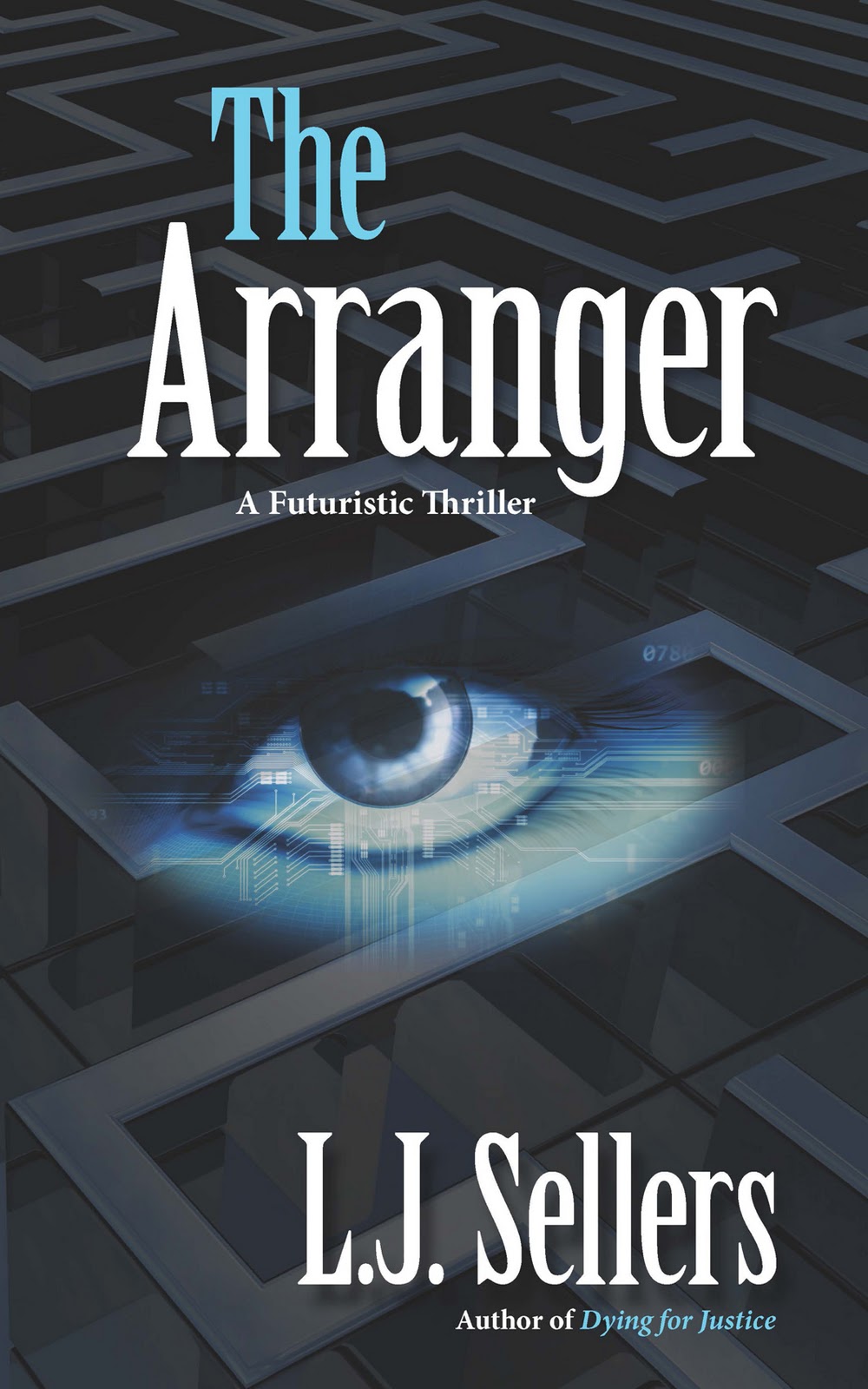
Interestingly enough, yesterday a blogger posted comparative reviews of The Catcher in the Rye, The Handmaid’s Tale and my futuristic thriller, The Arranger. The blogger focused on insecurities as the theme, both social and personal, and concluded they were necessary in fiction. First, I find it interesting that people are reading or re-reading The Handmaid’s Tale from 1985 because of the advertising for When She Woke. It’s fun to see the novel resurrected.

Second, it’s an honor to be listed in the same company as works by J.D. Salinger and Margaret Atwood.

I don’t mean to imply The Arranger compares to any of the brilliant works I’ve mentioned, most of which imagine a shockingly different future. (I’m still not sure why Catcher in the Rye is in there, but that was the blogger’s choice.) My story is set only 13 years in the future, and I don’t consider it dystopian. It presents a bleak vision of the United States, in that the economy is stagnant, government has shrunk, and people without health insurance are left to fend for themselves. But all that seems quite realistic to me and didn’t require much imagination.

The Gauntlet, however, is an intense physical and mental competition that provides a backdrop for my novel and required me to create entirely fictitious scenarios.

Overall, I’m excited for the revived interest in futuristic novels. Does it represent a dissatisfaction with our current state of affairs or a fear of what is waiting for us? Or both?

Do you read futuristic novels? What are your favorites? What themes do like to see?


Author Blogging 101: Up With Comments!

One of the first experiences you’ll have when you start your blog is publishing a post and then wondering if anyone is reading it.

Especially at the beginning, author blogging can feel a little bit like “pouring from the empty into the void.” We all know that some of the best blogs are about the conversation going on between the blogger and the readers, but it can take a long time before you start getting those comments on your blog articles.


Commenting is central to the kind of blogging I like the most, and the one that seems to work best for most bloggers. There are lots of reasons commenting is a tool you should learn to cultivate and respect. And whatever you do, try to make it easy for your readers to comment. It will do many things for you:

  1. Comments allow you to engage one-on-one with readers. When we write for publication, we’re writing for some group of people, and we may or may not know very much about who is reading. But when a reader steps forward and writes a comment, they are opening a dialogue with you, one that can have profound implications.
  2.  

  3. Readers will make your blog posts better with their comments. If you’ve missed something in an article, or made a factual error, astute readers may well point it out. And since none of us can know everything about a subject, comments can make a conversation more complete and well-rounded than it would have been with only one voice.
  4.  

  5. The voices of many people can be heard in the comments. These other voices help to expand the range of your blog and its appeal to more kinds of people.
  6.  

  7. Comments show that a community is building around your blog. Many of us follow dozens of blogs, but we can only give enough attention to become part of the community at a handful of sites.
  8.  

  9. Commenting gives readers an opportunity to get to know you better. In fact, this is one of the most common pieces of advice given to bloggers who want to write guest posts for other blogs, and it certainly works. For instance, the wonderful article on Friday by Joan Reeves came about because of her comments on another article.


A Word About Blogs Without Comments

Although it seems like most bloggers are eager for comments, sometimes you come across a blog where the comments have been turned off. I don’t read many of these blogs, and it’s interesting how different the environment is on a blog without comments.

It feels more like a website where articles are posted regularly, and that’s about the only relation to a blog. Some bloggers have good reasons for blogging this way, and it does take time and attention to have a conversation with readers that just goes on and on.

So it can be done, and done very well by the right person, but I’m not talking about those kinds of blogs in this article.

What is “Social Proof”?

One of the reasons you want comments from your readers is because it contributes a great deal to “social proof.” What does that mean?

Social proof is a psychological trigger that affects our behavior. It’s the tendency, when you are undecided about something, to be influenced in your choice by the apparent choices of a group of other people.

What does that mean? What I mean is that suppose you happen onto the blog at Copyblogger.com, one of the internet’s premier resources on the subjects of copywriting and content marketing. You like the article you’re reading, then you notice the subscription box:

Copyblogger.com

When you see that over 155,000 other people have subscribed to the Copyblogger blog, you are assured it would not be a big mistake to take a chance and put your email address into the subscription box. The number of subscribers is a kind of proof of quality, a social proof that can influence our behavior.

The same is true for blog comments. If you see a blog article with 10, 30, 50 comments, you might automatically think that it has some value, that it’s not just an empty post parroting something some other blogger said. Otherwise, why would it have so many comments?

So having comments, and displaying the number of comments on your blog posts, naturally prompts more comments. And remember, the vast majority of your readers will never comment on the blog, so each person who does represents a whole swath of readers who likely have similar opinions.

How Can You Stimulate Interaction?

As a blogger trying to build community and relationships, your readers are vitally important. Encouraging comments makes your blog a better read and more attractive for interaction.

So how do you get those comments?

  • Ask—I know it seems obvious, but it’s not that easy when you start out. If you’re writing a post that centers on your opinion, ask for reader’s opinions. If it’s a how-to article, ask if they understood it. If it’s a survey, ask if readers know other resources.
  •  

  • Unfinished posts—I learned this from Chris Brogan and it works. Instead of writing all the way to the logical end of an article, stop and ask readers how they would finish it.
  •  

  • Controversy—One of the easiest ways to spark a discussion is to take a controversial stand, to oppose the current trends in your field, or pick a fight with a leading figure.
  •  

  • Revelation—Discussing your problems and your passions, revealing yourself to your audience in an emotional, contactful way will bring in comments from a variety of readers.
  •  

  • Co-creation—You may want to try creating a resource with the help of your readers. This can be a powerful community-building experience, especially if you can get enough people to participate, and the comments are a great way to do that.

The Golden Rule of Comments

Okay, now you’ve got the story on blog comments. Comment on other people’s blogs so you can get inside the feeling and know what your readers are experiencing.

Use comments to ask your readers what their concerns are, what information they would like, or what they think of your new book cover. These conversations turn into relationships and the bond between you and your readers will grow strong.

The Golden Rule of blog comments, of course, is to never ignore them. What’s the point of asking people to comment if you never answer them?

You don’t have to answer every comment, but it makes a huge difference if readers sense that you are as much a part of the discussion as they are, and a well-placed response will be much appreciated.

So does that answer your questions about blog comments?


This is a reprint from Joel Friedlander‘s The Book Designer.

Categories, Key Words, and Tags, Oh My: Why should an Author Care?

Two weeks ago I published my second historical mystery, Uneasy Spirits, and in the process I was reminded of how confusing it can be to determine the best category and key words I should use on Amazon to describe my book. Since there are several other authors who have been wrestling with the same question in the Historical Fiction Authors Cooperative (HFAC) that I belong to, I decided to write this post on how to use categories and keywords to maximize ebook sales.

For the purpose of this post I am focusing on ebooks on Amazon, in part because that is where I have the most experience, but also because Amazon is definitely ahead of the other ebook stores in its sophisticated approaches to helping readers find books. My understanding of these issues is based on my experience as a self-published author using KDP (Kindle Direct Publishing). Finally, as with much of the publishing process, there is still a lot of conflicting information about how Amazon categories, keywords, and tags work, so some of what I say is more of an educated guess than documented fact.

First some definitions:

Categories: When a book is uploaded into KDP, an author (and, I assume, a traditional publisher) has the opportunity to choose two categories. It used to be that Amazon allowed you to choose five categories, which is why some books have more Kindle Store categories listed at the bottom of their product page. When you, as author, choose a category for your book, you are actually choosing a browsing-path for readers. That browsing-path/category consists of a hierarchy of sub-categories and your book is available for readers to discover under each of the parts of that hierarchy. For example, in the case of my most recent book, Uneasy Spirits, one of the two browsing-path/categories I chose was:

Fiction—Mystery&Thriller—Mystery—Historical 

If you browse for Uneasy Spirits in the Kindle store, you will find it in under all four parts of the hierarchy:

Fiction
Fiction–Mystery&Thriller
Fiction—Mystery&Thriller—Mystery
Fiction—Mystery&Thriller—Mystery—Historical  

Note that each time a reader goes one step further down the hierarchical browsing-path, there are fewer books to browse. For example, as I write this, here are the numbers of books in each of these four areas:

Fiction [324,671]
Fiction–Mystery&Thriller [43,629]
Fiction—Mystery&Thriller—Mystery [9,700]
Fiction—Mystery&Thriller—Mystery—Historical   [73]

By carefully choosing my category, I make it much more likely that a reader will find my book, since the pool of books is smaller with each step down the path.

The “categories” Amazon offers when you upload your book to KDP are apparently BISAC categories, a book industry standard for subject headings.  What is confusing is that the “browsing path” that Amazon generates from your choice is not always the same as the BISAC category you chose. Amazon apparently converts the BISAC categories that you pick into the Amazon browsing-path categories and subcategories that show up in the Kindle store — and the two are not always the same.

To make matters more confusing and frustrating, this conversion process does not always work accurately. You can read more about this on my blog post, “Working Amazon” and on Suzanne Adair’s blog post, which provides a hilarious description of the trouble she had with getting her wonderful new Revolutionary War thriller, Regulated for Murder, in the right category. (Suzanne is a fellow HFAC author.) To complicate issues further, the browsing categories for books and ebooks are not identical, and Amazon creates browsing categories like “newly released” and “best sellers” and “editors’ pick” — some of which are separate from the browsing-path/categories and some of which are available as additional qualifiers to the browsing-paths. Are you lost yet?

Keywords: When you publish your book with KDP, you can choose seven “key-words” in addition to the two categories. These are really key phrases since they can be more than one word. For example I used terms like “Victorian Mystery” and “cozy mystery.” These “key-words” are apparently used by Amazon in its own search engine — along with words in your title and subtitle and product description. This may seem very straightforward, until you get to the next definition—tags.

Tags: These are another kind of key-word or key phrase. They are listed on a book’s product page under the heading “Tag this product” and were designed by Amazon to help customers describe and find products using key words called “tags.” Readers can add tags to a product page and can indicate that an existing tag is useful. It used to be that the “key-words” that authors chose at the time of uploading a book to KDP were automatically displayed as “tags” on the book’s product page, but this evidently no longer happens. Of course, after publication, an author can add tags to a product page just like readers can.

There is contradictory information about how Amazon uses “tags” and “key-words” in its own main search engine, but I believe that “key-words” that the author has assigned to a book are searchable in Kindle store, the but “tags” are not.  For example, I did not add the word “clairvoyant” as a “key-word” when I uploaded my book Maids of Misfortune to KDP, but it has been added by customers as a tag on the Maids product page. So, if I go to the Kindle bookstore on the Kindle device (or the main search box on the Amazon website) and search for “clairvoyant,” Maids of Misfortune does not show up in the 100 books that are listed in the search result. So, apparently, Amazon does not include the customer-created “tags” in its Kindle bookstore search (available on the Kindle device) or in the standard search box on the Amazon website.

“Tags” are available for a different kind of searching, though. The “tags” themselves are clickable links. Readers can click on any “Tag” on a product page and find other books that have the same “tag.”  For example, if, on the Maids of Misfortune product page, I click on the tag “clairvoyant” (which 19 people checked as useful), the result is 152 books, including Maids of Misfortune. Also, in the “Tag” section of the product page there is a special search box labeled “Search Products Tagged with.”  By entering terms in that special search box, you are searching only “tags.”  Searching “clairvoyant” using the special tag search box finds those same 152 books. Note that “tags” are typed in by users so you will see misspelled tags!

Why Should an Author Care?

Categories, keywords, and tags can be used to help readers find your books, and these are methods that are generally not available to authors of print books that are sold in brick and mortar stores. As authors of ebooks, we need to learn how readers find books in estores like the Kindle store and use the tools that are available to us to maximize our sales.

When you sell a book to a traditional publisher, who then distributes that book to bookstores, you, as author, really don’t have much to say about how readers find your books. You hope that the bookstores will shelve your book on the right shelf (and that they have separate shelves for your genre) and you hope your publisher can convince the seller (or pay them) to put your book in special places like “newly released” tables, or “best seller” tables, or under “staff recommendations.” Beyond that, there isn’t much authors can do besides cultivating booksellers at conventions and through book signings, hoping this will convince them to feature their books — a time-consuming and expensive proposition. (Although I know one author who always turned their books and books of their friends so that the full cover showed whenever they found them in a bookstore!)

However, self-published authors, by their choice of categories, keywords, and tags, can increase the chances that a reader will find their books in an ebook store. I am going to discuss two strategies an author can use to achieve that end.

The first strategy is to choose a category (browsing path) that ends up with a small number of books at the end of the path.

For example, I could have chosen as one of my two categories, the browsing path of Fiction—Historical Fiction for my newest historical mystery, Uneasy Spirits, which is most certainly a work of historical fiction. However, this would have placed this book in a final pool of over 15,000 books in the Kindle store. Maybe some day I will be such a successful author that I can compete in a pool of that size, but right now as an indie author without a big promotional campaign behind me it would be easy for me to get lost in that pool. Few people are going to scroll down through hundreds if not thousands of books to find mine.

So, I chose to place both of my books, Maids of Misfortune and Uneasy Spirits in the Fiction—Mystery&Thrillers—Mystery—Historical category/browsing-path. Not only does this more accurately define the sub-genre of these two books, but there are fewer than 100 books in this subcategory. It took me six months to reach the top ten books in that subcategory with my first book, Maids of Misfortune, but once I did, my sales went up exponentially. In May 2010, I sold 55 copies of Maids in Kindle and in August, after the book hit the top 10 in this category, I sold 249.

I did a fair number of things to help Maids of Misfortune achieve that top ten status (price changes, reviews, short story, etc.) but I could have done all those things and it still wouldn’t have gotten me into the top 10 in the category of Historical Fiction—it is just too big a pool of books. With the publication of Uneasy Spirits, I had the benefit of now being a better known author, with an already existing fan base, which explains why it took only 24 hours for this book to hit the top ten in the historical mystery subcategory. Even so, as an independent author without a whole publicity machine behind me, I still would not have achieved this within the “Historical Fiction” category.

This strategy (getting your book into the smallest possible pool of books) is also why I chose to put Uneasy Spirits into the browsing path Fiction—Romance—Romantic Suspense (4,800), rather than into the Historical Fiction (15,000 books) or the Historical Romance (8,800 books) subcategories. Again, this was in part because this subcategory accurately describes the book, but also because the pool of books in this subcategory is smaller than in these other two. This is also why, when I had 5 choices of categories when I uploaded Maids of Misfortune, I chose History—United States—state and local—west as one browsing path. I not only figured that people looking for books about the western US would be interested in my book, based as it was on solid historical research, but this was also a pool of less than 500 books, and Maids of Misfortune has been at the top of this list for most of the last year.

The second strategy is to use key-words and tags that will help users find my book in a small pool of potential books.

Let’s take the example of a work of historical fiction that is not a mystery and that, therefore, doesn’t have a lot of options apart from being placed in the historical fiction category with those 15,000 other books in the Kindle store. Here the application of key-words (or tags for people who are doing a tag search) is the appropriate strategy for narrowing the pool to a reasonable level, giving your book a better chance to compete. For example, when I was giving advice to a fellow HFAC author, Elisabeth Storrs, who has written a well-reviewed work of historical fiction, The Wedding Shroud, which has not yet found the readership that it deserves, I investigated what key words she could use.

I discovered that a user who is browsing in the historical fiction subcategory and looking for books about Rome will narrow that list from 15,000 books to 221 books if they put in the search term “Rome.” If they search for “Ancient Rome” they will find a list of just 88 books. And, if they searched for “Early Rome” while browsing in the historical fiction subcategory, they would find just two books.

My recommendation was that she use “Rome” and “Ancient Rome” for two of her seven “key-words” because readers using this browse-then-search strategy would be more likely to find her book in these smaller lists of books that match. This would enable her to compete more successfully in an otherwise broad category. And, of course, these terms more accurately describe the historical fiction she has written!

However, I did not recommend the use of “Early Rome” (although it equally described the period of the book) because it produced such a small pool of books that readers probably wouldn’t return to that search. The other two key-words bring up enough books to make them search terms that readers would be likely to use the next time they were ready to look for a new book.

These two strategies can boost your sales in two additional ways.

First, they will help you get on an Amazon “Top 100 Best Seller List.” Second, they will help ensure that people who find your book will have found books similar to yours — and that improves the chances of your book showing up on the Amazon “Customers who bought this book also bought” recommendation system.

The best-seller lists: Amazon has a computer algorithm that updates the “best-seller lists” in each category and subcategory every hour. While secret, the algorithm evidently takes into consideration “all-time sales, as well as recent sales that are weighted more heavily than older sales…” according to an Amazon spokesperson quoted in this article. Needless to say, no matter how good your sales are in a given hour, or day, your chances of getting into a top 100 best-sellers list and staying there are pretty slim if you are competing against 15,000 other books.

If, however, you are in a group like Horror-Dark Fantasy (227 books), or Science Fiction—Series (169 books), or Fantasy—Authurian (27 books), or Mystery—Historical (73 books), your chances of being ranked in the top 100 in these categories increases (or becomes 100%). Since many customers start their searches for book in the best-seller lists, this heightens your visibility and cachet and increases your sales, which in turn helps you stay on and move up the best seller lists. The increase in sales may, in time, help your book rise in the other categories or key-word searches where your book is listed. Very briefly after Christmas of last year, when my sales were high (700 books in the 3 days after December 25), I actually made the top 100 of the category Mystery—Women sleuths (6,222 books). Heady days!

Customers Who Bought This Item Also Bought: Amazon uses an algorithm that identifies other books that people who have bought your book have bought. You have to have a certain number of sales for this to kick in (Uneasy Spirits had enough Kindle sales so this section appeared within a day—my print edition came out a week later and has had fewer sales, so its product page does not yet have this feature.) In addition, it appears that for a book to appear in this list, a certain number of your customers must have bought the book. For example, nearly 15,000 people have bought Maids of Misfortune, yet there are only 100 books that show up in the “Customers Who Bought” list, and I know that those 15,000 people bought more than 100 books altogether. It also appears that there might be some other limitations; I haven’t seen more than 100 “also-bought” books listed, even for popular books like Amanda Hocking’s ebooks.

You’ll want to do more than just sell enough books to trigger this feature, however. You’ll want to make sure that the books that show up are similar to your book – and you can do that by using the right categories, key-words, and tags. For example, I could certainly have put my books into the category of Romance—Historical, but then the books that would show up in this “Customer who Bought” list would be dominated by books that tend to put the romance before the history and have explicit sexual themes. While there is nothing wrong with these books, a customer who bought my book, based on the expectation it would be like these historical romances, might be very disappointed by the rather chaste nature of my protagonists’ relationship.

Since my books are in the Mystery—Historical category, it is not surprising that the list of books in the “Customer who Bought” feature is filled with historical fiction (usually in the Victorian era) and mysteries. This adds to the chance that the customer who is checking out my book will think, “Hey, I read those books and liked them, I will probably like this one.” And if they buy my book, there is less chance they will be disappointed —  thinking, “Where was the sex?” — and give my book a bad review. And finally, it will also mean that my book will show up on “customers who bought” lists for books that are in my sub-genre. You can imagine how pleased I was when I discovered that Maids of Misfortune had started showing up on a “customers who bought” list for Victoria Thompson’s Gaslight Mystery Series! That meant my book was being seen by exactly the readership I want to attract.

In Summary:

As an author, you need to carefully choose categories and key-words when you publish and add your own “tags” after publishing. You need to take into consideration not only what best describes your books but also what will maximize the chances that a reader who is browsing through the Kindle store will find your books. You also want to make sure that readers who find your book are the ones who would be most likely to buy it and enjoy it. Careful uses of categories and key-words and tags can also increase your chance of getting on one of the best-seller lists and showing up on one of the “Customers who bought” lists, which in turn will help boost your sales. Carelessness in using these strategies can condemn even the best work to the backwaters of the Kindle store —  undiscovered, unbought, and unread — and that would be a shame.


This is a reprint from M. Louisa Locke‘s blog.
Denying the Muse

This post, by T.L. Tyson, originally appeared on her blog on 11/1/11.

Like I’ve said a handful times before, I used to be the Queen of beginnings. For the longest time, I wrote stories I never finished. Beginning after beginning, start after start and nothing to show for it, except a truck load of half stories that I never wrapped up. I feel this is the curse of an overactive imagination.

A lot of writers talk about their ‘muse’. This is basically what we call our imagination. Some people even name them, things like Bob and Flutterbutt DeBarnacle, and give them characteristics. The idea of a muse is a bit crazy if you break it down. A lot of non-writers don’t understand why we have them. Well, a muse to a writer is much like an invisible friend is to a child. They keep us company when we’re all alone, or in really boring, never-ending business meetings. In a lot of ways they keep us sane, while giving the world the impression we’re completely off our rocker.

Writers, like fingerprints, are all uniquely different.

Some need complete silence while others need music. There are some people who can create under any circumstances. They have the luxury of being able to shut the world around them out. Others need to lock themselves away, burrowing themselves in a dank, dark cave as far away from humanity as possible. Some even write with their laptops precariously perched on the arm of their couch with the television playing the latest episode of something they can pay little attention to, a cat laying across one arm and a dog’s head in their lap. The later might be close to what I experience on a day to day basis.

But that’s all physical environment and, in reality, there is another environment writers are tested with every day. The mental environment. Humans are moody bastards. We allow the people around us to dictate our moods, as well as the weather and trivial things like how many dishes are in the sink. There are some writers out there who can write no matter what mood they are in. I hate them with my whole heart. Just kidding. Well, sort of. I just went through a very tedious couple of months where I was unable to write a word. Even the outgoing dirty emails I like to send screeched to a halt. (That’s another joke.) For me, I need a mental environment like a soothing rainy day, calm, slightly gray and a total sense of not caring.


Read the rest of the post (and see the funny cartoon, too!) on T.L. Tyson‘s blog.

Plumber by Day, Writer by Night

This article, by

Indie author focuses on Internet intrigue

David Moore knows joy.

A native Charlottean and resident of Matthews’ Windrow Estates, Moore recently turned 50 and launched his career as an indie author with the debut of his second ebook, "The Collective, " which came out last week.

Following in his father’s footsteps, Moore has been a plumber for more than 30 years.

Currently the plumbing superintendent at P.C. Jackson Plumbing in Charlotte, he’s overseeing two 10-story and one 12-story office building and three parking decks being built in Ballantyne.

Plumbing pays the bills, helps take care of his wife of 26 years and has seen both his sons through college.

But when the work day is done, Moore returns home, turns on his computer and turns into Maxwell Cynn, author and publisher of "The Collective" and "CybrGrrl," which came out in 2008. (Moore estimates he has sold about 1,000 copies of "CybrGrrl" at $2.99 a download.)

Cynn is more than just a pseudonym; he holds the consciousness of what Moore calls his muse.

Moore says, "(Dr. Carl Gustav) Jung (the founder of Analytical Psychology) would call her my anima: that part of me that is just below the surface, that is creative and free, that knows no boundaries or responsibilities, that part of me that dreams."

Through Cynn, Moore plunges into a world where computers and the Internet become weapons used to brainwash and kill innocent Web surfers all in the name of research and development.